Ultrasound and oxidative control in the establishment of ‘Velvick’ and ‘Duke 7’ rootstocks
DOI:
https://doi.org/10.29312/remexca.v17i7.4197Keywords:
Persea americana, chemical disinfestation, meristematic apices, silver nanoparticles, ultrasonic agitationAbstract
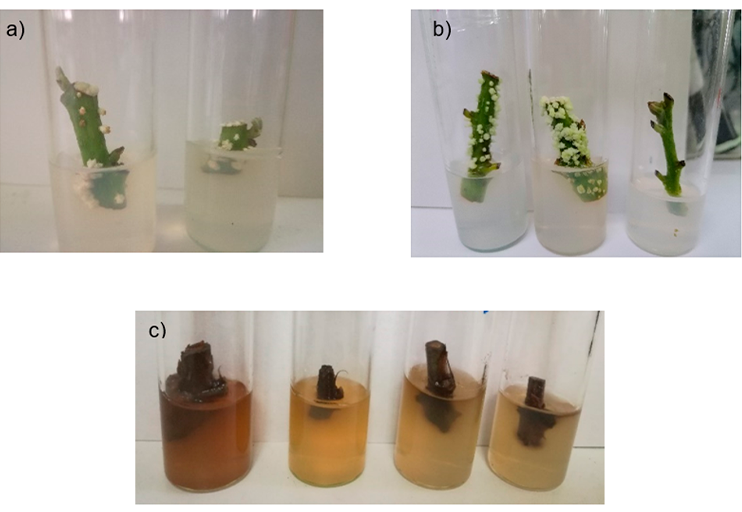
The in vitro establishment of Persea americana is limited by microbial contamination and oxidation, both of which are genotype-dependent processes. This study evaluated disinfestation and oxidative control in ‘Velvick’ and ‘Duke 7’ rootstocks using two factorial experiments: a 2×2 experiment comparing silver nanoparticles (AgNPs) with a sequential chemical protocol (SCP) and a 2×4 experiment analyzing antioxidant systems with ultrasonic agitation. A third experiment evaluated meristematic apices of ~400 μm. SCP was the most effective treatment for ‘Velvick’, achieving 75% establishment and reducing fungal and bacterial contamination to 20%; by contrast, in ‘Duke 7’, establishment was 48%, with high bacterial contamination. AgNPs were less efficient in both rootstocks. In ‘Velvick,’ ascorbic acid (800 mg L-1) and L-cysteine (50 mg L-1) reduced oxidation from 82% to 20% and promoted greater growth, whereas in ‘Duke 7’, oxidation remained high (61%), with no improvement in development. Ultrasonic agitation enhanced SCP activity. However, more than 90% of the 400 μm apices darkened completely before 15 days. In conclusion ‘Velvick’ responds best to ultrasound-assisted chemical disinfestation and to antioxidants at 800 mg L-1 ascorbic acid or 50 mg L-1 L-cysteine, and ‘Duke 7’ requires additional adjustments.
Downloads
References
Alonso-Fernández, M. A.; Beltrán-Olaya, A. B.; Gelvez-Delgado, J. y Martínez-Villarraga, J. P. 2019. Evaluación de dos protocolos de desinfección para establecimientos in vitro de portainjertos de aguacate (Persea americana) var. Criollo. II Simposio Nacional de Investigación en Ciencias Pecuarias y Agroempresariales del Magdalena Medio. 34-49 pp.
Amente, G. and Chimdessa, E. 2021. Control of browning in plant tissue culture: a review. Journal of Scientific Agriculture. 5:67-71. https://doi.org/10.25081/jsa.2021.v5.7266.
Bedoya-Ramírez, S. I.; Saavedra-Porras, S.; Loaiza-Ruíz, R. A.; Barrera-Sánchez, C. F., and Córdoba-Gaona, O. J. 2023. Physiological and morphological characterization of avocado creole (Persea americana Mill.) accessions for elite rootstocks. Revista Colombiana de Ciencias Hortícolas. 17(2):e15830. https://doi.org/10.17584/rcch.2023v17i2.15830.
Castro-Garibay, S. L.; Villegas-Monter, A.; Hernández-Nava, G. A.; Mendoza-Ramos, C.; Martínez-Villagómez, M.; Reyes Quiroz, C. and Aranda-Ocampo, S. 2023. Alternatives products in the in vitro disinfestation in rootstock explants duke-7 and identification of endophyte microorganisms. Tropical and Subtropical Agroecosystems. 27(1):1-12. https://doi.org/10.56369/tsaes.5005.
Chávez-García, J. A.; Andrade-Rodríguez, Ma.; Bello-Bello, J. J.; Rueda-Barrientos, Ma. C.; Guillén-Sánchez, D. and Sainz-Aispuro, M. J. 2020. Nanopartículas de plata en el establecimiento in vitro de ápices de gladiolo. Revista Fitotecnia Mexicana. 43(4-A):557. https://www.revfitotecnia.mx/index.php/RFM/article/view/834/794.
Dobránszki, J.; Asbóth, G.; Homoki, D.; Bíró-Molnár, P.; Teixeira-Da Silva, J. A. and Remenyik, J. 2017. Ultrasonication of in vitro potato single node explants: activation and recovery of antioxidant defence system and growth responses. Plant Physiology and Biochemistry. 121:153-160. https://doi.org/10.1016/j.plaphy.2017.10.022.
Esgrina, F. O.; Tan, R. J.; Baldo, N. B.; Dargantes, S. M. T.; Amper, C. D.; Marin, M. M.; Abello, Ma. J. M; Pedroso, M. L. and Alagos. A. L. C. 2026. Microclonal success of avocado using different scions and clonal rootstock varieties. Asia-Pacific Journal of Science and Technology. 31(1):1-9. https://doi.org/10.14456/APST.2026.14.
García-Cabrera, F.; Castro, M.; Cautin, R.; Estay, C.; Guzmán, L.; Marchant, M. J. and Guerra, F. 2025. Optimizing in vitro establishment protocols for ‘merensky 2’ avocado rootstock (Persea americana Mill.). Horticulturae. 11(8):900. https://doi.org/10.3390/horticulturae11080900.
Güler, G.; Gübbük, H. and Arslan, M. A. 2021. The effect of antioxidants on micropropagation of avocado by nodal segments. Horticultural studies. 38(1):50-55. https://doi.org/10.16882/hortis.900936.
Harahap, A. M.; Agustini, K.; Nuralih, N.; Ningsih, S.; Widyastuti, Y. and Bahtiar, A. 2025. LC-HRMS profiling and in vitro total phenolics, total flavonoids, antioxidant and cytotoxicity evaluation on MCF7 breast cancer cell lines of the extracts and fractions of aerva sanguinolenta from Java, Indonesia. Journal of Applied Pharmaceutical Science. 15(06):265-276. https://doi.org/10.7324/JAPS.2025.227288.
Hernández, Y. y González, M. E. 2010. Efectos de la contaminación microbiana y oxidación fenólica en el establecimiento in vitro de frutales perennes. Cultivos Tropicales. 31(4):58-69. https://www.redalyc.org/pdf/1932/193218885008.pdf.
Hiti-Bandaralage, J. C. A.; Hayward, A.; O’Brien, C.; Beveridge, C. and Mitter, N. 2018. Acclimatization of micropropagated mature avocado. Acta Horticulturae. 1224:13-20. https://doi.org/10.17660/ActaHortic.2018.1224.3.
Hiti-Bandaralage, J. C. A.; Hayward, A. and Mitter, N. 2017. Micropropagation of avocado (Persea Americana Mill.). American Journal of Plant Sciences. 8(11):2898-2921. https://doi.org/10.4236/ajps.2017.811197.
Huaman, J. J. P., Zavaleta-Espejo, G. G. y Bejarano-Navarrete, E. M. 2025. Mecanismos antibacterianos de nanopartículas de plata obtenidas por síntesis química: una revisión. Arnaldoa. 31(1):171-185. https://doi.org/10.22497/arnaldoa.311.31109.
Jan, S.; Jan, N.; Singh, S.; Shah, M. A. and Bhat, I. A. 2026. Nanotechnology in plant tissue culture: a review. Horticultural Plant Journal. 12(2):237-256. https://doi.org/10.1016/j.hpj.2025.02.019.
Király, A.; Farkas, D. and Dobránszki, J. 2025. Ultrasound in plant life and its application perspectives in horticulture and agriculture. Horticulturae. 11(3):1-28. https://doi.org/10.3390/horticulturae11030318.
Lloyd, G. and McCown, B. 1981. Commercially-feasible micropropagation of mountain laurel, Kalmia latifolia, by use of shoot-tip culture. Combined Proceedings-International Plant Propagator’s Society. 30:421-427. https://www.cabidigitallibrary.org/doi/full/10.5555/19830315515.
López-Galé, Y. D.; Fernando-Martínez, M.; Palacios-Joya, L. P.; Murcia-Riaño, N. and García-Dávila, M. A. 2024. Uniformity in shoot development in avocado grafts and its importance in establishing levels of indirect resistance to Phytophthora cinnamomi. Revista Mexicana de Fitopatología. Mexican Journal of Phytopathology. 42(3):1-18. https://doi.org/10.18781/R.MEX.FIT.2311-1.
Loyola-Vargas, V. M. y Ochoa-Alejo, N. 2012. Introducción al cultivo de células vegetales: El futuro que nos espera. Plant Cell Culture Protocols. Métodos en biología molecular. 877:1-8. Humana Press. https://doi.org/10.1007/978-1-61779-818-4-1.
Martínez-Villagómez, M.; Barrientos-Priego, A. F.; Mascorro-Gallardo, J. O.; Iturriaga, G. and Espíndola-Barquera, M. de la. C. 2025. Effect of auxins on the rooting of the avocado rootstock ‘Duke 7’. Advances in Horticultural Science. 3(29):175-189. https://doi.org/10.36253/ahsc-16747
Meza-Castillo, E.; Barrientos-Priego, A. F.; Rodríguez-Pérez, J. E.; Reyes-Alemán, J. C.; Borys, M. W. y Espíndola-Barquera, M. de la C. 2018. Caracterización morfológica e histológica de ápices de raíz de portainjertos de aguacate y su resistencia a factores adversos en el suelo. Bioagro. 30(2):107-116.
Pérez-Caselles, C.; Burgos, L.; Sánchez-Balibrea, I.; Egea, J. A.; Faize, L.; Martín-Valmaseda, M.; Bogdanchikova, N.; Pestryakov, A. and Alburquerque, N. 2023. The effect of silver nanoparticle addition on micropropagation of apricot cultivars (Prunus armeniaca L.) in semisolid and liquid media. Plants. 12(7):1547. https://doi.org/10.3390/plants12071547.
Pesti-Asbóth, G.; Molnár-Bíróné, P.; Forgács, I.; Remenyik, J. and Dobránszki, J. 2022. Ultrasonication affects the melatonin and auxin levels and the antioxidant system in potato in vitro. Frontiers in Plant Science. 13:979141. https://doi.org/10.3389/fpls.2022.979141.
Ramírez-Mosqueda, M. A.; Cadena-Zamudio, J. D.; Aguirre-Noyola, J. L.; Cruz-Gutiérrez, E. J. y Medina-Armenta, A. 2025. Cultivo in vitro: el futuro de la propagación vegetal y sus desafíos en México. Conexión Aura: Ciencia y Cultura. 22-24 pp.
Restrepo-Osorio, C.; Gil-Correal, A.; Saavedra-Porras, S.; Cárdenas-Ortiz, L.; Chamorro-Gutiérrez, L. and Villanueva-Mejía, D. 2026. An efficient protocol for clonal propagation of avocado (Persea americana Mill.) rootstocks via etiolation-enhanced micropropagation. Plant Cell, Tissue and Organ Culture (PCTOC). 164(3):1-16. https://doi.org/10.1007/s11240-026-03386-2.
Sánchez-Hernández, D.; Larsen, J. and Reverchon, F. 2025. Diversity of culturable endophytic fungi associated with avocado orchards under organic and conventional management. Microbiology. 466(82):1-12. https://doi.org/10.1101/2025.01.31.635834.
Teixeira-Da Silva, J. A.; Nezami-Alanagh, E.; Barreal, M. E.; Kher, M. M.; Wicaksono, A.; Gulyás, A.; Hidvégi, N.; Magyar-Tábori, K.; Mendler-Drienyovszki, N.; Márton, L.; Landín, M.; Gallego, P. P.; Driver, J. A. and Dobránszki, J. 2020. Shoot tip necrosis of in vitro plant cultures: a reappraisal of possible causes and solutions. Planta. 252(3):1-35. https://doi.org/10.1007/s00425-020-03449-4.
Turina, C. A. y Bima, P. 2017. Establecimiento in vitro de cuatro variedades de olivo cultivadas a campo (Olea europea L.). Agriscientia. 34(2):59-68. https://doi.org/10.31047/1668.298x.v34.n2.19041.
Vilchez, J.; Albany, N.; Martínez, L., Molina, M.; Alvarez, C. and Leal, E. 2011. Establecimiento in vitro de ocumo blanco (Xanthosoma sagittifolium (L.) Schott). Revista de la Facultad de Agronomía (LUZ). 28(Supl. 1):434-444.
Yashuda, T.; Fujii, Y. and Yamaguchi, T. 1985. Embryogenic callus induction from Coffea arabica leaf explants by benzyladenine. Plant and Cell Physiology. 26(3):595-597. https://doi.org/10.1093/oxfordjournals.pcp.a076946.
Downloads
Published
Issue
Section
License
Copyright (c) 2026 Revista Mexicana de Ciencias Agrícolas

This work is licensed under a Creative Commons Attribution-NonCommercial 4.0 International License.
The authors who publish in Revista Mexicana de Ciencias Agrícolas accept the following conditions:
In accordance with copyright laws, Revista Mexicana de Ciencias Agrícolas recognizes and respects the authors’ moral right and ownership of property rights which will be transferred to the journal for dissemination in open access. Invariably, all the authors have to sign a letter of transfer of property rights and of originality of the article to Instituto Nacional de Investigaciones Forestales, Agrícolas y Pecuarias (INIFAP) [National Institute of Forestry, Agricultural and Livestock Research]. The author(s) must pay a fee for the reception of articles before proceeding to editorial review.
All the texts published by Revista Mexicana de Ciencias Agrícolas —with no exception— are distributed under a Creative Commons License Attribution-NonCommercial 4.0 International (CC BY-NC 4.0), which allows third parties to use the publication as long as the work’s authorship and its first publication in this journal are mentioned.
The author(s) can enter into independent and additional contractual agreements for the nonexclusive distribution of the version of the article published in Revista Mexicana de Ciencias Agrícolas (for example include it into an institutional repository or publish it in a book) as long as it is clearly and explicitly indicated that the work was published for the first time in Revista Mexicana de Ciencias Agrícolas.
For all the above, the authors shall send the Letter-transfer of Property Rights for the first publication duly filled in and signed by the author(s). This form must be sent as a PDF file to: revista_atm@yahoo.com.mx; cienciasagricola@inifap.gob.mx; remexca2017@gmail.
This work is licensed under a Creative Commons Attribution-Noncommercial 4.0 International license.