Impacto del thidiazuron en inducción floral, rendimiento y calidad de fruto en Malus domestica Borkh.
DOI:
https://doi.org/10.29312/remexca.v17i4.4086Palabras clave:
brotación floral, inflorescencia, promotores de brotación, TDZResumen
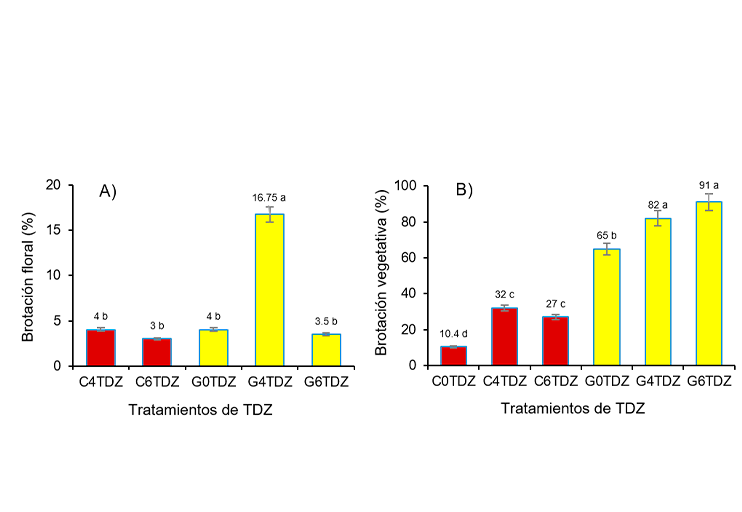
En la sierra nororiental de Puebla se ha mantenido la manzana ‘Criolla’ en producción; sin embargo, el cultivar no puede competir en mercados con cultivares comerciales, además ha disminuido su producción por el cambio climático. Con el objetivo de aumentar el porcentaje de brotación floral y la producción en árboles de manzanos de los cultivares de ‘Golden Delicious’ y ‘Criolla’ se realizaron aplicaciones del promotor de la brotación thidiazuron (TDZ) en Mexcalcuautla, Teziutlán, Puebla durante los ciclos 2022 y 2023. Los árboles recibieron 400 y 600 ppm de TDZ, se utilizó un arreglo en franjas divididas 2x3, acotado a seis tratamientos en un diseño experimental en bloques al azar, se evaluó la brotación floral y vegetativa, inflorescencia, amarre de fruto, rendimiento, aspectos físicos y bioquímicos de fruto. Los análisis estadísticos indicaron que manzana ‘Golden Delicious’ con 400 ppm de TDZ presentó mayor brotación floral y rendimiento. La calidad física de frutos fue mejor en ‘Golden Delicious’ con 400 ppm de TDZ y ‘Criolla’ sin TDZ ya que tuvieron mayor peso sus frutos, en cuanto al tamaño y velocidad de respiración de las manzanas no hubo diferencias entre los tratamientos, sin embargo, la firmeza fue superior en manzana ‘Golden Delicious’ con 400 ppm TDZ que a la de los demás tratamientos. El contenido de ácido málico, ascórbico, pH, contenido de azúcares solubles totales y almidones no estuvieron afectados por las aplicaciones de TDZ. Se concluyó que la aplicación de TDZ a 400 ppm aumentó el porcentaje de brotación floral en manzana ‘Golden Delicious’ y no perjudicó la calidad física y bioquímica de los frutos.
Descargas
Referencias
AOAC. 1984. Official methods of analysis of the association of official analytical chemists. 13th. Ed. Arlington, V. 1 023 p.
AOAC. 1988. Official methods of analysis of the association of official analytical chemists. 13 th. Ed. Arlington, V. 1 023 p.
Azcón-Bieto, J. y Talón, M. 2013. Fundamentos de fisiología vegetal. Editorial McGraw-Hill Interamericana de España. 41-247 pp.
Benincore, M.; Barbosa, V. R. y Fischer, G. 2000. Efecto de thidiazuron y cloruro de colina como biorreguladores sobre el rendimiento y la calidad de fruto en tres variedades de manzano (Malus domestica Borkh.). Agronomía Colombiana. 17(1):91-98.
Corona Leo, L. S.; Hernández-Martínez, D. M. y Meza-Márquez, O. G. 2020. Análisis de parámetros fisicoquímicos, compuestos fenólicos y capacidad antioxidante en piel, pulpa y fruto entero de cinco cultivares de manzana (Malus domestica) cosechadas en México. Biotecnia. 22(1):166-174. DOI: https://doi.org/10.18633/biotecnia.v22i1.1193
Cruz-Hernández, J. P. y Cruz-Díaz, H. 2006. Perspectivas del cultivo de manzana en el estado de Puebla. Revisión. 13 p.
Dreywood, R. 1946. Qualitative test for carbohydrate material. Indian Engineering Chemical Annal Education. 18(8):499-501. DOI: https://doi.org/10.1021/i560156a015
Dzanagov, S. K.; Gozdanov, A. V.; Lazarov, T. K.; Asaeva, T. D.; Basiev, A. E. and Kanukov, Z. T. 2021. Fertilizers affect yield and apples fruits quality on leached chernozem. Conference Earth and Environmental Science. 624. 10 p. DOI: https://doi.org/10.1088/1755-1315/624/1/012201
Greene, D. 1995. Thidiazuron effects fruit set, fruit quality and return bloom of apples. HortScience. 6(30):1238-1240. DOI: https://doi.org/10.21273/HORTSCI.30.6.1238
Hull, L. A.; Beers, E. H.; Asquit, D. and Meagher, R. L. 1985. Impact of selective use of the synthetic pyrethroid fen valerate on apple pests and natural enemies in large-orchard Trials. Journal of Economic Entomology. 78(1):163-168. DOI: https://doi.org/10.1093/jee/78.1.163
Kader, A. A. 2002. Postharvest biology and technology: an overview. In: Kader, A. A. (Ed.) Postharv. Technol. Hort. Crops. 3rd Ed. Pub. No. 3311. Oakland. University California. 39-47 pp.
Kupferman, E. M. 2005. Using consumers to determine standards for Red Delicious apple edible quality. ISHS Acta Hort. 687(28):229-234. DOI: https://doi.org/10.17660/ActaHortic.2005.687.28
Milosevic, T. and Milosevic, N. 2009. The effect of zeolite, organic and inorganic fertilizers on soil chemical properties, growth and biomass yield of apple trees. Plant Soil Environ. 55(12):528-535. DOI: https://doi.org/10.17221/107/2009-PSE
Musacchi, S. and Serra, S. 2018. Apple fruit quality: overview of pre-harvest factors. Scientia Horticulturae. 234(17)409-430. DOI: https://doi.org/10.1016/j.scienta.2017.12.057
SAS Institute. 2013. Base SAS 9.4 Procedures guide: statistical procedures. Second edition. SAS Institute Inc. Cary, NC, USA. 500 p.
SIAP. 2023. Servicio de Información Agroalimentaria y Pesquera. Anuario estadístico de la producción agrícola. Secretaría de Agricultura y Desarrollo Rural. https://nube.siap.gob.mx/cierreagricola.
Silveira, A. C.; Sautter, C. K.; Tonetto de Freitas, S.; Galieta, G. and Brackmann, A. 2007. Determination of some quality parameters of the Fuji cultivar and their mutants at harverst. Ciênc. Tecnol. Aliment. Campinas. 27(1):149-153. DOI: https://doi.org/10.1590/S0101-20612007000100026
Soto-Parra, J. M.; Flores-Córdova, M. A.; Sánchez-Chávez, E.; Pérez-Leal, R. y Piña-Ramírez, F. J. 2020. Compensadores de frío en manzana ‘Golden Glory’: desarrollo y producción. Revista Mexicana de Ciencias Agrícolas. 11(1):69-82. DOI: https://doi.org/10.29312/remexca.v11i1.1744
Tirado-Gallegos, J. M.; Zamudio-Flores, P. B.; Ornelas-Paz, J. de J.; Ríos-Velasco, C.; Acosta-Muñiz, C. H.; Gutiérrez-Meraz, F.; Islas-Hernández, J. J. y Salgado-Delgado, R. 2016. Efecto del método de aislamiento y el estado de madurez en las propiedades fisicoquímicas, estructurales y reológicas de almidón de manzana. Revista mexicana de Ingeniería Química. 15(2):391-408. DOI: https://doi.org/10.24275/rmiq/Alim1130
UNIFRUT. 1997. Unión de fruticultores del estado de Chihuahua. Información sobre producción y superficie plantada de manzano a nivel nacional y específicamente en la entidad de Chihuahua.
Víctor-Gómez, E.; López-Jiménez, A.; Cortes-Flores, J. I.; Jaén-Contreras, D. y Suárez-Espinoza, J. 2020. Estimulación floral en nopal tunero en respuesta al efecto de Thidiazuron. Revista Mexicana Ciencias Agrícolas. 11(3):519-529. DOI: https://doi.org/10.29312/remexca.v11i3.1995
Yepes, A. y Silveira-Buckeridge, M. 2011. Respuestas de las plantas ante los factores ambientales del cambio climático global. Colombia Forestal. 14(2):213-232. DOI: https://doi.org/10.14483/udistrital.jour.colomb.for.2011.2.a06
Zermeño, A.; Gil, J. A.; Hernández, A.; Rodríguez, R.; Ramírez, H.; Benavides, A.; Jasso, D.; Munguia, J. e Ibarra, L. 2010. Efectos del encalado completo y aplicación de tdz sobre la brotación, rendimiento y calidad de frutos del manzano cv Golden Delicious. Bioagro. 22(1):75-80.
Zermeño-González, A.; Gill-Marín, J. A.; Jasso-Cantú, D.; Ramírez-Rodríguez, H.; Hernández-Herrera, A.; Rodríguez-García, R. y Benavidez-Mendoza, A. 2009. Efecto del encalado total del manzano en la temperatura interna, rendimiento de frutos y su relación con la aplicación de thidiazuron. Revista Chapingo Serie Horticultura. 15(3):289-296. DOI: https://doi.org/10.5154/r.rchsh.2009.15.040
Descargas
Publicado
Número
Sección
Licencia
Derechos de autor 2026 Revista Mexicana de Ciencias Agrícolas

Esta obra está bajo una licencia internacional Creative Commons Atribución-NoComercial 4.0.
Los autores(as) que publiquen en Revista Mexicana de Ciencias Agrícolas aceptan las siguientes condiciones:
De acuerdo con la legislación de derechos de autor, Revista Mexicana de Ciencias Agrícolas reconoce y respeta el derecho moral de los autores(as), así como la titularidad del derecho patrimonial, el cual será cedido a la revista para su difusión en acceso abierto.
Los autores(as) deben de pagar una cuota por recepción de artículos antes de pasar por dictamen editorial. En caso de que la colaboración sea aceptada, el autor debe de parar la traducción de su texto al inglés.
Todos los textos publicados por Revista Mexicana de Ciencias Agrícolas -sin excepción- se distribuyen amparados bajo la licencia Creative Commons 4.0 atribución-no comercial (CC BY-NC 4.0 internacional), que permite a terceros utilizar lo publicado siempre que mencionen la autoría del trabajo y a la primera publicación en esta revista.
Los autores/as pueden realizar otros acuerdos contractuales independientes y adicionales para la distribución no exclusiva de la versión del artículo publicado en Revista Mexicana de Ciencias Agrícolas (por ejemplo incluirlo en un repositorio institucional o darlo a conocer en otros medios en papel o electrónicos) siempre que indique clara y explícitamente que el trabajo se publicó por primera vez en Revista Mexicana de Ciencias Agrícolas.
Para todo lo anterior, los autores(as) deben remitir el formato de carta-cesión de la propiedad de los derechos de la primera publicación debidamente requisitado y firmado por los autores(as). Este formato debe ser remitido en archivo PDF al correo: revista_atm@yahoo.com.mx; revistaagricola@inifap.gob.mx.
Esta obra está bajo una licencia de Creative Commons Reconocimiento-No Comercial 4.0 Internacional.