Environmental and economic assessment of white corn production in Guanajuato
DOI:
https://doi.org/10.29312/remexca.v17i6.4189Keywords:
Life Cycle Assessment (LCA), irrigation and seasonality, sustainabilityAbstract
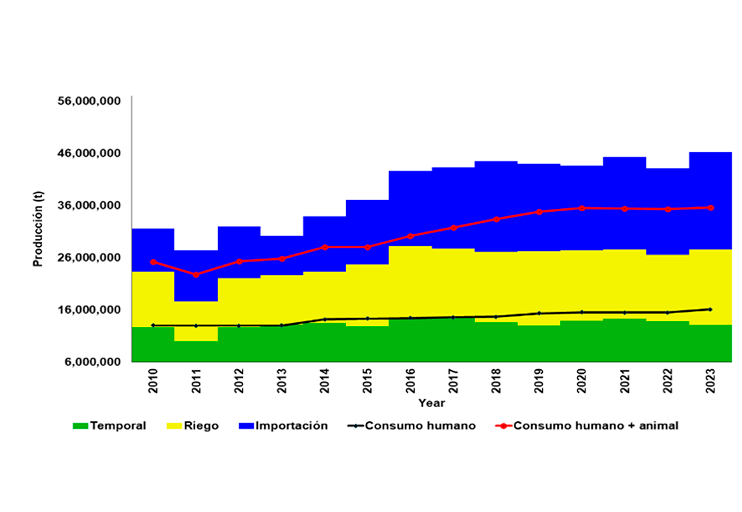
The environmental and economic aspects of white corn production in Guanajuato between 2016 and 2020 were studied. The factors that significantly contribute to the environmental impact of irrigated (MR) and rainfed (MT-450) corn production, as well as the profitability of production and its contribution to local self-sufficiency of this grain, were determined. The environmental impact was evaluated using the life cycle assessment methodology, with one tonne of grain as the functional unit; emissions were estimated using Ecoinvent v 3.9, and the environmental impact indicators were estimated using ReCiPe 2016 v 1.1. The economic analysis was performed with an optimization model that seeks the maximum gross income with constraints on food self-sufficiency, soil, and water. Irrigated and rainfed corn have loads of 871 and 244 kg CO2eq t-1 respectively, for the climate change indicator. In irrigated corn, the environmental impact is primarily associated with high electricity consumption for water extraction and distribution. In rainfed corn, the environmental impact is associated with the disproportion between production and inputs. In the economic analysis, it was estimated that local corn production meets 83% of the total demand for the grain. The benefit/cost ratio for rainfed and irrigated corn was estimated at 1.48 and 0.8, respectively. Agricultural profitability is conditioned by prices and the market: with a 3% change in the irrigated area of cereals, a 50% increase in the demand for vegetables can be met.
Downloads
References
Eakin, H.; Perales, H.; Appendini, K. and Sweeney, S. 2014. Selling maize in Mexico: the persistence of peasant farming in an era of global markets. United Kingdom. Development and Change. 45(1):133-155. Doi:10.1111/dech.12074.
Erenstein, O.; Jaleta, M.; Sonder, K.; Mottaleb, K. A. and Prasanna, B. M. 2022. Global maize production, consumption and trade: trends and R&D implications. Switzerland. Food Security. 14(5):1295-1319. https://doi.org/10.1007/s12571-022-01288-7.
Espejel-García, M. V.; Mora-Flores, J. S.; García-Salazar, J. A.; Pérez-Elizalde, S. y García-Mata, R. 2016. Caracterización del consumidor de tortilla en el Estado de México. Agricultura, Sociedad y Desarrollo. 13(3):371-384. https://doi.org/10.22231/asyd.v13i3.401.
FAO. 2022. Food and Agriculture Organization of the United Nations. The state of food and agriculture 2022: leveraging automation in agriculture for transforming agrifood systems. Italia.
FAO. 2023. Food and Agriculture Organization of the United Nations. FAOSTAT: food balance sheets. Italia.
FIRA 2024. Fideicomisos Institucionales de Relación con la Agricultura. Panorama agroalimentario 2024: maíz. México.
Foley, D. J.; Thenkabail, P. S.; Aneece, I. P.; Teluguntla, P. G. and Oliphant J. 2020. A meta-analysis of global crop water productivity of three leading world crops (wheat, corn and rice) in the irrigated areas over three decades. International Journal of Digital Earth. 13(8): 939-975. https://doi.org/10.1080/17538947.2019.1651912.
GYGA. 2024. Global Yield Gap Atlas. Yield gap Atlas. https://yieldgap.com/atlas/.
Holka, M. and Bieńkowski, J. 2020. Carbon footprint and life-cycle costs of maize production in conventional and non-inversion tillage systems. Agronomy. 10(12):1877. https://doi.org/10.3390/agronomy10121877.
Huijbregts, M. A. J.; Steinmann, Z. J. N.; Elshout, P. M. F.; Stam, G.; Verones, F.; Vieira, M. D. M.; Hollander, A.; Zijp, M. and Van Zelm, R. 2017. ReCiPe 2016 v1.1: A harmonized life cycle impact assessment method at midpoint and endpoint level. The International Journal of Life Cycle Assessment. 22(2):138-147. https://doi.org/10.1007/s11367-016-1246-y.
INIFAP. 2017. Instituto Nacional de Investigaciones Forestales, Agrícolas y Pecuarias. Agenda técnica agrícola de Guanajuato. Gobierno de México. 324 p. https://vun.inifap.gob.mx/VUN-MEDIA/BibliotecaWeb/-media/-agendas/4129-4826-Agenda-Técnica-Guanajuato-2017.pdf?utm-source=chatgpt.com.
ISO. 2006. International Organization for Standardization. ISO 14040-14044:2006 Environmental Management-Life cycle assessment-Principles and framework; ISO 14044:2006 Environmental Management-Life cycle assessment-Requirements and guidelines. First edition. Geneva, Switzerland.
Koushki, R.; Sharma, S.; Warren, J. and Foltz, M. E. 2023. Life cycle greenhouse gas emissions for irrigated corn production in the US. Great Plains. Paises Bajos. Environmental Challenges. 13:100750. https://doi.org/10.1016/j.envc.2023.100750.
Lähde, V.; Vadén, T.; Toivanen, T.; Järvensivu, P. and Eronen, J. T. 2023. The crises inherent in the success of the global food system. Canada. Ecology and Society. 28(4):16. https://doi.org/10.5751/ES-14624-280416.
Lambin, E. F. and Meyfroidt, P. 2011. Global land use change, economic globalization, and the looming land scarcity. PNAS. 108(9):3465-3472. https://doi.org/10.1073/pnas.1100480108.
Macfadyen, S. 2019. Farming systems analysis in relation to ACIAR objectives and projects. Australian Centre for international agricultural research (ACIAR). 42 p. https://www.aciar.gov.au/publication/farming-systems-analysis-aciar-objectives-and-projects.
OECD. 2023. Organisation for Economic Co-operation and Development y Food and Agriculture Organization of the United Nations (FAO). OECD-FAO Agricultural Outlook 2023-2032. Francia. OECD Publishing.
Qi, J. Y.; Yang, S. T.; Xue, J. F.; Liu, C. X.; Du, T. Q.; Hao, J. P. and Cui, F. Z. 2018. Response of carbon footprint of spring maize production to cultivation patterns in the Loess Plateau, China. Journal of Cleaner Production. 187:525-536. https://doi.org/10.1016/j.jclepro.2018.02.184.
Qiao, L.; Silva, J. V.; Fan, M.; Mehmood, I.; Fan, J.; Li, R. and Van Ittersum, M. K. 2021. Assessing the contribution of nitrogen fertilizer and soil quality to yield gaps in maize. Países Bajos. Field Crops Research. 273:108304. https://doi.org/10.1016/j.fcr.2021.108304.
Ríos-Fuentes, B.; Rivas-García, P.; Estrada-Baltazar, A.; Rico-Martínez, R.; Miranda-López, R. y Botello-Álvarez, J. E. 2022. Life cycle assessment of frozen broccoli processing: environmental mitigation scenarios. Netherlands. Sustainable Production and Consumption. 32:27-34. Doi:10.1016/j.spc.2022.04.001.
SADER. 2025. Secretaría de Agricultura y Desarrollo Rural. Programa Sectorial de Agricultura y Desarrollo Rural 2025-2030. Secretaría de Agricultura y Desarrollo Rural. Ciudad de México, México. 120 p.
Sánchez-de Jesús, M. A.; Volke-Haller, V. H.; Cortés-Flores, J. I.; María-Ramírez, A. y San Martín-Hernández, C. 2024. Aporte de nitrógeno por el suelo y eficiencia de aprovechamiento del nitrógeno aplicado en maíz de temporal. México. Revista Fitotecnia Mexicana. 47(2):99-110. https://doi.org/10.35196/rfm.2024.2.99.
SIAP. 2023. Servicio de Información Agroalimentaria y Pesquera. Cierre agrícola. México, DF.
SIAP. 2024. Servicio de Información Agroalimentaria y Pesquera. Cierre agrícola. México, DF.
USDA. 2024. United States Department of Agriculture. Grain: world markets and trade. foreign agricultural service. Washington, DC, USA. 62 p.
Walters, J. P.; Archer, D. W.; Sassenrath. G. F.; Hendrickson, J. R.; Hanson, J. D.; Halloran, J. M.; Peter Vadas, P.; Alarcon, V. J. 2016. Exploring agricultural production systems and their fundamental components with system dynamics modelling. Ecological Modelling. 333:51-65.
Zhang, F.; Wang, Q.; Hong, J.; Chen, W.; Qi, C. and Ye, L. 2017. Life cycle assessment of diammonium and monoammonium-phosphate fertilizer production in China. Paises Bajos. Journal of Cleaner Production. 141:1087-1094. https://doi.org/10.1016/j.jclepro.2016.09.107.
Downloads
Published
Issue
Section
License
Copyright (c) 2026 Revista Mexicana de Ciencias Agrícolas

This work is licensed under a Creative Commons Attribution-NonCommercial 4.0 International License.
The authors who publish in Revista Mexicana de Ciencias Agrícolas accept the following conditions:
In accordance with copyright laws, Revista Mexicana de Ciencias Agrícolas recognizes and respects the authors’ moral right and ownership of property rights which will be transferred to the journal for dissemination in open access. Invariably, all the authors have to sign a letter of transfer of property rights and of originality of the article to Instituto Nacional de Investigaciones Forestales, Agrícolas y Pecuarias (INIFAP) [National Institute of Forestry, Agricultural and Livestock Research]. The author(s) must pay a fee for the reception of articles before proceeding to editorial review.
All the texts published by Revista Mexicana de Ciencias Agrícolas —with no exception— are distributed under a Creative Commons License Attribution-NonCommercial 4.0 International (CC BY-NC 4.0), which allows third parties to use the publication as long as the work’s authorship and its first publication in this journal are mentioned.
The author(s) can enter into independent and additional contractual agreements for the nonexclusive distribution of the version of the article published in Revista Mexicana de Ciencias Agrícolas (for example include it into an institutional repository or publish it in a book) as long as it is clearly and explicitly indicated that the work was published for the first time in Revista Mexicana de Ciencias Agrícolas.
For all the above, the authors shall send the Letter-transfer of Property Rights for the first publication duly filled in and signed by the author(s). This form must be sent as a PDF file to: revista_atm@yahoo.com.mx; cienciasagricola@inifap.gob.mx; remexca2017@gmail.
This work is licensed under a Creative Commons Attribution-Noncommercial 4.0 International license.