Analysis of the factors determining coffee production in Mexico
DOI:
https://doi.org/10.29312/remexca.v17i4.4108Keywords:
coffee production, economic factors, elasticity of supply, Mexican agricultural sector, multiple linear regressionAbstract
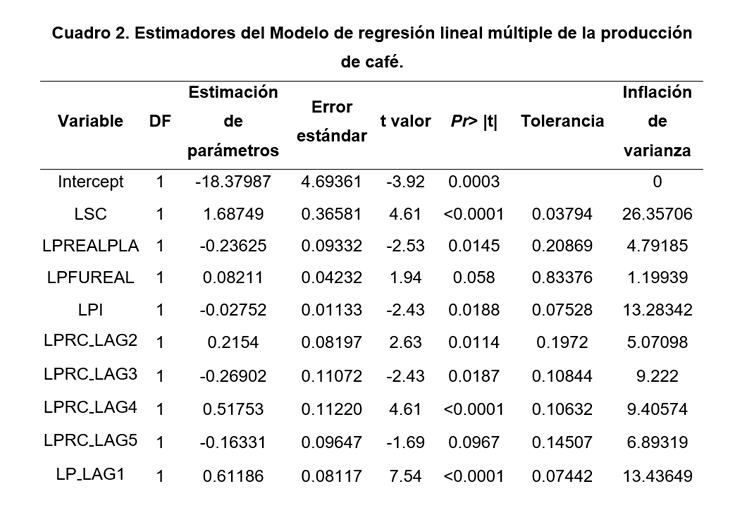
Coffee is one of the most important agricultural crops in Mexico due to its economic and social relevance and because it generates income in rural areas, placing the country in the fourteenth place worldwide as a producer. In order to identify the economic factors that determine national coffee production, an econometric study was conducted in Mexico for the 1960-2024 period. A multiple linear regression model was applied based on time series obtained from official sources such as INEGI, SADER, OIC and Banxico. The dependent variable was coffee production, explained by the cultivated area, international prices, real input prices and production lags. The results show a high level of fit (R²= 0.974; Fcalculated= 207.72> Ftabulated= 2.15), indicating that the selected variables significantly explain the variations in production. It was found that the cultivated area, lagged production and two- and four-period lagged prices positively influence production, while international prices and some price lags have negative effects. In conclusion, Mexican coffee production depends mainly on the cultivated area and the behavior of production in previous years, reflecting the temporal persistence characteristic of this perennial crop.
Downloads
References
AMECAFÉ. 2022. Asociación Mexicana de la Cadena Productiva del Café. Informe anual cafeto 2022. Gobierno de México. https://www.gob.mx/cms/uploads/attachment/file/722402/01-enero-cafeto-2022.pdf.
Barham, B. L.; Callenes, M.; Gitter, S. R; Lewis, J. and Weber, J. G. 2011. Fair trade/organic coffee, rural livelihoods and the agrarian question: Southern Mexican coffee families in transition. Estados Unidos. World Development. 39(1):134-145. https://doi.org/10.1016/j.worlddev.2010.08.005. DOI: https://doi.org/10.1016/j.worlddev.2010.08.005
Bartra-Vergés, A.; Cobo, R. y Paz-Paredes, L. 2011. La hora del café: dos siglos a muchas voces. Comisión Nacional para el Conocimiento y Uso de la Biodiversidad (CONABIO). https://www.biodiversidad.gob.mx/publicaciones/versiones-digitales/horacafe.pdf.
Enders, W. 2015. Applied econometric time series. 4th. Ed. Wiley. 179-235 pp.
Engle, R. F. and Granger, C. W. J. 1987. Co-integration and error correction: Representation, estimation and testing. Econometrica. 55(2):251-276. https://doi.org/10.2307/1913236. DOI: https://doi.org/10.2307/1913236
FAO. 2023. Food and Agriculture Organization of the United Nations. The state of agricultural commodity markets 2023. Food and Agriculture Organization of the United Nations. https://www.fao.org/documents.
Gujarati, D. N. y Porter, D. C. 2012. Econometría. 5ta. Ed. McGraw-Hill. 19-65 pp.
INAES. 2019. Instituto Nacional de la Economía Social. Historia del café y su cultivo. Gobierno de México. 1 p. https://www.gob.mx/inaes/articulos/historia-del-cafe-y-su-cultivo?idiom=es.
INEGI. 2023. Instituto Nacional de Estadística y Geografía. Censo Agropecuario 2022. Resultados definitivos nacionales. 17-32 pp. https://www.inegi.org.mx/contenidos/programas/ca/2022/doc/ca2022-rdnal.pdf.
Martínez-Damián, M. Á. y Salinas-Callejas, E. 2004. La elasticidad precio del café mexicano: un modelo para una canasta de bienes, 1976-2000. Economía, Sociedad y Territorio. 4(14):415-448. https://www.redalyc.org/pdf/111/11101404.pdf.
Montgomery, D. C.; Peck, E. A. and Vining, G. G. 2012. Introduction to linear regression analysis. 5th Ed. Wiley. 25-276 pp.
Nerlove, M. 1958. The dynamics of supply: Estimation of farmers’ response to price. Johns Hopkins Press. 15-42 pp.
OECD-FAO. 2023. OECD-FAO. Agricultural Outlook 2023-2032. OECD Publishing, Paris. 17-36 pp. https://doi.org/10.1787/08801ab7-en. DOI: https://doi.org/10.1787/08801ab7-en
OECD-FAO. 2023. Organización para la Cooperación y el Desarrollo Económicos-Organización de las Naciones Unidas para la Alimentación y la Agricultura. OCDE-FAO Perspectivas agrícolas 2023-2032. OECD Publishing. 35-52 pp. https://doi.org/10.1787/2ad6c3ab-es. DOI: https://doi.org/10.1787/2ad6c3ab-es
OIC. 2024. Organización Internacional del Café. Coffee Market Report Organization Internacional the Caffe. 1-6 pp. https://www.ico.org.
Rendón-Medel, J. R. 2019. Sistemas de renovación de cafetales para recuperar y estabilizar la producción. Centro Nacional de Investigaciones de Café (Cenicafé). Avances Técnicos Cenicafé Núm. 463. 1-6 pp. https://www.cenicafe.org/es/publications/avt0463.pdf. DOI: https://doi.org/10.38141/10779/0500
Rendón-Medel, R. y Aguilar-Ávila, J. 2013. Gestión de redes de innovación en zonas rurales marginadas. Universidad Autónoma Chapingo-Miguel Ángel Porrúa.
SADER. 2023a. Secretaría de Agricultura y Desarrollo Rural. Panorama del café en México 2023. Gobierno de México. https://www.gob.mx/agricultura.
Salazar, H. A. 2019. Variables agronómicas determinantes de la productividad del cultivo de café en fincas del Departamento de Caldas, Colombia. Revista Cenicafé. 70(1):81-92. https://www.cenicafe.org/es/publications/arc070%2801%29081-090.pdf. DOI: https://doi.org/10.38141/10778/70106
SAS Institute Inc. 2023. SAS ondemand for academics: documentation and software capabilities. Cary, NC: SAS Institute Inc. 1-10 pp.
Terrones-Cordero, A. y Sánchez-Torres, Y. 2013. Demandas de insumos de la producción agrícola en México, 1975-2011. Revista Mexicana de Ciencias Agrícolas. 4(2):243-257. https://doi.org/10.29312/remexca.v4i2.1211.
Tomek, W. G. and Kaiser, H. M. 2014. Agricultural Product Prices. 5th Ed. Cornell University Press. 45-130 pp.
UAEH. 2015. Universidad Autónoma del Estado de Hidalgo. El comportamiento de la producción del café en México. ISBN:978-607-482-378-3. 15-32 pp. https://www.uaeh.edu.mx/investigacion/productos/7223/el-comportamiento-de-la-produccion-del-cafe-en-mexico-isbn-978-607-482-378-3.pdf.
Valencia-Sandoval, K. 2023. La competitividad del café mexicano en el mercado europeo. Ciencia Ergo-sum. 30(3):1-12. https://www.redalyc.org/journal/104/10475688010/10475688010.pdf. DOI: https://doi.org/10.30878/ces.v30n3a1
Wooldridge, J. M. 2013. Introductory econometrics: A modern approach 5th. Ed. Cengage Learning. 419-442 pp.
Downloads
Published
Issue
Section
License
Copyright (c) 2026 Revista Mexicana de Ciencias Agrícolas

This work is licensed under a Creative Commons Attribution-NonCommercial 4.0 International License.
The authors who publish in Revista Mexicana de Ciencias Agrícolas accept the following conditions:
In accordance with copyright laws, Revista Mexicana de Ciencias Agrícolas recognizes and respects the authors’ moral right and ownership of property rights which will be transferred to the journal for dissemination in open access. Invariably, all the authors have to sign a letter of transfer of property rights and of originality of the article to Instituto Nacional de Investigaciones Forestales, Agrícolas y Pecuarias (INIFAP) [National Institute of Forestry, Agricultural and Livestock Research]. The author(s) must pay a fee for the reception of articles before proceeding to editorial review.
All the texts published by Revista Mexicana de Ciencias Agrícolas —with no exception— are distributed under a Creative Commons License Attribution-NonCommercial 4.0 International (CC BY-NC 4.0), which allows third parties to use the publication as long as the work’s authorship and its first publication in this journal are mentioned.
The author(s) can enter into independent and additional contractual agreements for the nonexclusive distribution of the version of the article published in Revista Mexicana de Ciencias Agrícolas (for example include it into an institutional repository or publish it in a book) as long as it is clearly and explicitly indicated that the work was published for the first time in Revista Mexicana de Ciencias Agrícolas.
For all the above, the authors shall send the Letter-transfer of Property Rights for the first publication duly filled in and signed by the author(s). This form must be sent as a PDF file to: revista_atm@yahoo.com.mx; cienciasagricola@inifap.gob.mx; remexca2017@gmail.
This work is licensed under a Creative Commons Attribution-Noncommercial 4.0 International license.