Alternative agroforestry for improving the semi-arid climate of Salamanca
DOI:
https://doi.org/10.29312/remexca.v17i2.4249Keywords:
agroforestry, agrarian diagnosis, agriculture in GuanajuatoAbstract
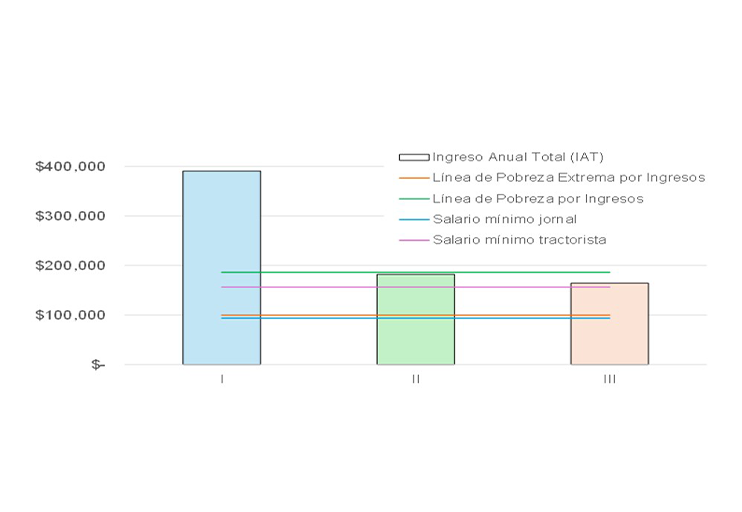
The research was conducted during 2022 and 2023 in the northern region of the municipality of Salamanca, Guanajuato, in the localities (Los Hernández, Los Razos de Ancón, Los Cenizos and La Compañía) corresponding to the semi-arid zone, where production systems are highly vulnerable to accidents, mainly due to water scarcity. In order to know their complexity and propose alternatives for improvement, a diagnosis of the production systems was carried out. The methodology used was the agrarian diagnosis, and the tools employed to obtain the information were semi-structured interviews, geographic information systems, and the 2020 Population and Housing Census. The results showed three principal agroecosystems: irrigated agriculture (agricultural), rainfed agriculture (agrosilvopastoral), and rangeland (silvopastoral), as well as 10 cultivation or rearing systems. In order to understand their complexity and propose alternatives for improvement, a typology of production units was developed, identifying three categories that were very similar to one another yet distinct. To determine economic indicators, the methodology generated by Dufumier (1996) and Apollin and Eberhart (1999) was used, which aims to understand the functioning of production systems and their prospects of evolution. It was concluded that the stability and permanence of production units depend on the ways of using available resources, whereas their differentiation is a function of the availability of water, the degree of intensification of labor, the available surface area, and the use of technology.
Downloads
References
Agüero, J. C. y León, N. J. 2010. Reparto agrario e institucionalización de la organización campesina. In: atlas del patrimonio natural, histórico y cultural de Veracruz. II Patrimonio Histórico. 191-198 pp.
Alayón, J . A. 2015. Ganadería de traspatio en la vida familiar. Ecofronteras. 19(54):6-9.
Apollin, F. y Eberhart, C. 1999. Análisis y diagnóstico de los sistemas de producción en el medio rural. Guía metodológica. CARE. 239 p.
Cochet, H. 2016. Agricultura comparada. Universidad Autónoma Chapingo. 16-17 pp.
CONEVAL. 2024. Consejo Nacional de Evaluación de la Política de Desarrollo Social. Líneas de pobreza por ingresos 1992-2024.
Cruz, J. y León, N. 2010. Reparto agrario e institucionalización de la organización campesina. En: atlas del patrimonio natural, histórico y cultural de Veracruz: II Patrimonio Histórico. 191-198 pp.
Cruz, R.; Uribe, M.; Leos, J. A.; Rendón, R. y Cruz, A. 2015. Tipología de unidades de producción familiar del sistema agroforestal tradicional café-plátano-cítricos en el municipio de Tlapacoyan, Veracruz. Tropical and Subtropical Agroecosystems. 18(3):323-334.
DOF. 2021. Diario Oficial de la Federación. Reglas de Operación del Programa de Precios de Garantía a Productos Alimentarios Básicos.
Dufumier, M. 1996. Les projets de développement agricole Manuel d’expertise. 360 p.
FAO. 1999. Guidelines for agrarian systems diagnosis.
Fare, Y.; Dufumier, M.; Loloum., M.; Miss, F.; Pouye, A.; Khastalani, A. and Fall, A. 2017. Analysis and diagnosis of the agrarian system in the Niayes region, northwest Senegal (West Africa). Agriculture. 7(59): 1-25 pp.
Hernández, R.; Fernández-Collado, C. and Baptista, P. 2008. Metodología de la investigación 4a Ed. McGraw Hill. 561-578 pp.
INEGI. 2020. Instituto Nacional de Estadística, Geografía e Informática. Censo de Población y Vivienda 2020.
Méndez, J. E. 2022. Sistemas agroforestales con metepantle y sus aportes socioeconómicos a comunidades campesinas de Españita, Tlaxcala. Universidad Autónoma Chapingo (UACH). Tesis de Maestría. 64-75 pp.
Morse, J. M. 1995. The significance of saturation. Qualitative Health Research. 147-149 p.
Nair, P. K. R.; Kumar, B. M. and Nair, V. D. 2021. An introduction to agroforestry 2nd Ed. Springer. 37 p.
Sagarnaga, L. M.; Salas, J. M. y Aguilar, J. 2018. Metodología para estimar costos, ingresos y viabilidad financiera y económica en Unidades Representativas de Producción. Universidad Autónoma Chapingo. 20-30 pp.
Sánchez, M. A.; Hernández, E.; Cristóbal, D.; Uribe, M.; Díaz, P. and Lara, A. 2016. Sistema agroforestal coquia-mezquite establecido en suelos del Distrito de Riego Tulancingo, Hidalgo, México. Revista Mexicana de Ciencias Agrícolas. 7(16):3207-3217.
SMN. 2023. Servicio Meteorológico Nacional. Bases de datos climatológicos.
Uribe, M.; Lara, A.; Cruz, A; Uribe, J. I. and Hernández, S. A. 2021. Traditional agroforestry systems: a methodological proposal for its analysis, intervention and development. Agroforestry Systems. 96(3):491-503.
Downloads
Published
Issue
Section
License
Copyright (c) 2026 Revista Mexicana de Ciencias Agrícolas

This work is licensed under a Creative Commons Attribution-NonCommercial 4.0 International License.
The authors who publish in Revista Mexicana de Ciencias Agrícolas accept the following conditions:
In accordance with copyright laws, Revista Mexicana de Ciencias Agrícolas recognizes and respects the authors’ moral right and ownership of property rights which will be transferred to the journal for dissemination in open access. Invariably, all the authors have to sign a letter of transfer of property rights and of originality of the article to Instituto Nacional de Investigaciones Forestales, Agrícolas y Pecuarias (INIFAP) [National Institute of Forestry, Agricultural and Livestock Research]. The author(s) must pay a fee for the reception of articles before proceeding to editorial review.
All the texts published by Revista Mexicana de Ciencias Agrícolas —with no exception— are distributed under a Creative Commons License Attribution-NonCommercial 4.0 International (CC BY-NC 4.0), which allows third parties to use the publication as long as the work’s authorship and its first publication in this journal are mentioned.
The author(s) can enter into independent and additional contractual agreements for the nonexclusive distribution of the version of the article published in Revista Mexicana de Ciencias Agrícolas (for example include it into an institutional repository or publish it in a book) as long as it is clearly and explicitly indicated that the work was published for the first time in Revista Mexicana de Ciencias Agrícolas.
For all the above, the authors shall send the Letter-transfer of Property Rights for the first publication duly filled in and signed by the author(s). This form must be sent as a PDF file to: revista_atm@yahoo.com.mx; cienciasagricola@inifap.gob.mx; remexca2017@gmail.
This work is licensed under a Creative Commons Attribution-Noncommercial 4.0 International license.