Socioecological study of Sowing Life in the agroecosystems of central Veracruz
DOI:
https://doi.org/10.29312/remexca.v17i6.4211Keywords:
dimensions of socioecological analysis, gender perspective, socioecological system, Sowing LifeAbstract
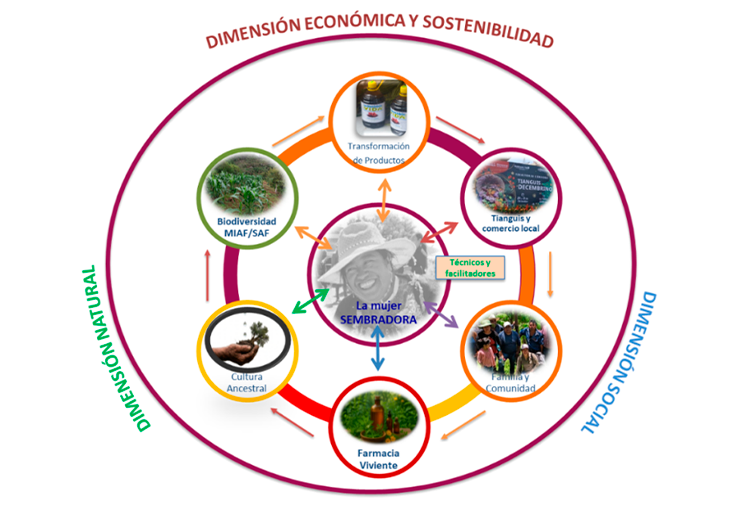
The objective was to conduct a comparative analysis of the Sowing Life program along an altitudinal gradient in the central region of the state of Veracruz, using a socioecological approach. The research was carried out from January 2023 to November 2025; the sample comprised 90 structured questionnaires and 30 semi-structured interviews administered to active legal subjects in three municipalities (Puente Nacional, Chocamán, and Atlahuilco). The research method was a survey with a comparative and diachronic multiple case study design. Data collection combined quantitative and qualitative techniques. Qualitative information was analyzed using the socioecological systems framework (SES Framework), and quantitative data were analyzed using nonparametric descriptive and inferential statistics (Kruskal-Wallis test). The results indicate that the program consolidated a circular and agroecological management model based on technological sovereignty, which articulates three dimensions (natural, social, and economic) through six operational axes. The impact of the model is heterogeneous according to the altitudinal gradient: the middle zone achieved the highest socioecological performance (89.3%) due to coffee social capital; the upper zone, 85.7%; and the lower zone, 75%, due to risks of economic dependence. The role of the woman planter emerges as the key driving force of the system, whose leadership transforms government subsidies into resilience and community autonomy. It is concluded that the Sowing Life program consolidated a circular, agroecological management model based on technological sovereignty and the self-management of bioinputs. The impact is heterogeneous according to the altitudinal gradient, with the middle zone standing out for its social capital and low risk of economic dependence.
Downloads
References
Altieri, M. A. y Nicholls, C. I. 2020. Agroecología y la búsqueda de sistemas alimentarios resilientes. Revista de Cultura Agroecológica. 36(1):7-13. https://doi.org/10.1080/03066150.2020.1782891.
Altieri, M. A.; Nicholls, C. I.; Henao, A. and Lana, M. A. 2015. Agroecology and the design of climate change-resilient farming systems. Agronomy for Sustainable Development. 35(3):869-890. https://doi.org/10.1007/s13593-015-0285-2.
CEDRSSA. 2024. Centro de Estudios para el Desarrollo Rural Sustentable y la Soberanía Alimentaria. El Programa Sembrando Vida y su impacto en el sector agroforestal en México: balance y perspectivas de la gestión comunitaria. Cámara de Diputados. Ciudad de México, México.
Cerón-Hernández, V. A.; Fernández-Vargas, G.; Figueroa, A. y Restrepo, I. 2019. El enfoque de sistemas socioecológicos en las ciencias ambientales. Investigación y Desarrollo. 27(2):85-109. https://doi.org/10.14482/indes.27.2.311.6.
Coneval. 2024. Evaluación de impacto cualitativo del Programa Sembrando Vida. Consejo Nacional de Evaluación de la Política de Desarrollo Social. Ciudad de México, México.
Cortez-Egremy, J. G.; Baca-Del Moral, J.; Uribe-Gómez, M.; Gómez-Hernández, T. y Valdés-Velarde, E. 2022. La multifuncionalidad de la agricultura como herramienta de análisis: el caso del programa Sembrando Vida. Acta Universitaria. 32:1-18. https://doi.org/10.15174/au.2022.3339.
Creswell, J. W. and Poth, C. N. 2023. Qualitative inquiry and research design: choosing Among Five Approaches. 4th. Edition. Sage Publications. Thousand Oaks, California, EE. UU.
Ferguson, R. and Ghaley, B. T. 2022. Bioinputs for sustainable transition in agroecosystems. Frontiers in Sustainable Food Systems, 6. https://doi.org/10.3389/fsufs.2022.845672.
García-García, J. 2023. Gobernanza y capacidad de agencia en programas agroforestales nacionales. Revista de Desarrollo Rural Sostenible. 5(2):45-62.
García-López, R.; Martínez-Salvador, M. y Ramírez-Valverde, B. 2023. Género, agroecología y soberanía alimentaria: el papel de las mujeres en el programa Sembrando Vida. Revista de Economía y Sociología Rural. 61(2):e254110. https://doi.org/10.1590/1806-9479.2021.254110.
Gliessman, S. R. 2020. Agroecology: the ecology of food systems. 3rd. Edition. CRC Press. https://doi.org/10.1201/9780429446368.
Guber, R. 2021. La etnografía: método, campo y reflexividad. Siglo XXI Editores. Buenos Aires, Argentina.
Guzmán, F. y Zúñiga, R. 2022. Medicina tradicional y gestión de agroecosistemas medicinales. Revista de Etnobiología. 20(1):12-28. https://revistaetnobiologia.mx/index.php/etno/article/view/439.
Hernández-Ortiz, J. 2022. Transición agroecológica y soberanía alimentaria en el México rural: un análisis crítico de los programas de subsidio directo. Revista de Geografía Agrícola. 68:45-63. https://doi.org/10.5154/r.rga.2021.68.03.
Hernández-Sampieri, R. y Mendoza, C. P. 2018. Metodología de la investigación: las rutas cuantitativa, cualitativa y mixta. McGraw-Hill Education. Ciudad de México, México.
Linares-Gabriel, A.; Granados-Carreto, J. A.; Flota-Bañuelos, C. y Martínez-Chávez, C. 2024. Limitaciones técnicas y adecuación ecológica de los sistemas agroforestales en el programa Sembrando Vida. Revista de Geografía Agrícola. 72:85-104. https://doi.org/10.5154/r.rga.2023.72.04.
López-Gómez, A. M.; Williams-Linera, G. and Manson, R. H. 2008. Tree species diversity and vegetation structure in shade coffee plantations as compared to adjacent rainforest in Veracruz, Mexico. Biotropica. 40(2):138-145. https://doi.org/10.1111/j.1744-7429.2007.00361.x.
Marín, L. y Heredia-Cortes, E. 2024. El enfoque de los sistemas socioecológicos aplicado a dos casos de estudio en la subregión capital de Veracruz. UVserva. 18:359-381. https://doi.org/10.25009/uvs.vi18.3006.
Martínez-Borrego, E.; Vallejo-Román, J. y Hernández-Lara, I. 2025. Incorporación de técnicas agroecológicas en el Programa Sembrando Vida en Chiapas, Guerrero y Veracruz. Convergencia Revista de Ciencias Sociales. 32(1):1-26. https://doi.org/10.29101/crcs.v32i1.26027.
Ostrom, E. 2009. A general framework for analyzing sustainability of social-ecological systems. Science. 325(5939):419-422. https://doi.org/10.1126/science.1172133.
Ostrom, E. 2015. Governing the commons: the evolution of institutions for collective action. Cambridge University Press. Cambridge, Reino Unido. https://doi.org/10.1017/CBO9780511807763.
Pérez-Ponciano, P. y Rojas, I. 2025. Sembrando Vida: una evaluación de impacto sobre la cobertura forestal. Sobre México Temas de Economía. 1(11):80-130. https://doi.org/10.48102/rsm.v1i11.161.
Pimm, S. L.; Jenkins, C. N. and Li, B. V. 2021. How to conserve biodiversity in a changing world. Science Advances. 7(12):eabd2610. https://doi.org/10.1126/sciadv.abd2610.
Pretty, J.; Benton, T. G.; Bharucha, Z. P.; Dicks, L. V.; Flora, C. B.; Godfray, H. C. J.; Goulson, D.; Hartley, S.; Sotherton, N. G. and Williams, C. 2020. Global assessment of agricultural intensification and sustainability. Nature Sustainability. 1(8):437-446. https://doi.org/10.1038/s41893-018-0114-0.
Rogers, E. M. 2003. Diffusion of innovations. 5th. Edition. Free Press. Nueva York, EE. UU.
Rosset, P. and Altieri, M. A. 2017. Agroecology: science and politics. Fernwood Publishing. Halifax, Nueva Escocia, Canadá.
Sevilla-Guzmán, E. 2006. De la sociología rural a la agroecología. Icaria Editorial. Barcelona, España. 256 p.
Toledo, V. M. y Barrera-Bassols, N. 2021. La memoria biocultural: la importancia ecológica de las sabidurías tradicionales. Junta de Andalucía/Icaria Editorial (reeditado posteriormente por UNAM/FCE). Barcelona, España.
Toledo, V. M.; Alarcón Cháires, P. y Barón L. 2002. Revisualizar lo rural: un enfoque socioecológico. Gaceta Ecológica. 62:7-20. https://www.redalyc.org/articulo.oa?id=53906202.
Wezel, A.; Gemmill-Herren, B.; Bezner, K. R.; Prager, K.; Lamine, C.; Garbach, P. M. and Wittman, H. 2023. Agroecological principles and elements and their implications for public policies. Agronomy for Sustainable Development. 40(6):40. https://doi.org/10.1007/s13593-020-00646-z.
Downloads
Published
Issue
Section
License
Copyright (c) 2026 Revista Mexicana de Ciencias Agrícolas

This work is licensed under a Creative Commons Attribution-NonCommercial 4.0 International License.
The authors who publish in Revista Mexicana de Ciencias Agrícolas accept the following conditions:
In accordance with copyright laws, Revista Mexicana de Ciencias Agrícolas recognizes and respects the authors’ moral right and ownership of property rights which will be transferred to the journal for dissemination in open access. Invariably, all the authors have to sign a letter of transfer of property rights and of originality of the article to Instituto Nacional de Investigaciones Forestales, Agrícolas y Pecuarias (INIFAP) [National Institute of Forestry, Agricultural and Livestock Research]. The author(s) must pay a fee for the reception of articles before proceeding to editorial review.
All the texts published by Revista Mexicana de Ciencias Agrícolas —with no exception— are distributed under a Creative Commons License Attribution-NonCommercial 4.0 International (CC BY-NC 4.0), which allows third parties to use the publication as long as the work’s authorship and its first publication in this journal are mentioned.
The author(s) can enter into independent and additional contractual agreements for the nonexclusive distribution of the version of the article published in Revista Mexicana de Ciencias Agrícolas (for example include it into an institutional repository or publish it in a book) as long as it is clearly and explicitly indicated that the work was published for the first time in Revista Mexicana de Ciencias Agrícolas.
For all the above, the authors shall send the Letter-transfer of Property Rights for the first publication duly filled in and signed by the author(s). This form must be sent as a PDF file to: revista_atm@yahoo.com.mx; cienciasagricola@inifap.gob.mx; remexca2017@gmail.
This work is licensed under a Creative Commons Attribution-Noncommercial 4.0 International license.