Soybean grain conditioning and its effect on antinutrients, protein and lipids
DOI:
https://doi.org/10.29312/remexca.v17i6.4195Keywords:
Phytates, family farming, trypsin inhibitorsAbstract
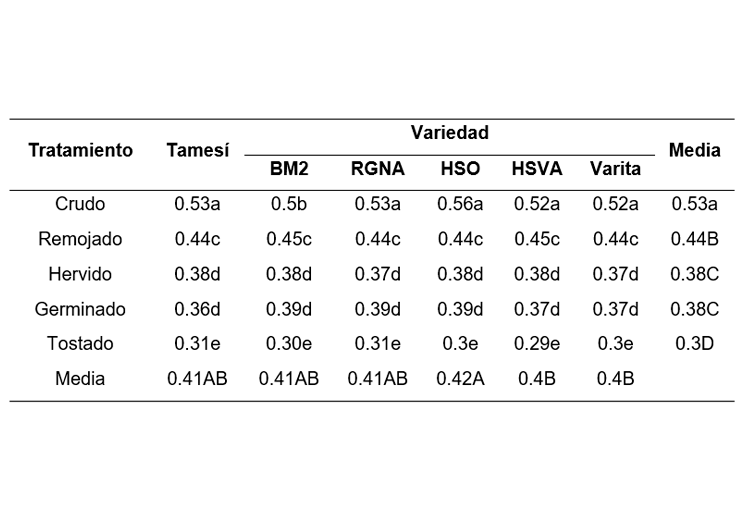
Soybeans are a strategic source of plant protein for animal nutrition; however, the presence of antinutritional factors such as trypsin inhibitors, phytates and saponins limits their utilization when the grain is used unprocessed. The research was conducted in 2025 and evaluated the effects of four postharvest conditioning methods (soaking, boiling, germination and roasting) on antinutritional factors, crude protein and lipid concentrations in six soybean varieties grown in Puebla (HSO, RGNA, BM2, HSVA, Varita and Tamesí). Crude protein, total lipids, phytates, trypsin inhibitors, and saponins were determined and analyzed using a completely randomized design with a two-factor (variety x method) factorial arrangement and Tukey’s multiple comparisons (α= 0.05). The results showed differences between varieties and conditioning methods. The Hoja Seca Original variety stood out for having the highest crude protein content, intermediate and stable total lipid values, and an efficient reduction of the main antinutritional factors after treatments. In contrast, the BM2 variety had the lowest protein content and the greatest sensitivity to heat treatment. Raw grain had the highest concentrations of antinutritional factors. Roasting and boiling achieved the greatest reductions in trypsin inhibitors, while germination and soaking decreased phytates and saponins with less impact on protein content. The varieties differ in chemical composition, but this variation is less than the effect produced by the conditioning method, with roasting being the one that best reduced antinutrients.
Downloads
References
AACC. 2009. International Approved Methods of Analysis. 11th. Edition. Method 22-40.01: Measurement of trypsin inhibitor activity of soy products-spectrophotometric method. AACC International. St. Paul, MN, USA.
AOAC. 2012a. International. Official Method 2001.11: protein (crude) in animal feed, forage (plant tissue), grain and oilseeds: block digestion method using copper catalyst and steam distillation into boric acid. In: official methods of analysis of AOAC international. AOAC International. Gaithersburg, MD, USA.
AOAC. 2012b.International. AOAC Official Method 986.11: Phytate in foods. In: Official Methods of Analysis of AOAC International. AOAC International. Gaithersburg, MD, USA.
AOAC. 2023. International. AOAC Official Method 920.39: fat (crude) or ether extract in animal feed. In: Official Methods of Analysis of AOAC international. 22th. Edition. Oxford University Press. Oxford, UK.
AOCS. 2017. American Oil Chemists’ Society. Official methods and recommended practices of the 7th. Edition. Method Ba 12-75: trypsin inhibitor activity. AOCS Press. Urbana, IL, USA.
De la Luna, J. A. 2006. Valor nutritivo de la proteína de soya. México. Investigación y Ciencia-Universidad Autónoma de Aguascalientes (UAA). 14(36):29-34. https://www.redalyc.org/articulo.oa?id=67403606.
Gu, L.; Tao, G. and Gu, W. 2002. Changes of saponins during soybean germination. Food Chemistry. 78(4):497-501. https://doi.org/10.1016/S0308-8146(02)00214-7.
Hostettmann, K. and Marston, A. 1995. Saponins. Cambridge University Press. Cambridge, UK. https://doi.org/10.1017/CBO9780511565113.
Hou, H. J. and Chang, K. C. 2004. Storage conditions affect soybean color, chemical composition and tofu quality. Journal of Food Science. 69(4):C293-C300. https://doi.org/10.1111/j.1365-2621.2004.tb06337.x.
Hu, J.; Webster, D. E.; Brauer, D. and Thompson, L. U. 2002. Quantification of group B soyasaponins by high-performance liquid chromatography. Journal of Agricultural and Food Chemistry. 50(9):2587-2594. https://doi.org/10.1021/jf011181r.
INIFAP. 2019. Instituto Nacional de Investigaciones Forestales, Agrícolas y Pecuarias. Tablas de requerimientos nutricionales de especies pecuarias. INIFAP. Ciudad de México, México.
ISO. 2001. International Organization for Standardization. ISO 14902:2001. Animal feeding stuffs-determination of trypsin inhibitor activity of soya products. ISO. Ginebra, Suiza. http://higiene.unex.es/Bibliogr/ISO-BS-USDA/ISO-BS/BS%20EN%20ISO/BS%20EN%20ISO%2014902-2001.pdf.
Kakade, M. L.; Rackis, J. J.; McGhee, J. E. and Puski, G. 1973. Determination of trypsin inhibitor activity of soy products: a collaborative analysis of an improved procedure. Cereal Chemistry. 51(3):376-382.
Kong, X.; Li, Y. and Liu, X. 2022. A review of thermosensitive antinutritional factors in plant-based foods. Journal of Food Biochemistry. 46(9):e14199. https://doi.org/10.1111/jfbc.14199.
Liener, I. E. 1994. Implications of antinutritional components in soybean foods. Critical Reviews in Food Science and Nutrition. 34(1):31-67. https://doi.org/10.1080/10408399409527649.
Liu, K. 2019. Soybeans: chemistry, technology, and utilization. 2nd. Edition. Wiley-Blackwell. Hoboken, NJ, USA. https://doi.org/10.1002/9781119383956.
Lott, J. N. A.; Ockenden, I.; Raboy, V. and Batten, G. D. 2000. Phytic acid and phosphorus in crop seeds and fruits: a global estimate. Seed Science Research. 10(1):11-33. https://doi.org/10.1017/S0960258500000039.
Luo, Y.; Xie, W. and Cui, Q. 2009. Effects of phytase, germination, and cooking on the total phosphorus and phytic acid contents of brown rice. Journal of Agricultural and Food Chemistry. 57(20):9600-9606. https://doi.org/10.1021/jf901628q.
Panthee, D. R.; Pantalone, V. R.; Saxton, A. M.; West, D. R. and Sams, C. E. 2016. Quantitative trait loci controlling soybean seed protein and oil content. Agronomy Journal. 108(3):1134-1142. https://doi.org/10.2134/agronj2015.0386.
Raboy, V. 2001. Seeds for a better future: ‘low phytate’ grains help to overcome malnutrition and reduce pollution. Trends in Plant Science. 6(10):458-462. https://doi.org/10.1016/S1360-1385(01)02054-5.
Rotundo, J. L. and Westgate, M. E. 2009. Meta-analysis of environmental effects on soybean seed protein and oil concentration. Field Crops Research. 110(2):147-156. https://doi.org/10.1016/j.fcr.2008.07.012.
SADER. 2023. Secretaría de Agricultura y Desarrollo Rural. Panorama agroalimentario 2023. Soya. Ciudad de México, México. https://nube.agricultura.gob.mx/panorama-dgsiap/.
Sandberg, A. S.; Larsen, T. and Sandström, B. 1999. High dietary phytate intake is associated with low mineral absorption in humans. The Journal of Nutrition. 129(10):1910-1914. https://doi.org/10.1093/jn/129.10.1910.
Sharma, A. 2021. A review on traditional technology and safety challenges with regard to antinutrients in legume foods. Journal of Food Science and Technology. 58(8):2863-2883. https://doi.org/10.1007/s13197-020-04883-8.
Sharma, S.; Goyal, R. and Barwal, S. 2013. Domestic processing effects on physiochemical, nutritional and anti-nutritional attributes in soybeans (Glycine Max L. Merill). International Food Research Journal. 20(6):3203-3209.
Shimoyamada, M.; Ikedo, S.; Ootsubo, R. and Watanabe, K. 1990. Effects of soybean saponins on chymotryptic hydrolysis of proteins. Journal of Agricultural and Food Chemistry. 38(3):717-722. https://doi.org/10.1021/jf00093a015.
Singer, W. M.; Lee, Y. C.; Shea, Z.; Vieira, C. C.; Lee, D.; Li, X.; Cunicelli M.; Kadam, S. S.; Khan, M. A. W.; Shannon, G.; Mian, M. A. R.; Nguyen, H, T. and Zhang, B. 2023. Soybean genetics, genomics, and breeding for improving nutritional value and reducing antinutritional traits in food and feed. The Plant Genome. 16(4):e20415. https://doi.org/10.1002/tpg2.20415.
Wang, N.; Hatcher, D. W. and Gawalko, E. J. 2022. Legume seed protein digestibility as influenced by traditional and emerging physical processing technologies. Foods. 11(15):2202. https://doi.org/10.1002/tpg2.20415.
Welham, T. and Domoney, C. 2000. Temporal and spatial activity of a promoter from a pea enzyme inhibitor gene and its exploitation for seed quality improvement. Plant Science. 159(2):289-299. https://doi.org/10.1016/S0168-9452(00)00358-7.
Wheeler, E. L. and Ferrel, R. E. 1971. A method for phytic acid determination in wheat and wheat fractions. Cereal Chemistry. 48(3):312-320.
Wilson, R. F. 2004. Seed composition. In: Soybeans: Improvement, production and uses. Boerma, H. R. and Specht, J. E. (Eds.). 3th. edition. American Society of Agronomy. Crop Science Society of America and Soil Science Society of America. Madison, WI, USA. 621-677 pp. https://doi.org/10.2134/agronmonogr16.3ed.c13.
Downloads
Published
Issue
Section
License
Copyright (c) 2026 Revista Mexicana de Ciencias Agrícolas

This work is licensed under a Creative Commons Attribution-NonCommercial 4.0 International License.
The authors who publish in Revista Mexicana de Ciencias Agrícolas accept the following conditions:
In accordance with copyright laws, Revista Mexicana de Ciencias Agrícolas recognizes and respects the authors’ moral right and ownership of property rights which will be transferred to the journal for dissemination in open access. Invariably, all the authors have to sign a letter of transfer of property rights and of originality of the article to Instituto Nacional de Investigaciones Forestales, Agrícolas y Pecuarias (INIFAP) [National Institute of Forestry, Agricultural and Livestock Research]. The author(s) must pay a fee for the reception of articles before proceeding to editorial review.
All the texts published by Revista Mexicana de Ciencias Agrícolas —with no exception— are distributed under a Creative Commons License Attribution-NonCommercial 4.0 International (CC BY-NC 4.0), which allows third parties to use the publication as long as the work’s authorship and its first publication in this journal are mentioned.
The author(s) can enter into independent and additional contractual agreements for the nonexclusive distribution of the version of the article published in Revista Mexicana de Ciencias Agrícolas (for example include it into an institutional repository or publish it in a book) as long as it is clearly and explicitly indicated that the work was published for the first time in Revista Mexicana de Ciencias Agrícolas.
For all the above, the authors shall send the Letter-transfer of Property Rights for the first publication duly filled in and signed by the author(s). This form must be sent as a PDF file to: revista_atm@yahoo.com.mx; cienciasagricola@inifap.gob.mx; remexca2017@gmail.
This work is licensed under a Creative Commons Attribution-Noncommercial 4.0 International license.