Optimal strawberry distribution in Mexico (cycle 2023): a linear programming model
DOI:
https://doi.org/10.29312/remexca.v17i2.4070Keywords:
strawberry consumption, strawberry distribution, strawberry exportAbstract
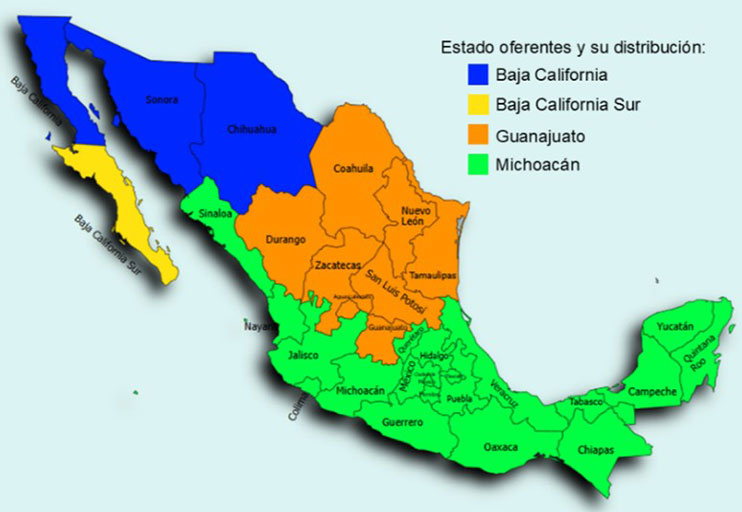
Strawberries are a strategic crop in Mexico due to their economic and social importance, with more than 640 000 t produced in 2023, concentrated in Michoacán, Guanajuato, and Baja California. Their high perishability requires efficient logistics systems. The study aimed to estimate the optimal strawberry distribution routes for the 2023 cycle, using a linear programming model that minimizes the total distance transported, comparing closed- and open-economy scenarios. To do this, linear programming was applied using the simplex method in Lingo 18.0, considering distance as a cost variable. In the first scenario (closed economy), 4 of the 16 producers concentrated 95% of the supply and supplied the 28 demanding destinations; in the second (open economy), a surplus of 158 000 t was exported, mainly via Mexicali, Tijuana, and Matamoros. The model allowed us to minimize the variable of travel distance; however, limitations were identified, such as the absence of monetary costs, seasonality and a lack of storage infrastructure. In conclusion, strengthening these areas will increase the competitiveness of the strawberry sector and improve national food security.
Downloads
References
Alvarado-Chávez, J. A.; Gómez-Gonzales, A.; Lara-Herrera, A.; Díaz-Pérez, J. C. y García-Herrera, E. J. 2020. Rendimiento y calidad de fruto de fresa cultivada en invernadero en sistema hidropónico piramidal. Revista Mexicana de Ciencias Agrícolas. 11(8):1737-48. https://doi.org/10.29312/remexca.v11i8.2460.
Arana-Coronado, J. J.; Trejo, P. C. O.; Aguilar, C. O. J.; Martínez, D. M. Á. y Mondragón, H. R. 2019. Crecimiento potencial de las exportaciones de fresa (Fragaria) mexicana. Agrociencia. 53(3):417-431. https://agrociencia-colpos.org/index.php/agrociencia/article/view/1793/1790.
Ariza, Á. L. G. y Llinás, G. A. G. 2015. Programación lineal. In: manual práctico de investigación de operaciones I. 4th Ed. Editorial Universidad del Norte. 17-70 pp. https://doi.org/10.2307/j.ctvdf0jz0.6.
Arroyo-Cossío, A. J. y Hernández-Flores, A. A. 2021. Competitividad de la fresa mexicana en el mercado estadounidense de 1992 a 2017. Ciencia y Tecnología Agropecuaria. 22(1):e1414. https://doi.org/10.21930/rcta.vol22-num1-art:1414.
Bustamante-Lara, T. I.; Vargas-Canales, J. M.; Díaz-Sánchez, F. y Rosas-Vargas, R. 2020) Especialización y competitividad en el sector agrícola mexicano: caso fresa. Agro Productividad. 13(8):31-37. https://doi.org/10.32854/agrop.vi.1697.
Castillo-Altamirano, M.; Martínez-Jiménez, D. D.; Luquez-Gaitán, C. E. y Aguirre-López, J. M. 2024. Optimización de las rutas comerciales de maíz en México mediante programación lineal. Revista Mexicana de Ciencias Agrícolas. 15(8):3-4. https://doi.org/10.29312/remexca.v15i8.3535.
CONAPO. 2025. Consejo Nacional de Población. Datos abiertos. Gobierno de México. https://conapo.segob.gob.mx/es/CONAPO/Datos-abiertos.
FAOSTAT. 2023. Food and Agriculture Organization of the United Nations (Statistical database. https://www.fao.org/faostat/es/#data.
Garrapa, A. M. 2019. Jornaleros agrícolas y corporaciones transnacionales en el Valle de San Quintín. Frontera Norte. 31(1):3-5. https://doi.org/10.33679/rfn.v1i1.2018.
Hernández-Soto, D.; Mejía-Ramírez, R. e Hilario-Méndez, L. 2021. Determinación de la rentabilidad de producir fresa en México para exportar a Estados Unidos. Entorno Udlap. 14(5):44-48. https://entorno.udlap.mx/determinacion-de-la-rentabilidad-de-producir-fresa-en-mexico-para-exportar-a-estados-unidos/.
León-López L.; Guzmán-Ortíz D. L. A.; García-Berumen J. A.; Chávez-Marmolejo C. G. y Peña-Cabriales J. J. 2018. Consideraciones para mejorar la competitividad de la región ‘El Bajío’ en la producción nacional de fresa. Revista Mexicana de Ciencias Agrícolas. 5(4):673-686. https://doi.org/10.29312/remexca.v5i4.929.
Moncayo-Martínez, L. A. and Zhang, D. Z. 2013. Optimizing safety stock placement and lead time in an assembly supply chain using bi-objective MAX-MIN ant system. International Journal of Production Economics. 145(1):3-6. https://doi.org/10.1016/j.ijpe.2012.12.024.
Peniche-Camps, S. y Ávila-García, P. 2018. Exploración del concepto de exportación de agua virtual: el caso de la fresa mexicana. Revista Mexicana de Ciencias Agrícolas. 3(8):1579-1590. https://doi.org/10.29312/remexca.v3i8.1322.
Ramírez-Padrón, L. C.; Caamal-Cauich, I.; Pat-Fernández, V. G.; Martínez-Luis, D. y Pérez-Fernández, A. 2020. Análisis de los indicadores de competitividad de las exportaciones de fresa mexicana. Revista Mexicana de Ciencias Agrícolas. 11(4):815-827. https://doi.org/10.29312/remexca.v11i4.2049.
SIAP. 2024. Servicio de Información Agroalimentaria y Pesquera. Anuario estadístico de la producción agrícola. Secretaría de Agricultura y Desarrollo Rural (SADER). https://nube.agricultura.gob.mx/cierre-agricola/.
SICT. 2025. Secretaría de Infraestructura, Comunicaciones y Transportes. Sistema de Información de Rutas (SIBUAC). Gobierno de México. https://app.sct.gob.mx/sibuac-internet/controllerui?action=cmdescogeruta.
Soto-Mora, C. y Fuentes-Aguilar, L. 1992. Problemática en la reproducción y comercialización de hortalizas en México. El caso de la fresa y el melón. Investigaciones Geográficas. 1(24):79-83. https://doi.org/10.14350/rig.59009.
Terrones-Rodríguez, A. I.; Caamal-Cauich, I.; Pat-Fernández, V. G.; Ávila-Dorantes, J. A.; Martínez-Luis, D. y Caamal-Pat, Z. H. 2022. Análisis de las variables económicas que determinan las exportaciones de fresa de México a Estados Unidos de América. Revista Mexicana de Ciencias Agrícolas. 13(4):631-640. https://doi.org/10.29312/remexca.v13i4.2532.
Zamora-Torres, A. I. y Riveros-Figueroa, E. 2016. Estudio de la región michoacana de Zamora como polo de competitividad internacional agrícola. Clío América. 10(20):139-159. https://doi.org/10.21676/23897848.1873.
Zarazúa-Escobar, J. A.; Almaguer-Vargas, G. y Márquez-Berber, S. R. 2011. Redes de innovación en el sistema productivo fresa en Zamora, Michoacán. Revista Chapingo. Serie horticultura. 17(1):51-60. https://revistas.chapingo.mx/horticultura/revista/articulos/rchshXVII1144.pdf.
Downloads
Published
Issue
Section
License
Copyright (c) 2026 Revista Mexicana de Ciencias Agrícolas

This work is licensed under a Creative Commons Attribution-NonCommercial 4.0 International License.
The authors who publish in Revista Mexicana de Ciencias Agrícolas accept the following conditions:
In accordance with copyright laws, Revista Mexicana de Ciencias Agrícolas recognizes and respects the authors’ moral right and ownership of property rights which will be transferred to the journal for dissemination in open access. Invariably, all the authors have to sign a letter of transfer of property rights and of originality of the article to Instituto Nacional de Investigaciones Forestales, Agrícolas y Pecuarias (INIFAP) [National Institute of Forestry, Agricultural and Livestock Research]. The author(s) must pay a fee for the reception of articles before proceeding to editorial review.
All the texts published by Revista Mexicana de Ciencias Agrícolas —with no exception— are distributed under a Creative Commons License Attribution-NonCommercial 4.0 International (CC BY-NC 4.0), which allows third parties to use the publication as long as the work’s authorship and its first publication in this journal are mentioned.
The author(s) can enter into independent and additional contractual agreements for the nonexclusive distribution of the version of the article published in Revista Mexicana de Ciencias Agrícolas (for example include it into an institutional repository or publish it in a book) as long as it is clearly and explicitly indicated that the work was published for the first time in Revista Mexicana de Ciencias Agrícolas.
For all the above, the authors shall send the Letter-transfer of Property Rights for the first publication duly filled in and signed by the author(s). This form must be sent as a PDF file to: revista_atm@yahoo.com.mx; cienciasagricola@inifap.gob.mx; remexca2017@gmail.
This work is licensed under a Creative Commons Attribution-Noncommercial 4.0 International license.