Influence of Sargassum spp. extract on germination and antioxidant activity of tomato seedlings
DOI:
https://doi.org/10.29312/remexca.v17i2.4239Keywords:
Solanum lycopersicum L., biostimulants, seed primingAbstract
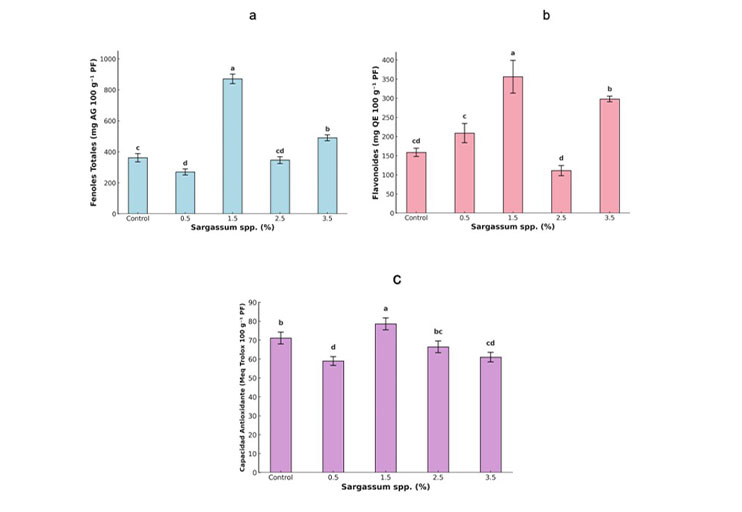
In recent years, the macroalga Sargassum spp. has become an economic and environmental problem in several coastal regions. Nonetheless, due to the wide variety of bioactive compounds it possesses, it has been proposed as a sustainable alternative in agriculture, as it can improve seed germination, nutrient absorption, and photosynthesis, and mitigate biotic and abiotic stress. The objective of this study was to evaluate the effect of priming tomato seeds with aqueous extracts of Sargassum spp. on germination, vigor, biomass, photosynthetic pigments and some indicators of the antioxidant system of seedlings. The concentrations of the extracts were: 0.5, 1.5, 2.5 and 3.5%, and a control with distilled water. The results indicate that the extracts improved germination, vigor, phenolic compounds, flavonoids, antioxidant capacity and photosynthetic pigments. There were no significant improvements in biomass. These results suggest that applying Sargassum spp. extracts may be an ecological alternative to improve germination parameters and stimulate the synthesis of secondary metabolites in tomato seedlings.
Downloads
References
Abinandan, S.; Praveen, K.; Venkateswarlu, K. and Megharaj, M. 2025. Seed priming with microalgae enhances plant productivity and rhizosphere health. Soil Ecology Letters. 7(1):1-13. https://doi.org/10.1007/s42832-024-0271-1.
Adderley, A.; Wallace, S.; Stubbs, D.; Bowen-O’Connor, C.; Ferguson, J.; Watson, C. and Gustave, W. 2023. Sargassum sp. as a biofertilizer: is it really a key towards sustainable agriculture for The Bahamas? Bulletin of the National Research Centre. 47(1):1-11. https://doi.org/10.1186/s42269-023-01087-w.
Aebi, H. E. 1974. Catalase. In: methods of enzymatic analysis 2nd. Bergmeyer HU. Ed. Academic Press. New York, USA. 673-684 pp.
Bradford, M. M. 1976. A rapid and sensitive method for the quantitation of microgram quantities of protein utilizing the principle of protein-dye binding. Analytical Biochemistry. 72(1-2):248-254.
Brand-Williams, W.; Cuvelier, M. E. and Berset, C. 1995. Use of a free radical method to evaluate antioxidant activity. LWT-Food Science and Technology. 28(1):25-30.
Buendía-García, A.; Lozano-Cavazos, C. J.; Rodríguez-Ortiz, J. C.; Carballo-Méndez, F. D. J.; Moreno-Reséndez, A.; Sariñana-Navarrete, M. D. A. y Preciado-Rangel, P. 2021. La biofortificación con selenio mejora la calidad nutracéutica y la capacidad antioxidante de la lechuga (Lactuca sativa L.). Ecosistemas y Recursos Agropecuarios. 8(3):1-8. https://doi.org/10.19136/era.a8n3.3104.
Castro, I.; Calero, A.; Rodríguez, M. G.; Peláez, A.; Martínez, D. y Pérez, Y. 2022. Potencialidades de dos bioestimulantes en la germinación y el crecimiento de las plántulas de tomate. Ciencia y Tecnología Agropecuaria. 23(1):1-16. https://doi.org/10.21930/rcta.vol23-num1-art:2343.
Collins, E. J.; Bowyer, C.; Tsouza, A. and Chopra, M. 2022. Tomatoes: an extensive review of the associated health impacts of tomatoes and factors that can affect their cultivation. Biology. 11(2):1-44. https://doi.org/10.3390/biology11020239.
Cossa, G. E.; Silva, V. N.; Milanesi, P. M. and Tironi, S. P. 2023. Physiology of carrot seeds treated with red seaweed biostimulant and exposed to different temperatures and salinity. Acta Agronómica. 72(1):63-69. https://doi.org/10.15446/acag.v72n1.96143.
Dumanović, J.; Nepovimova, E.; Natić, M.; Kuča, K. and Jaćević, V. 2021. The significance of reactive oxygen species and antioxidant defense system in plants: a concise overview. Frontiers in Plant Science. 6(11):1-13.
Durán-Hernández, D.; Uribe-Orozco, M. E.; Mateo-Cid, L. E. y González-Mendoza, D. 2022. Potencial biotecnológico de las macroalgas en la agricultura. IDESIA (Chile). 40(3):81-88.
FAO. 2025. Food and Agriculture Organization of the United Nation. Alimentación y agricultura sostenibles. https://www.fao.org/sustainability/es.
Genard, H.; Saos, J. L.; Billard, J. P.; Tremolieres, A. and Boucaud, J. 1991. Effect of salinity on lipid composition, glycine betaine content and photosynthetic activity in chloroplasts of Suaeda maritima. Plant Physiology and Biochemistry. 29(5):421-427.
González-Morales, S.; Solís-Gaona, S.; Valdés-Caballero, M. V.; Juárez-Maldonado, A.; Loredo-Treviño, A. and Benavides-Mendoza, A. 2021. Transcriptomics of biostimulation of plants under abiotic stress. Frontiers in genetics. 12(5):1-24. https://doi.org/10.3389/fgene.2021.583888.
Hashim, A. M.; Alharbi, B. M.; Abdulmajeed, A. M.; Elkelish, A.; Hozzein, W. N. and Hassan, H. M. 2020. Oxidative stress responses of some endemic plants to high altitudes by intensifying antioxidants and secondary metabolites content. Plants. 9(7):1-24. https://doi.org/10.3390/plants9070869.
Hernández-Herrera, R. M.; González-González, M. F.; Velasco-Ramírez, A. P.; Velasco-Ramírez, S. F.; Santacruz-Ruvalcaba, F. and Zamora-Natera, J. F. 2023. Seaweed extract components are correlated with the seeds germination and growth of tomato seedlings. Seeds. 2(4):436-448. https://doi.org/10.3390/seeds2040033.
Kumar, G.; Nanda, S.; Singh, S. K.; Kumar, S.; Singh, D.; Singh, B. N. and Mukherjee, A. 2024. Seaweed extracts: enhancing plant resilience to biotic and abiotic stresses. Frontiers in Marine Science. 11(4):1-14. https://doi.org/10.3389/fmars.2024.1457500.
Lau, S. E.; Lim, L. W. T.; Hamdan, M. F.; Chan, C.; Saidi, N. B.; Ong-Abdullah, J. and Tan, B. C. 2025. Enhancing plant resilience to abiotic stress: the power of biostimulants. Phyton-International. Journal of Experimental Botany. 94(1):1-31. https://doi.org/10.32604/phyton.2025.059930.
Li, R.; He, J.; Xie, H.; Wang, W.; Bose, S. K.; Sun, Y.; Hu, J. and Yin, H. 2019. Effects of chitosan nanoparticles on seed germination and seedling growth of wheat (Triticum aestivum L.). International Journal of Biological Macromolecules. 126(1):91-100.
Lichtenthaler, H. K. and Wellburn, A. R. 1983. Determinations of total carotenoids and chlorophylls a and b of leaf extracts in different solvents. Biochemical Society Transactions. 11(5):591-592.
Makhaye, G.; Aremu, A. O.; Gerrano, A. S.; Tesfay, S.; Du Plooy, C. P. and Amoo, S. O. 2021. Biopriming with seaweed extract and microbial-based commercial biostimulants influences seed germination of five Abelmoschus esculentus genotypes. Plants. 10(7):1-11. https://doi.org/10.3390/plants10071327.
Margal, P. B.; Thakare, R. S.; Kamble, B. M.; Patil, V. S.; Patil, K. B. and Titirmare, N. S. 2023. Effect of seaweed extracts on crop growth and soil: a review. Journal of Experimental Agriculture International. 45(9):9-19. https://doi.org/10.9734/JEAI/2023/v45i92170.
Martínez-González, L.; Pérez-Domínguez, G.; López-Padrón, I.; Reyes-Guerrero, Y. y Núñez-Vázquez, M. C. 2022. Efecto de un extracto de Sargassum fluitans sobre la germinación de semillas de tomate. Cultivos Tropicales. 43(2):1-22.
Mohammed, S.; El-Sheekh, M. M.; Aly, S. H.; Al-Harbi, M.; Elkelish, A. and Nagah, A. 2023. Inductive role of the brown alga Sargassum polycystum on growth and biosynthesis of imperative metabolites and antioxidants of two crop plants. Frontiers in Plant Science. 14(11):1-12. https://doi.org/10.3389/fpls.2023.1136325.
Morales-Meléndez, R.; Betancourt-Galindo, R.; Juárez-Maldonado, A.; Hernández-Pérez, A.; González-Fuentes, J. A.; Puente-Urbina, B. y Méndez-López, A. 2023. Aplicación de extractos de algas, NP’SZnO y microorganismos sobre la biomasa vegetal en tomate. Ecosistemas y Recursos Agropecuarios. 10(2):1-11. https://doi.org/10.19136/era.a10n2.3206.
Papoui, E. and Koukounaras, A. 2025. Evaluation of Ascophyllum nodosum and Sargassum spp. seaweed Extracts’ effect on germination of tomato under salinity Stress. Horticulturae. 11(3):1-13. https://doi.org/10.3390/horticulturae11030290.
Reed, R.; Bradford, K. and Khanday, I. 2022. Seed germination and vigor: ensuring crop sustainability in a changing climate. Heredity. 128(6):450-459. https://doi.org/10.1038/s41437-022-00497-2.
Repke, R. A.; Silva, D. M. R.; Dos Santos, J. C. C. and Almeida-Silva, M. 2022. Increased soybean tolerance to high-temperature through biostimulant based on Ascophyllum nodosum (L.) seaweed extract. Journal of Applied Phycology. 34(6):3205-3218.
Rivera-Solís, L. L.; Rodríguez-Jasso, R. M.; Flores-López, M. L.; Robledo-Olivo, A.; Sandoval-Rangel, A.; Sariñana-Aldaco, O. y González-Morales, S. 2021. Extractos de Sargassum spp. como inductores de tolerancia a Fusarium oxysporum en plántulas de tomate. Ecosistemas y Recursos Agropecuarios. 8(1):1-8. https://doi.org/10.19136/era.a8n1.2826.
Ruiz-Ramirez, S.; Sánchez-Lucio, R.; Zelaya-Molina, L. X.; Chávez-Díaz, I. F.; Cruz-Cárdenas, C. I. y Valdivia-Bernal, R. 2021. Germinación y vigor de semillas de especies hortícolas inoculadas con biofertilizantes y soluciones salinas. Revista Mexicana de Ciencias Agrícolas. 12(7):1199-1208.
Salazar-Salazar, W.; Monge-Pérez, J. E. y Loría-Coto, M. 2022. Aplicación foliar de extracto de algas y fertilizantes en pimiento (Capsicum annuum). UNED Research Journal. 14 (2):1-12.
Sariñana-Aldaco, O.; Benavides-Mendoza, A.; Juarez-Maldonado, A.; Robledo-Olivo, A.; Rodríguez-Jasso, R. M.; Preciado-Rangel, P. y Gonzalez-Morales, S. 2021. Efecto de extractos de Sargassum spp. en el crecimiento y antioxidantes de plántulas de tomate. Ecosistemas y Recursos Agropecuarios. 8(2):1-15. https://doi.org/10.19136/era.a8n2.2814.
Sariñana-Aldaco, O.; Benavides-Mendoza, A.; Robledo-Olivo, A. and González-Morales, S. 2022. The biostimulant effect of hydroalcoholic extracts of Sargassum spp. in tomato seedlings under salt stress. Plants. 11(22):1-24. https://doi.org/10.3390/plants11223180.
Sariñana-Aldaco, O.; Rivera-Solís, L. L.; Benavides-Mendoza, A.; Robledo-Olivo, A., Rodríguez-Jasso, R. M. and González-Morales, S. 2025. Using brown algae in the plant-soil system: a sustainable approach to improving the yield and quality of agricultural crops. Horticulturae. 11(1):1-29. https://doi.org/10.3390/horticulturae11010094.
Senthilkumar, S.; Kuppusamy, S.; Palai, S.; Rajanbabu, V. and Vennila, A. 2024. Exploring Sargassum extract as a bio stimulant: advancements and benefits in soil plant systems a review. Communications in Soil Science and Plant Analysis. 55(22):3638-3648. https://doi.org/10.1080/00103624.2024.2397013.
Sherin, G.; Aswathi, K. P. R. and Puthur, J. T. 2022. Photosynthetic functions in plants subjected to stress are positively influenced by priming. Plant Stress. 4(10):1-13. https://doi.org/10.1016/j.stress.2022.100079.
Singleton, V. L.; Orthofer, R. and Lamuela-Raventós, R. M. 1999. Analysis of total phenols and other oxidation substrates and antioxidants by means of Folin-Ciocalteu reagent. Methods in Enzymology. 299(7):152-178.
Wang, X. and Shi, Y. 2024. Effects of different seed priming agents on seed germination and physiological characteristics of wheat under saline-alkali stress. Chilean Journal of Agricultural Research. 84(4):489-499.
Zluhan-Martínez, E.; López-Ruíz, B. A.; García-Gómez, M. L.; García-Ponce, B.; De la Paz Sánchez, M.; Álvarez-Buylla, E. R. and Garay-Arroyo, A. 2021. Integrative roles of phytohormones on cell proliferation, elongation and differentiation in the Arabidopsis thaliana primary root. Frontiers in Plant Science. 12(6):1-20. https://doi.org/10.3389/fpls.2021.659155.
Downloads
Published
Issue
Section
License
Copyright (c) 2026 Revista Mexicana de Ciencias Agrícolas

This work is licensed under a Creative Commons Attribution-NonCommercial 4.0 International License.
The authors who publish in Revista Mexicana de Ciencias Agrícolas accept the following conditions:
In accordance with copyright laws, Revista Mexicana de Ciencias Agrícolas recognizes and respects the authors’ moral right and ownership of property rights which will be transferred to the journal for dissemination in open access. Invariably, all the authors have to sign a letter of transfer of property rights and of originality of the article to Instituto Nacional de Investigaciones Forestales, Agrícolas y Pecuarias (INIFAP) [National Institute of Forestry, Agricultural and Livestock Research]. The author(s) must pay a fee for the reception of articles before proceeding to editorial review.
All the texts published by Revista Mexicana de Ciencias Agrícolas —with no exception— are distributed under a Creative Commons License Attribution-NonCommercial 4.0 International (CC BY-NC 4.0), which allows third parties to use the publication as long as the work’s authorship and its first publication in this journal are mentioned.
The author(s) can enter into independent and additional contractual agreements for the nonexclusive distribution of the version of the article published in Revista Mexicana de Ciencias Agrícolas (for example include it into an institutional repository or publish it in a book) as long as it is clearly and explicitly indicated that the work was published for the first time in Revista Mexicana de Ciencias Agrícolas.
For all the above, the authors shall send the Letter-transfer of Property Rights for the first publication duly filled in and signed by the author(s). This form must be sent as a PDF file to: revista_atm@yahoo.com.mx; cienciasagricola@inifap.gob.mx; remexca2017@gmail.
This work is licensed under a Creative Commons Attribution-Noncommercial 4.0 International license.