Attributes of physical, chemical, sensory quality and microbiological stability of muffins with non-toxic edible Jatropha curcas L. flour
DOI:
https://doi.org/10.29312/remexca.v17i7.4224Keywords:
baking, non-toxic genotype, protein, underutilized resourcesAbstract
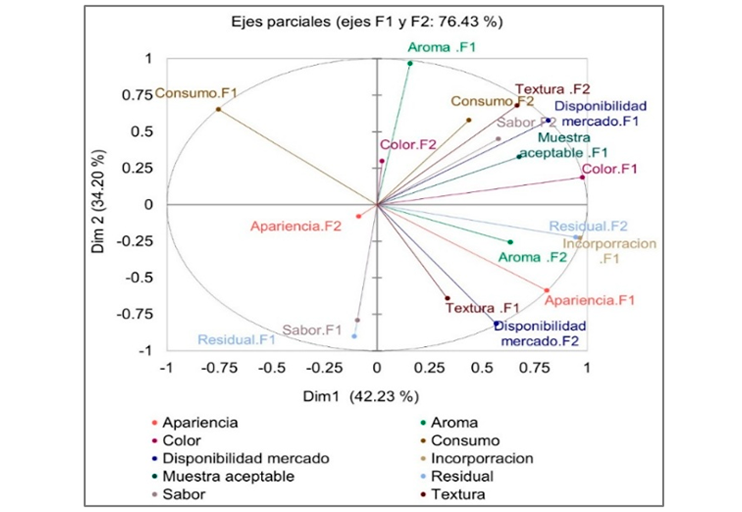
The non-toxic edible genotype of Jatropha curcas L. is an underutilized resource with potential to diversify tropical agrifood systems. This study evaluated the partial substitution of wheat flour with defatted J. curcas flour on the physicochemical and sensory quality and microbiological stability of muffins stored at 4 °C. In 2024, the material was collected in Pueblillo, Papantla, Veracruz. The flour was obtained by Soxhlet extraction with hexane, and muffins were prepared with 0, 5, 10 and 15% substitution. The proximate composition, water activity, color, microbiological stability and sensory acceptance of muffins were evaluated among 150 consumers. Determinations were made in triplicate; the data were analyzed by Anova and Tukey’s test (α= 0.05), and the sensory data were also analyzed using multiple factor analysis. Protein increased from 9.57 to 12.06%; ash increased from 1.59 to 2.66% and lipids varied from 21.64 to 24.91%, with a nonlinear response. Moisture and water activity did not vary significantly. M-5 and M-10 presented more intense reddish and yellow tones; M-15 retained a light-yellow color similar to the control. Microbial counts were <1 log CFU g-1 for six days at 4 °C; muffins showed favorable sensory acceptance in all treatments. Under the conditions evaluated, substituting up to 15% wheat flour with defatted J. curcas flour increased protein content without compromising sensory acceptance or microbiological stability.
Downloads
References
Alemán-Huerta, M. E.; Castillo-Cázares, B. A.; Márquez-Reyes, J. M.; Báez-González, J. G.; Quintero-Zapata, I.; Gandarilla-Pacheco, F. L.; de Luna-Santillana, E. J. and Treviño-Garza, M. Z. 2023. Muffin-type bakery product based on Mexican mesquite (Prosopis spp.) flour: texture profile, acceptability and physicochemical properties. Suiza. Foods. 12(19):3587. https://doi.org/10.3390/foods12193587.
Alpers, T.; Kerpes, R.; Frioli, M.; Nobis, A.; Hoi, K. I.; Bach, A.; Jekle, M. and Becker, T. 2021. Impact of storing condition on staling and microbial spoilage behavior of bread and their contribution to prevent food waste. Suiza. Foods. 10(1):76. https://doi.org/10.3390/foods10010076.
AOAC. 2000. Association of official analytical chemists. Official methods of analysis of AOAC International. AOAC International. 17th. Edition. Gaithersburg, Maryland, EE. UU. 1-30 pp. https://www.aoac.org/official-methods-of-analysis/.
Argüello-García, E.; Córdova-Téllez, L.; Martínez-Herrera, J.; Sánchez-Sánchez, O.; Pérez-Herrera, P. and Zaldívar-Cruz, J. M. 2020. Rheological, chemical and sensory characterization of fortified cookies with edible flour of Xuta (Jatropha curcas L.). Alemania. Journal of Food Science and Technology. 57(9):3502-3508. https://doi.org/10.1007/s13197-020-04385-7.
Argüello-García, E.; Martínez-Herrera, J.; Córdova-Téllez, L.; Sánchez-Sánchez, O. and Corona-Torres, T. 2017. Textural, chemical and sensorial properties of maize tortillas fortified with nontoxic Jatropha curcas L. flour. Reino Unido. CyTA-Journal of Food. 15(2):301-306. https://doi.org/10.1080/19476337.2016.1255915.
CIOMS. 2016. Council for international organizations of medical sciences. International ethical guidelines for health-related research involving humans. 4th. Edition. Geneva, Switzerland. Council for International Organizations of Medical Sciences. 34-38 pp. https://doi.org/10.56759/rgxl7405.
Figueroa-Saavedra, M.; Montero, L. and Sánchez-Sánchez, O. 2020. Aproximación etnohistórica sobre el uso y semidomesticación de la Xuta (Jatropha curcas L.) en la Nueva España. Relaciones. Estudios de Historia y Sociedad. 41(162):62-85. https://doi.org/10.24901/rehs.v41i162.790.
Grasso, S.; Liu, S. and Methven, L. 2020. Quality of muffins enriched with upcycled defatted sunflower seed flour. Reino Unido. LWT-Food Science and Technology. 119:108893. https://doi.org/10.1016/j.lwt.2019.108893.
Grünwald, M.; Adrar, N.; Francis, G.; Rugen, N.; Döring, M.; Braun, H. P. and Esatbeyoglu, T. 2026. A comparative study of the nutritional and physiological potential of Xuta (edible Jatropha curcas L.) protein: insights into its digestibility and effects on the intestinal barrier. Paises Bajos. Current Research in Food Science. 12:101257. https://doi.org/10.1016/j.crfs.2025.101257.
Heo, Y.; Kim, M. J.; Lee, J. W. and Moon, B. K. 2019. Muffins enriched with dietary fiber from kimchi byproduct: baking properties, physical-chemical properties and consumer acceptance. Estados Unidos. Food Science and Nutrition. 7(5):1778-1785. https://doi.org/10.1002/fsn3.1020.
INEGI. 2025. Instituto Nacional de Estadística y Geografía. Climatología. México. Instituto Nacional de Estadística y Geografía. https://www.inegi.org.mx/temas/climatologia/.
Martínez-Herrera, J.; Argüello-García, E.; Sánchez-Sánchez, O. and Valdés-Rodríguez, O. A. 2017. Fortification of hotcakes from edible flour of non-toxic Mexican Jatropha curcas L. African Journal of Food Science. 11(4):106-111. https://doi.org/10.5897/AJFS2016.1551.
Martínez-Herrera, J.; Siddhuraju, P.; Francis, G.; Dávila-Ortiz, G. and Becker, K. 2006. Chemical composition, toxic/antimetabolic constituents and effects of different treatments on their levels, in four provenances of Jatropha curcas L. from Mexico. Países Bajos. Food Chemistry. 96(1):80-89. https://doi.org/10.1016/j.foodchem.2005.01.059.
NOM-092-SSA1-1994. 1994. Bienes y servicios. Método para la cuenta de bacterias aerobias en placa. México. Diario Oficial de la Federación. https://dof.gob.mx/nota-detalle.php?codigo=4886029.
NOM-110-SSA1-1994. 1994. Bienes y servicios. Preparación y dilución de muestras de alimentos para su análisis microbiológico. México. Diario Oficial de la Federación. http://www.ordenjuridico.gob.mx/Documentos/Federal/wo69533.pdf.
NOM-111-SSA1-1994. 1994. Bienes y servicios. Método para la cuenta de mohos y levaduras en alimentos. México. Diario Oficial de la Federación. https://dof.gob.mx/nota-detalle.php?codigo=4881226.
NOM-113-SSA1-1994. 1994. Bienes y servicios. Método para la cuenta de microorganismos coliformes totales en placa. México. Diario Oficial de la Federación. http://www.ordenjuridico.gob.mx/Documentos/Federal/wo69536.pdf.
Ozuna, C.; Trueba-Vázquez, E.; Moraga, G.; Llorca, E. and Hernando, I. 2020. Agave syrup as an alternative to sucrose in muffins: impacts on rheological, microstructural, physical and sensorial properties. Suiza. Foods. 9(7):895. https://doi.org/10.3390/foods9070895.
Pareyt, B.; Finnie, S. M.; Putseys, J. A. and Delcour, J. A. 2011. Lipids in bread making: sources, interactions and impact on bread quality. Journal of Cereal Science. 54(3):266-279. https://doi.org/10.1016/j.jcs.2011.08.011.
Paulos, M. 2024. Morphological characterization of pigeon pea [Cajanus cajan (L.) Millspaugh] accessions for agronomic traits in Assosa district, northwestern Ethiopia. México. Tropical and Subtropical Agroecosystems. 27(1):1-12. http://doi.org/10.56369/tsaes.5681.
Peryam, D. R. and Pilgrim, F. J. 1957. Hedonic scale method of measuring food preferences. Food Technology. 11(9):9-14.
Salazar, D; Arancibia, M.; Silva, D. R.; López-Caballero, M. E. and Montero, M. P. 2021. Exploring the potential of Andean crops to produce gluten-free muffins. Suiza. Agronomy. 11(8):1642. https://doi.org/10.3390/agronomy11081642.
Sánchez-Chino, X. M.; Corzo-Ríos, L. J.; Martínez-Herrera, J.; Cardador-Martínez, A. and Jiménez-Martínez, C. 2019. Effect of thermal treatment on the extraction efficiency, physicochemical quality of Jatropha curcas oil and biological quality of its proteins. India. Journal of Food Science and Technology. 56(3):1567-1574. https://doi.org/10.1007/s13197-019-03666-0.
Senger, E.; Bohlinger, B.; Esgaib, S.; Hernández-Cubero, L. C.; Montes, J. M. and Becker, K. 2017. Chuta (edible Jatropha curcas L.), the newcomer among underutilized crops: a rich source of vegetable oil and protein for human consumption. Alemania. European Food Research and Technology. 243(6):987-997. https://doi.org/10.1007/s00217-016-2814-x.
Talucder, M. S. A.; Ruba, U. B. and Robi, M. A. S. 2024. Potentiality of neglected and underutilized species (NUS) as a future resilient food: a systematic review. Países Bajos. Journal of Agriculture and Food Research. 16:101116. https://doi.org/10.1016/j.jafr.2024.101116.
Tsykhanovska, I.; Stabnikova, O.; Riabchykov, M.; Lazarieva, T. and Korolyova, N. 2024. Effect of partial replacement of wheat flour with extruded sunflower seed flour on muffin quality. Plant Foods for Human Nutrition. 79(4):769-778. https://doi.org/10.1007/s11130-024-01232-4.
Zielińska, E.; Pankiewicz, U. and Sujka, M. 2021. Nutritional, physiochemical, and biological value of muffins enriched with edible insect’s flour. Antioxidants. 10(7):1122. https://doi.org/10.3390/antiox10071122.
Downloads
Published
Issue
Section
License
Copyright (c) 2026 Revista Mexicana de Ciencias Agrícolas

This work is licensed under a Creative Commons Attribution-NonCommercial 4.0 International License.
The authors who publish in Revista Mexicana de Ciencias Agrícolas accept the following conditions:
In accordance with copyright laws, Revista Mexicana de Ciencias Agrícolas recognizes and respects the authors’ moral right and ownership of property rights which will be transferred to the journal for dissemination in open access. Invariably, all the authors have to sign a letter of transfer of property rights and of originality of the article to Instituto Nacional de Investigaciones Forestales, Agrícolas y Pecuarias (INIFAP) [National Institute of Forestry, Agricultural and Livestock Research]. The author(s) must pay a fee for the reception of articles before proceeding to editorial review.
All the texts published by Revista Mexicana de Ciencias Agrícolas —with no exception— are distributed under a Creative Commons License Attribution-NonCommercial 4.0 International (CC BY-NC 4.0), which allows third parties to use the publication as long as the work’s authorship and its first publication in this journal are mentioned.
The author(s) can enter into independent and additional contractual agreements for the nonexclusive distribution of the version of the article published in Revista Mexicana de Ciencias Agrícolas (for example include it into an institutional repository or publish it in a book) as long as it is clearly and explicitly indicated that the work was published for the first time in Revista Mexicana de Ciencias Agrícolas.
For all the above, the authors shall send the Letter-transfer of Property Rights for the first publication duly filled in and signed by the author(s). This form must be sent as a PDF file to: revista_atm@yahoo.com.mx; cienciasagricola@inifap.gob.mx; remexca2017@gmail.
This work is licensed under a Creative Commons Attribution-Noncommercial 4.0 International license.