Economic analysis of whitefly management in tomato cultivation
DOI:
https://doi.org/10.29312/remexca.v17i4.4063Keywords:
Bemisia tabaci, Physalis ixocarpa, profitabilityAbstract
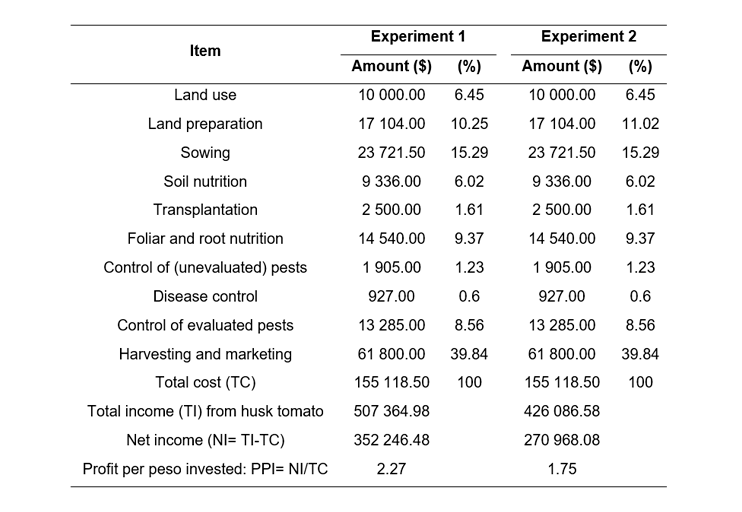
Husk tomato (Physalis ixocarpa Brot.) is an important crop in Mexico whose profitability is affected by pests; therefore, it is necessary to evaluate management alternatives that improve yield and reduce losses. The research was conducted in 2023 to evaluate the efficacy of chemical and natural plant protection products, applied individually and in combination with a plant extract (Aza-Direct® 1.2 CE), on fruit yield and profitability. Sixteen treatments were evaluated under a completely randomized block design with three replications (48 experimental units per trial). Each unit consisted of three 4 m-long furrows, 0.95 m apart, with plants spaced 0.4 m apart. The insecticides were applied 16 days after transplantation on three occasions, with seven-day intervals. Yield evaluation was performed up to 105 days after transplantation. An Anova and a Tukey test (α≤ 0.05) were performed using the SAS statistical software. The experiment was replicated twice. In experiment 1, the Minecto Duo®, Benevia® and Toretto® treatments, in combination with azadirachtin, showed yield increases of 48.8%, 46.7% and 32.7%, respectively, compared to the control without application. In experiment 2, Minecto Duo® with azadirachtin showed the highest increase, reaching 96.2% compared to the control. In the absence of the plant extract, the largest increases were recorded with Benevia® (88.5%) in experiment 2 and with Minecto Duo® (27.2%) in experiment 1. All treatments were economically viable, with return-on-investment ratios greater than $1.50.
Downloads
References
Camacho-Luna, J. J. 2005. Evaluación económica de la producción de calabacita (Cucurbita pepo L.) tipo Zucchini en invernadero. Universidad Autónoma Chapingo (UACH). Chapingo, México.
Castro-Brindis, R.; Sánchez-García, P.; Peña-Lomelí, A.; Alcantar-González, G.; Baca-Castillo, G. y López-Romero, R. M. 2000. Niveles críticos de suficiencia y toxicidad, de N-NO3 en el extracto celular de pecíolos de tomate de cáscara. Terra Latinoamericana. 18(2):141-145.
Cervantes-Godoy, D. and Dewbre, J. 2010. Economic importance of agriculture for poverty reduction. Food, Agriculture and Fisheries Papers Num. 23. OECD Publishing. DOI: 10.1787/5kmmv9s20944-en. DOI: https://doi.org/10.1787/5kmmv9s20944-en
Cruz-Delgado, D.; Leos-Rodríguez, J. A.; Altamirano-Cárdenas, J. R. 2013. México: factores explicativos de la producción de frutas y hortalizas ante la apertura comercial. Revista Chapingo. Serie Horticultura. 19(3):267-278. DOI: https://doi.org/10.5154/r.rchsh.2012.05.029
Díaz-Nájera, J. F.; Ayvar-Serna S.; Arispe-Vázquez J. L. y Vargas-Hernández, M. 2025. Insecticidas biorracionales para el manejo del gusano del fruto en tomate de cáscara. Ciencia e Innovación Agroalimentaria. 7(1):28-38.
Durán, R. J. A. 2006. Apuntes de economía agrícola. Centro de Estudios Profesionales. Colegio Superior Agropecuario del Estado de Guerrero. Cocula, Guerrero, México. Manual técnico. 120 p.
Espinosa-Castañeda, M. A.; López-Baca, J. D. y Ramírez-González, J. R. 2018. Rentabilidad del cultivo de tomate (Physalis ixocarpa) bajo manejo convencional y orgánico. Agrociencia. 52(4):351-362.
Krugman, P. y Wells, R. 2006. Introducción a la economía, microeconomía. Editorial Reverte. Barcelona, España. 537 p.
Martínez-Carrillo, J. L.; Salazar-Sosa, E.; Guzmán-López, A. y Mendoza-Pedroza, S. I. 2009. Producción de tomate de cáscara (Physalis ixocarpa Brot.) basado en el conocimiento de la lámina de riego óptima. Terra Latinoamericana. 27(1):1-8.
Muñante, D. D. 2002. Manual de formulación y evaluación de proyectos. Universidad Autónoma Chapingo (UACH). 27 p.
Nájera, N. E. y Campos, C. C. 2021. Plan de desarrollo municipal de Huitzuco, Guerrero. H. Ayuntamiento municipal. congresogro.gob.mx.
Orona-Castillo, I.; Del-Toro-Sánchez, C. L.; Fortis-Hernández, M.; Preciado-Rangel, P.; Espinoza-Arellano, J. J.; Rueda-Puente, E.; Flores-Vázquez, M. y Cano-Ríos, P. 2022. Indicadores técnico-económicos de la producción del cultivo de tomate bajo agricultura protegida en la Comarca Lagunera, México. Biotecnia. 24(3):70-76. DOI: https://doi.org/10.18633/biotecnia.v24i3.1721
Peña-Lomelí, A.; Ponce-Valerio, J.; Sánchez-del Castillo, F. y Magaña-Lira, N. 2014. Desempeño agronómico de variedades de tomate de cáscara en invernadero y campo abierto. Revista Fitotecnia Mexicana. 37(4):381-391. DOI: https://doi.org/10.35196/rfm.2014.4.381
Perdomo-Moreno, A. 2001. Métodos y modelos básicos de planeación financiera. International Thomson Editores, SA de C V. ISBN: 9706862625. 316 p.
Rahman, Md. M.; Barua, S.; Zhou, D.; Li, T. and Farid, Md. S. 2022. Analyzing the value chain for vegetables in the North-Eastern part of Bangladesh. Cogent Business and Amp. Management. 9(1):2135222. DOI: 10.1080/23311975.2022.2135222. DOI: https://doi.org/10.1080/23311975.2022.2135222
Rendón-Medel, R.; Rosegrant, M. W. y Gómez-Merino, F. C. 2012. Gestión eficiente de costos de producción en sistemas agrícolas mexicanos. Economía Agrícola y Recursos Naturales. 12(2):57-73.
Rivadeneyra-Manzanilla, R. D.; Hernández-Gómez, A. y Salinas-Ramos, F. 2024. Panorama de la producción orgánica en México: avances y limitaciones. Revista Latinoamericana de Producción Agroecológica. 15(1):35-45.
Rucoba-García, A.; Anchondo-Nájera, Á.; Luján-Álvarez, C. y Olivas-García, J. M. 2006. Análisis de rentabilidad de un sistema de producción de tomate bajo invernadero en la región centro-sur de Chihuahua. Revista Mexicana de Agronegocios. 10(19):1405-9282. https://hdl.handle.net/20.500.14330/CLA01000258988.
Samuelson, P. A. y Nordhaus, W. D. 2009. Economía. Editorial McGrawHill Interamericana. Madrid, España. ISBN:9788448151546. 788 p.
SAS Institute Inc. 2016. SAS® 9.4 User’s guide: Statistics. Release 9.4. Cary, NC., USA.
SIAP. 2018. Servicio de Información Agroalimentaria y Pesquera. Tomate verde: ingrediente esencial de la comida mexicana. Gobierno de México. https://www.gob.mx/siap/articulos/tomate-verde-ingrediente-esencial-de-la-comida-mexicana?idiom=es.
SIAP. 2024. Anuario estadístico de la producción agrícola. https://nube.siap.gob.mx/cierreagricola/.
Terrones-Cordero, A. y Sánchez-Torres, Y. 2011. Análisis de la rentabilidad económica de la producción de jitomate bajo invernadero en Acaxochitlán, Hidalgo. Revista Mexicana de Agronegocios. 15(29):752-761.
Tiwari, S. 2020. Effectiveness of integrated pest management with neem extract and cyantraniliprole on tomato plants. Journal of Agricultural Sciences. 58(1):45-56. https://doi.org/10.1007/s11703-020-0487-1.
Zoilo, O. J.; Bernardi, M. J.; Colonese, M. C. y Castro, J. E. 2018. Tecnologías de producción y costos disponibles para la agricultura familiar: margen bruto e índices de rentabilidad. 1ra. Edición. Publicación EEA Bella Vista. Serie técnica núm. 66. https://inta.gob.ar/sites/default/files/inta-s.t.-66-tecnologias-de-produccion-y- costos-disponibles-para-la-agricultura-familiar.pdf fecha=07/10/2021.
Downloads
Published
Issue
Section
License
Copyright (c) 2026 Revista Mexicana de Ciencias Agrícolas

This work is licensed under a Creative Commons Attribution-NonCommercial 4.0 International License.
The authors who publish in Revista Mexicana de Ciencias Agrícolas accept the following conditions:
In accordance with copyright laws, Revista Mexicana de Ciencias Agrícolas recognizes and respects the authors’ moral right and ownership of property rights which will be transferred to the journal for dissemination in open access. Invariably, all the authors have to sign a letter of transfer of property rights and of originality of the article to Instituto Nacional de Investigaciones Forestales, Agrícolas y Pecuarias (INIFAP) [National Institute of Forestry, Agricultural and Livestock Research]. The author(s) must pay a fee for the reception of articles before proceeding to editorial review.
All the texts published by Revista Mexicana de Ciencias Agrícolas —with no exception— are distributed under a Creative Commons License Attribution-NonCommercial 4.0 International (CC BY-NC 4.0), which allows third parties to use the publication as long as the work’s authorship and its first publication in this journal are mentioned.
The author(s) can enter into independent and additional contractual agreements for the nonexclusive distribution of the version of the article published in Revista Mexicana de Ciencias Agrícolas (for example include it into an institutional repository or publish it in a book) as long as it is clearly and explicitly indicated that the work was published for the first time in Revista Mexicana de Ciencias Agrícolas.
For all the above, the authors shall send the Letter-transfer of Property Rights for the first publication duly filled in and signed by the author(s). This form must be sent as a PDF file to: revista_atm@yahoo.com.mx; cienciasagricola@inifap.gob.mx; remexca2017@gmail.
This work is licensed under a Creative Commons Attribution-Noncommercial 4.0 International license.