Productive diversity and fruit quality of peach and nectarine cultivars
DOI:
https://doi.org/10.29312/remexca.v17i5.4103Keywords:
Prunus persica, genetic improvement, yieldAbstract
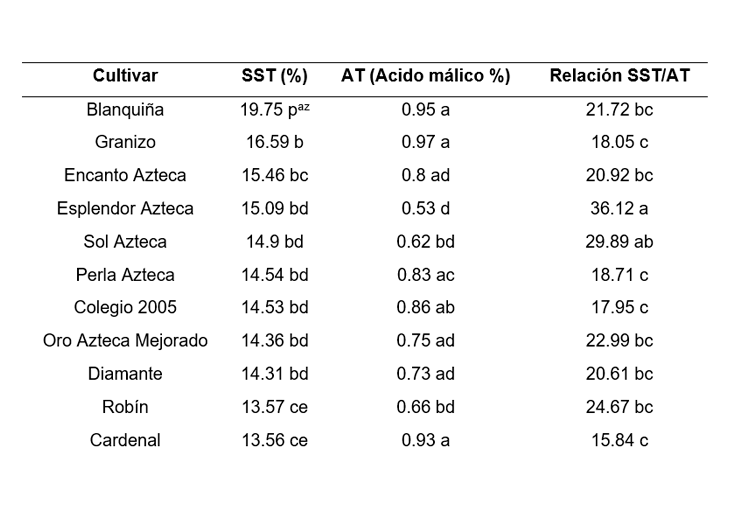
From 2022 to 2023, 15 cultivars with low cold requirements were evaluated in Coatepec Harinas, State of Mexico, in order to select the most outstanding materials for their productive potential and fruit quality. Four-year-old trees were evaluated under forced production management, and growth, productivity and fruit quality were determined. Productive behavior in yield ranged from 3 to 23 kg tree-1, the period from flowering to fruit maturity lasted between 105 and 134 days, and fruit production efficiency ranged from 0.18 to 0.91 kg cm-2. The total soluble solids, content ranged from 11.6 to 19.7 °Brix, titratable acidity, from 0.5 to 0.97% malic acid and the TSS/TA ratio from 15.8 to 36.12. Fruit size ranged from 68 to 168 g, shaped from 64 to 255 and firmness from 1.2 to 4.4 kgF mm-1. ‘Oro de San Juan’ and ‘Cardenal’ presented the highest yields; in terms of fruit quality, most cultivars showed excellent attributes in size, shape, firmness and sweeter, more aromatic fruity flavor in white-fleshed fruits. ‘Cardenal’ presented the earliest fruit ripening, 28 days before ‘Diamante’. The introduction and production of the peach cultivars Oro de San Juan, Cardenal, and Robín are real alternatives to increase per-hectare yields and the crop’s profitability, as well as to improve per capita consumption with better fruit characteristics in the market.
Downloads
References
Anthony, B. M. and Minas, I. S. 2021. Optimizing peach tree canopy architecture for efficient light use, increased productivity, and improved fruit quality. Agronomy. 11(10):120.
AOAC. 1990. Official methods of analysis. International Association of Official Agricultural Chemist 16th. Maryland, USA. Vol. 2. 1114 p.
Bussi, C.; Genard, M. M. 2016. Thinning and pruning to overcome alternate bearing in peach trees. Eur. J. Hort. Sci. 79(6):313-317.
Famiani, F.; Battistelli, A.; Moscatello, S.; Cruz-Castillo, J. G. and Walker, R. P. 2015. The organic acids that are accumulated in the flesh of fruits: occurrence, metabolism and factors affecting their contents -a review. Revista Chapingo, Serie Horticultura. 21(2):97-128.
Fanwoua, B. J.; Bairam, E.; Delaire, M. and Buck-Sorlin, G. 2014. The role of branch architecture in the production and partitioning of assimilates: the example of the apple tree (Malus domestica). Frontiers of Plant Science. 5(338):1-6.
FAO. 2025. FAOSTAT Agriculture. Agricultural data-production: crops. http://faostat.fao.org.
García, A. A.; Espíndola, B. Ma. de la C. y Calderón, Z. G. 2018. Guía técnica para la producción de durazno. Toluca, Estado de México. 103 p.
Kader, A. A. and Mitchell, G. F. 1989. Maturity and quality. In: peaches, plum and nectarines. growing and handling for fresh market. LaRue, J. H. and Johnson, R. S. (Eds.). University of California-Davis. Davis, CA, USA. 191-196 pp.
Li, X.; Gao, P.; Zhang, Ch.; Xiao, X.; Chen, C. and Song, F. 2023. Aroma of peach fruit: a review on aroma volatile compounds and underlying regulatory mechanisms. International Journal of Food Science and Technology. 58(10):4965-4979.
Ortiz, C., A.; Lara, I.; Graell, J.; López, M. L. and Echeverría, G. 2008. Sensory acceptance of peaches stored in AC. Relationship with instrumental quality parameters. Acta Hortic. 796(30):225-230.
Osborne, J. L.; Robinson, T. L. and Parra, Q. R. 2005. Chemical blossom thinning agents reduce crop load of ‘Rising Star’ peach in New York. Acta Hort. 727(51):423-428.
Qian, J.; Zhao, Y.; Shi, Y. and Chen, K. 2022. Transcriptome analysis of peach fruit treated with 1-MCP: information on the peach softening regulatory network. Food Quality and Safety. 17(6):1-11.
Raseira, M. C. B. y Franzón, R. C. 2021. Situación general de la cría de melocotón. Agrociencia Uruguay. NE1(25):1-10.
Rawandoozi, Z. J.; Hartmann, T. P.; Byrne, D. H. and Carpenedo, S. 2020. Heritability, correlation and genotype-environment interaction of phenological and fruit quality traits in peaches. Journal of the American Society for Horticultural Science. 146(1):56-67.
SAGARPA-SIAP. 2025. Producción agrícola por cultivo. Durazno. http//www.siap.gob.mx.
Sanches, A. G; Silva, M. D; Moreira, E. G. and Cordeiro, C. A. 2017. Starch sources and storage temperature in maintaining the post-harvest quality of red-fleshed pitaya. Colloq. Agrar. 2(13):41-54.
Veerappan, K.; Natarajan S.; Chung H. and Park, J. 2021. Molecular insights of fruit quality trainst in peaches, Prunus persica. Plants (Basel). 10(10):1-14.
Downloads
Published
Issue
Section
License
Copyright (c) 2026 Revista Mexicana de Ciencias Agrícolas

This work is licensed under a Creative Commons Attribution-NonCommercial 4.0 International License.
The authors who publish in Revista Mexicana de Ciencias Agrícolas accept the following conditions:
In accordance with copyright laws, Revista Mexicana de Ciencias Agrícolas recognizes and respects the authors’ moral right and ownership of property rights which will be transferred to the journal for dissemination in open access. Invariably, all the authors have to sign a letter of transfer of property rights and of originality of the article to Instituto Nacional de Investigaciones Forestales, Agrícolas y Pecuarias (INIFAP) [National Institute of Forestry, Agricultural and Livestock Research]. The author(s) must pay a fee for the reception of articles before proceeding to editorial review.
All the texts published by Revista Mexicana de Ciencias Agrícolas —with no exception— are distributed under a Creative Commons License Attribution-NonCommercial 4.0 International (CC BY-NC 4.0), which allows third parties to use the publication as long as the work’s authorship and its first publication in this journal are mentioned.
The author(s) can enter into independent and additional contractual agreements for the nonexclusive distribution of the version of the article published in Revista Mexicana de Ciencias Agrícolas (for example include it into an institutional repository or publish it in a book) as long as it is clearly and explicitly indicated that the work was published for the first time in Revista Mexicana de Ciencias Agrícolas.
For all the above, the authors shall send the Letter-transfer of Property Rights for the first publication duly filled in and signed by the author(s). This form must be sent as a PDF file to: revista_atm@yahoo.com.mx; cienciasagricola@inifap.gob.mx; remexca2017@gmail.
This work is licensed under a Creative Commons Attribution-Noncommercial 4.0 International license.