Protective effect of Pycnoporus sanguineus against phytopathogenic fungi in tomato and strawberry plants
DOI:
https://doi.org/10.29312/remexca.v17i2.4014Keywords:
Pycnoporus sanguineus, biological control, phytopathogens, secondary metabolites, synthetic fungicidesAbstract
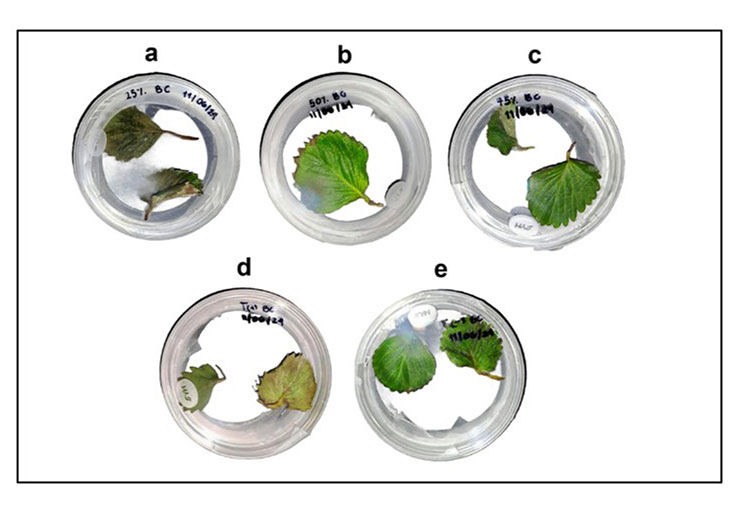
The search for sustainable alternatives to synthetic fungicides has increased interest in bioactive compounds from basidiomycetes, particularly Pycnoporus sanguineus. The present study evaluated the protective effect of aqueous extracts of P. sanguineus against two phytopathogens of agricultural importance: Botrytis cinerea in strawberries (Fragaria ananassa) and Fusarium oxysporum in tomatoes (Solanum lycopersicum). The tests were conducted under controlled conditions, applying different concentrations of extract (25-100 g L-1). In strawberries, using an infection scale that was established in vitro, the severity caused by B. cinerea declined significantly in the treatments with the highest concentrations (50 and 75 g L-1), which decreased leaf damage by 58 and 74%, respectively. In tomatoes, the treatments with the highest concentrations (50 and 100 g L-1) promoted an aboveground biomass similar to that of non-infected plants (p= 0.05), which shows a positive effect against F. oxysporum. Nonetheless, no significant differences were observed in root biomass, indicating limited systemic activity or low mobility of the compounds. Although these findings are promising, it is necessary to optimize the formulations and validate their efficacy in field conditions.
Downloads
References
Agrios, G. N. 2005. Plant pathology. Elsevier. 5a Ed. San Diego, California, EUA. 952 p.
Arfi, Y.; Levasseur, A. and Record, E. 2013. Differential gene expression in Pycnoporus coccineus during interspecific mycelial interactions with different competitors. Applied and Environmental Microbiology. 79(21):6626-6636.
Assi, L.; Meinerz, C. C.; Stangarlin, J. R.; Kuhn, O. J.; Viecelli, C. A. and Schwan-Estrada, K. R. F. 2017. Control of Alternaria solani and Xanthomonas vesicatoria in tomato by Pycnoporus sanguineus formulated extract. Scientia Agraria Paranaensis. 16(3):314-320.
Borderes, J.; Costa, A.; Guedes, A. and Tavares, L. B. B. 2011. Antioxidant activity of the extracts from Pycnoporus sanguineus mycelium. Brazilian Archives of Biology and Technology. 54(4):1167-1174.
Brent, K. J. and Hollomon, D. W. 1995. Fungicide resistance in crop pathogens: how can it be managed? FRAC. Monograph núm. 1. 48 p.
Brito, O. D. C.; Schons, B. C.; Junior, R. C.; Dalevedove, D. B.; Fujimoto, J. Y. H. and Stangarlin, J. R. 2025. Proteins of Pycnoporus sanguineus have nematicide activity and induce resistance to Meloidogyne spp. in micro-tom tomato plants. Tropical Plant Pathology. 50(1):43-53.
Cruz-Muñoz, R. 2021. Aplicación del hongo Pycnoporus sanguineus en postcosecha. Universidad Autónoma Chapingo (UACH). Chapingo, Estado de México. 150 p.
Cycoń, M.; Mrozik, A. and Piotrowska-Seget, Z. 2017. Bioaugmentation as a strategy for the remediation of pesticide-polluted soil: a review. Chemosphere. 172:52-71.
Elisashvili, V.; Kachlishvili, E.; Tsiklauri, N.; Metreveli, E.; Khardziani, T. and Agathos, S. N. 2009. Lignocellulose-degrading enzyme production by white-rot Basidiomycetes isolated from the forests of Georgia. World Journal of Microbiology and Biotechnology. 25(2):331-339.
Gayosso-Barragán, O.; López-Benítez, A.; Marroquín-Morales, J. Á.; López-Aguilar, K.; Hidalgo-Ramos, D. M. y Chávez-Aguilar, G. 2021. Evaluación de la respuesta de diferentes genotipos de tomate a Fusarium oxysporum raza 3. Revista Mexicana de Ciencias Agrícolas. 12(3):409-420.
Hassan, E. A.; Mostafa, Y. S.; Alamri, S.; Hashem, M. and Nafady, N. A. 2021. Biosafe management of Botrytis grey mold of strawberry fruit by novel bioagents. Plants. 10(12):2737. https://doi.org/10.3390/plants10122737.
Heikal, Y. M.; Albahi, A. M.; Alyamani, A. A.; Abdelmigid, H. M.; Haroun, S. A. and Soliman, H. M. 2025. Integrated management of tomato fusarium wilt: ultrastructure insights into zn nanoparticles and phytohormone applications. Cells. 14(14):1055. https://doi.org/10.3390/cells14141055.
Kursa, W.; Jamiołkowska, A.; Wyrostek, J. and Kowalski, R. 2022. Antifungal effect of plant extracts on the growth of the cereal pathogen Fusarium spp. an in vitro study. Agronomy. 12(12):3204. https://doi.org/10.3390/agronomy12123204.
Lim, C. L.; Yang, C. H.; Pan, X. Y.; Tsai, H. Y.; Chen, C. Y. and Chen, W. L. 2024. Different wavelengths of LED irradiation promote secondary metabolite production in Pycnoporus sanguineus for antioxidant and immunomodulatory applications. Photochemical & Photobiological Sciences. 23(5):987-996.
Lin, W.; Jia, G.; Sun, H.; Sun, T. and Hou, D. 2020. Genome sequence of the fungus Pycnoporus sanguineus, which produces cinnabarinic acid and pH- and thermo-stable laccases. Gene. 742:144586. https://doi.org/10.1016/j.gene.2020.144586.
Patel, H.; Gupte, A. and Gupte, S. 2009. Effect of different culture conditions and inducers on production of laccase by a basidiomycete fungal isolate Pleurotus ostreatus HP-1 under solid state fermentation. BioResources. 4(1):268-284.
Pérez-López, R. I.; Romero-Arenas, O.; Parraguirre-Lezama, C.; Romero-López, A.; Rivera, A. and Cedillo-Ramírez, L. 2024. Comparison of three biological control models of Pycnoporus sanguineus on phytopathogenic fungi. Applied Sciences. 14(18):8263. https://doi.org/10.3390/app14188263.
Pinar, O. and Rodríguez-Couto, S. 2024. Biologically active secondary metabolites from white-rot fungi. Frontiers in Chemistry. 12:1363354. https://doi.org/10.3389/fchem.2024.1363354.
Pineda-Insuasti, J. A.; Gómez-Andrade, W. E.; Duarte-Trujillo, A. S.; Soto-Arroyave, C. P.; Pineda-Soto, C. A.; Fierro-Ramos, F. J. y Álvarez-Ramos, S. E. 2017. Producción de Pycnoporus spp. y sus metabolitos secundarios: Una revisión. ICIDCA. sobre los derivados de la caña de azúcar. 51(2):60-69.
Romero-Arenas, O.; Jara-Rivera, A. P.; Valencia-de-Ita, M. A.; Parraguirre-Lezama, C.; Villa-Ruano, N. and Rivera, A. 2021. In vitro antimicrobial activity of Cinnabarin on Xanthomonas campestris isolated from bean crops of Puebla, Mexico. Applied Sciences. 11(12):5391. https://doi.org/10.3390/app11125391.
Rongai, D.; Pulcini, P.; Pesce, B. and Milano, F. 2015. Antifungal activity of some botanical extracts on Fusarium oxysporum. Open Life Sciences. 10(1):220-225.
Rosa, L. H.; Machado, K. M. G.; Jacob, C. C.; Capelari, M.; Rosa, C. A. and Zani, C. L. 2003. Screening of Brazilian basidiomycetes for antimicrobial activity. Memórias do Instituto Oswaldo Cruz. 98(7):967-974.
Saat, M. N.; Annuar, M. S. M.; Alias, Z.; Chuan, L. T. and Chisti, Y. 2014. Modeling of growth and laccase production by Pycnoporus sanguineus. Bioprocess and Biosystems Engineering. 37(5):765-775.
Sivanandhan, S.; Khusro, A.; Paulraj, M. G.; Ignacimuthu, S. and Al-Dhabi, N. A. 2017. Biocontrol properties of basidiomycetes: an overview. Journal of Fungi. 3(1):2. https://doi.org/10.3390/jof3010002.
Smânia, A.; Delle-Monache, F.; Smânia, E. F. A.; Gil, M. L.; Benchetrit, L. C. and Cruz, F. S. 1995. Antibacterial activity of a substance produced by the fungus Pycnoporus sanguineus (Fr.) Murr. Journal of Ethnopharmacology. 45(3):177-181.
Smânia, A.; Marques, C. J. S.; Smânia, E. F. A.; Zanetti, C. R.; Carobrez, S. G.; Tramonte, R. and Loguercio-Leite, C. 2003. Toxicity and antiviral activity of Cinnabarin obtained from Pycnoporus sanguineus (Fr.) Murr. Phytotherapy Research. 17(9):1069-1072.
Téllez-Téllez, M.; Villegas, E.; Rodríguez, A.; Acosta-Urdapilleta, M. L.; O’Donovan, A. and Díaz-Godínez, G. 2016. Mycosphere essay 11: fungi of Pycnoporus: morphological and molecular identification, worldwide distribution and biotechnological potential. Mycosphere. 7(10):1500-1525.
Teoh, Y. P.; Don, M. M. and Ujang, S. 2011. Media selection for mycelia growth, antifungal activity against wood-degrading fungi and GC-MS study by Pycnoporus sanguineus. BioResources. 6(3):3001-3015.
Waszczuk, U. and Zapora, E. 2021. Arboreal fungi in biological control against soil fungi. Environmental Sciences Proceedings. 9(1):31.
Downloads
Published
Issue
Section
License
Copyright (c) 2026 Revista Mexicana de Ciencias Agrícolas

This work is licensed under a Creative Commons Attribution-NonCommercial 4.0 International License.
The authors who publish in Revista Mexicana de Ciencias Agrícolas accept the following conditions:
In accordance with copyright laws, Revista Mexicana de Ciencias Agrícolas recognizes and respects the authors’ moral right and ownership of property rights which will be transferred to the journal for dissemination in open access. Invariably, all the authors have to sign a letter of transfer of property rights and of originality of the article to Instituto Nacional de Investigaciones Forestales, Agrícolas y Pecuarias (INIFAP) [National Institute of Forestry, Agricultural and Livestock Research]. The author(s) must pay a fee for the reception of articles before proceeding to editorial review.
All the texts published by Revista Mexicana de Ciencias Agrícolas —with no exception— are distributed under a Creative Commons License Attribution-NonCommercial 4.0 International (CC BY-NC 4.0), which allows third parties to use the publication as long as the work’s authorship and its first publication in this journal are mentioned.
The author(s) can enter into independent and additional contractual agreements for the nonexclusive distribution of the version of the article published in Revista Mexicana de Ciencias Agrícolas (for example include it into an institutional repository or publish it in a book) as long as it is clearly and explicitly indicated that the work was published for the first time in Revista Mexicana de Ciencias Agrícolas.
For all the above, the authors shall send the Letter-transfer of Property Rights for the first publication duly filled in and signed by the author(s). This form must be sent as a PDF file to: revista_atm@yahoo.com.mx; cienciasagricola@inifap.gob.mx; remexca2017@gmail.
This work is licensed under a Creative Commons Attribution-Noncommercial 4.0 International license.