Corn yield, interdependence and genotype-environment interaction in southeastern Mexico
DOI:
https://doi.org/10.29312/remexca.v16i8.3778Keywords:
localities, path analysis, stability, yieldAbstract
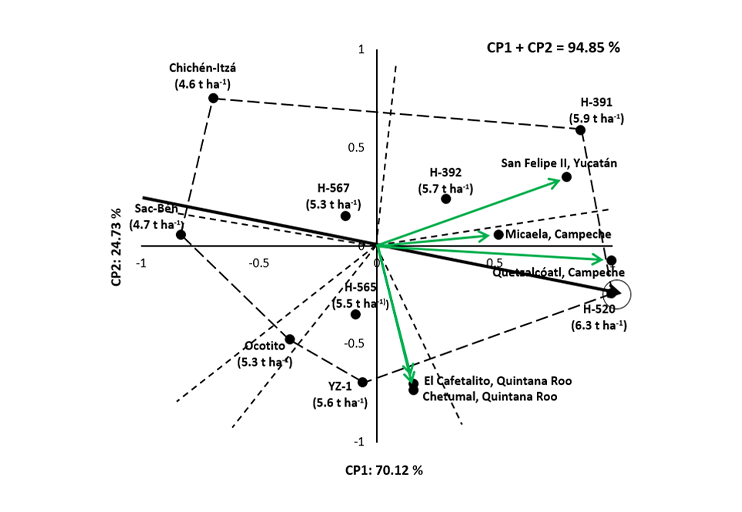
The Yucatán Peninsula presents high temperatures and soils where corn (Zea mays L.) crops have a yield of 2.4 to 3.2 t ha-1 under rainfed conditions. One strategy to correct the reduced productivity of corn in the YP is to generate, evaluate, and disseminate the use of hybrids and varieties that adapt to various production environments, identify those that present a superior and predictable grain yield, as well as the possible interdependence of yield with agronomic variables. The experiments were established under rainfed conditions in five locations of the YP to evaluate nine commercial corn genotypes -six hybrids and three varieties- in random complete blocks with three replications. Grain yield, plant and ear height, diameter, length and number of grains per ear were quantified. To identify the most outstanding genotypes and their interaction with the environment (stability and adaptability), the following was performed: combined analysis of variance across localities, test of means, principal component analysis, environment-genotype interaction analysis and path analysis. The H-520 hybrid presented the highest yield in both the favorable (Quetzalcóatl) and unfavorable (Micaela) environments, both in Campeche, and was the most stable; H-391 was the best choice for grain yield in San Felipe II, Yucatán, and YZ-1 in Cafetalito and Chetumal, Quintana Roo. Plant height had a direct effect, and ear length had an indirect effect; both were the variables that had the biggest impact on yield. Thus, the lower the plant height, the higher the yield and the longer the ear.
Downloads
References
CNA. 2024. Comisión Nacional del Agua. Observaciones diarias de temperatura, lluvia y evaporación. Organismo de cuenca Península de Yucatán https://www.gob.mx/conagua/es/#960.
FIRA. 2024. Fideicomisos Instituidos en Relación con la Agricultura. Panorama agroalimentario maíz. México. 28 p.
García, E. 2004. Modificaciones al sistema de clasificación climática de Köppen. Instituto de Geografía-Universidad Nacional Autónoma de México (UNAM). 97 p.
Gómez-Montiel, N. O.; Hernández-Galeno, C. Á.; Anzures-Olvera, F.; Toledo-Aguilar, R.; Ramírez-Díaz, J. L.; Espinosa-Calderón, A.; Tadeo-Robledo, M.; Santos-Echeverría, R. y Antúnez-Ocampo, O. M. 2023. Variedad mejorada de maíz de grano amarillo para pequeños ganaderos del trópico seco. Agro-Divulgación. 3(3):45-47. https://doi.org/10.54767/ad.v3i3.186.
Lozano-Ramírez, Á.; Santacruz-Varela, A.; Vicente-García, F.; Crossa, J.; Burgueño, J. y Molina-Galán, J. D. 2015. Modelación de la interacción genotipo x ambiente en rendimiento de híbridos de maíz blanco en ambientes múltiples. Revista Fitotecnia Mexicana. 38(4):337-347.
Medina-Méndez, J.; Soto-Rocha, J. M.; Villalobos-González, A.; Volke-Haller, V. H. and Gómez-Tejero J. 2019. Productivity of white and yellow grain corns in Campeche, México. Agricultural Sciences. 10(9):1255-1269. https://doi.org/10.4236/as.2019.109093.
Pacheco-Gil, R. A.; Vargas, M.; Alvarado, G.; Rodríguez, F.; López, M.; Crossa, J. and Burgueño, J. 2015. GEA-R (genotype × environment analysis with R for Windows) version 4.1. https://data.cimmyt.org/dataset.xhtml?persistentId=hdl:11529/10203. CIMMYT Research Data & Software Repository Network.
Pranay, G.; Shashibhushan, D.; Rani, K. J.; Bhadru, D. and Kumar, C. V. S. 2022. Correlation and path analysis in elite maize (Zea mays L.) lines. International Journal of Plant & Soil Science. 34(24):414-422. Doi: 10.9734/IJPSS/2022/v34i242657.
Ramírez-Díaz, J. L.; Alemán-Torre, I.; Ledesma-Miramontes, A.; Vidal-Martínez, V. A.; Salinas-Moreno, Y.; Briones-Reyes, D.; Gómez-Montiel, N. O.; Peña Ramos, A. y Reyes-Méndez, C. A. 2023. H-391: Híbrido trilineal de maíz de grano blanco para regiones del subtrópico de México. Revista Fitotecnia Mexicana. 46(3):327-329.
Ramírez-Díaz, J. L.; Peña-Ramos, A.; Ledesma-Miramontes, A.; Alemán-Torre, I.; Vidal-Martínez, V. A.; Briones-Reyes, D.; Salinas-Moreno, Y.; Gómez-Montiel, N. O.; Reyes-Méndez, C. A. y Bautista-Ramírez, E. 2022. H-392: Híbrido de maíz de grano blanco para regiones agrícolas del subtrópico y transición de México. Revista Fitotecnia Mexicana. 45(4):523-525.
Sánchez-Hernández, M. A.; Jiménez-Maya, J. B.; Morales-Terán, G.; Acevedo-Gómez, R.; Antonio-Estrada, C. y Villanueva-Verduzco, C. 2019. Rendimiento de grano en maíces adaptados a condiciones de la baja cuenca del Papaloapan. Tropical and Subtropical Agroecosystems. 22(2):519-529.
SAS. 2011. Institute, Statistical Analysis System. User’s guide. Software Release V 9.3. SAS Institute Inc. Cary, N. C. USA.
SIAP. 2024. Servicio de Información Agroalimentaria y Pesquera. Anuario estadístico de la producción agrícola. Secretaría de Agricultura y Desarrollo Rural (SADER). Ciudad de México, México. https://nube.siap. gob.mx/cierreagricola/.
Sierra-Macías, M.; Rodríguez-Montalvo, F. A.; Palafox-Caballero, A.; Espinosa-Calderón, A.; Andrés-Meza, P.; Gómez-Montiel, N. O. y Valdivia-Bernal, R. 2016. Productividad de semilla y adopción del híbrido de maíz H-520, en el trópico de México. Agricultura, Sociedad y Desarrollo. 13(1):19-32.
Tadeo, R. M.; Espinosa, C. A.; Canales, I. E. I.; Monter, S. A.; Turrent, F. A.; Arteaga, E. I.; López, L. C.; Virgen, V. J.; Gómez, M. N.; Sierra, M. M.; Zaragoza, E. J.; Macedo, G. J. J.; Valdivia, B. R.; Zamudio, G. B.; Andrés, M. P. y Aguilar, V. K. E. 2023. Mistli UNAM: Híbrido varietal de maíz precoz de grano amarillo para Valles Altos de México. Revista Fitotecnia Mexicana. 46(3):331-333.
Taiwo O. P.; Nwonuala, A. I.; Isaiah, B. F.; Olawamide, D. O. and Agbugba, I. K. 2020. Correlation and path coefficient analysis studies on grain yield and its contributing characters in maize (Zea mays L.). International Journal of Plant & Soil Science. 32(7):7-13. Doi: 10.9734/IJPSS/2020/v32i730300.
Uzcanga, P. N. G.; Cano, A. J. G.; Ramírez, J. H. S. y Tun, C. D. 2015. Características socioeconómicas y rentabilidad de los sistemas de producción de maíz bajo condiciones de temporal de la Península de Yucatán, México. Revista Mexicana de Agronegocios. 37:173-183.
Uzcanga, P. N. G.; Larqué, S. A. L.; Ángel, P. M. A.; Rangel, F. A. y Cano, J. G. 2017. Preferencias de los agricultores por semillas mejoradas y nativas de maíz en la Península de Yucatán, México. Revista Mexicana de Ciencias Agrícolas. 8(5):1021-1033.
Vatca, S. D.; Stoian, V. A.; Man, T. C.; Horvath, C.; Vidican, R.; Gadea, S.; Vatca, A.; Rotaru, A.; Varban, R.; Cristina, M. and Stoian, V. 2021. Agrometeorological requirements of maize crop phenology for sustainable cropping A historical review for Romania. Sustainability. 13(14):7719. https://doi.org/10.3390/su13147719. 14 p.
Yan, W. and Kang, M. S. 2003. GGE biplot analysis: a graphical tool for breeders, geneticists and agronomists. CRC press: Boca Raton, Fl. 271 p.
Published
How to Cite
Issue
Section
License
Copyright (c) 2025 Revista Mexicana de Ciencias Agrícolas

This work is licensed under a Creative Commons Attribution-NonCommercial 4.0 International License.
The authors who publish in Revista Mexicana de Ciencias Agrícolas accept the following conditions:
In accordance with copyright laws, Revista Mexicana de Ciencias Agrícolas recognizes and respects the authors’ moral right and ownership of property rights which will be transferred to the journal for dissemination in open access. Invariably, all the authors have to sign a letter of transfer of property rights and of originality of the article to Instituto Nacional de Investigaciones Forestales, Agrícolas y Pecuarias (INIFAP) [National Institute of Forestry, Agricultural and Livestock Research]. The author(s) must pay a fee for the reception of articles before proceeding to editorial review.
All the texts published by Revista Mexicana de Ciencias Agrícolas —with no exception— are distributed under a Creative Commons License Attribution-NonCommercial 4.0 International (CC BY-NC 4.0), which allows third parties to use the publication as long as the work’s authorship and its first publication in this journal are mentioned.
The author(s) can enter into independent and additional contractual agreements for the nonexclusive distribution of the version of the article published in Revista Mexicana de Ciencias Agrícolas (for example include it into an institutional repository or publish it in a book) as long as it is clearly and explicitly indicated that the work was published for the first time in Revista Mexicana de Ciencias Agrícolas.
For all the above, the authors shall send the Letter-transfer of Property Rights for the first publication duly filled in and signed by the author(s). This form must be sent as a PDF file to: revista_atm@yahoo.com.mx; cienciasagricola@inifap.gob.mx; remexca2017@gmail.
This work is licensed under a Creative Commons Attribution-Noncommercial 4.0 International license.