Microbial contamination during stages of in vitro propagation of Agave angustifolia Haw.
DOI:
https://doi.org/10.29312/remexca.v17i2.4251Keywords:
antibiotics, microbial contamination, microorganisms, organogenesisAbstract
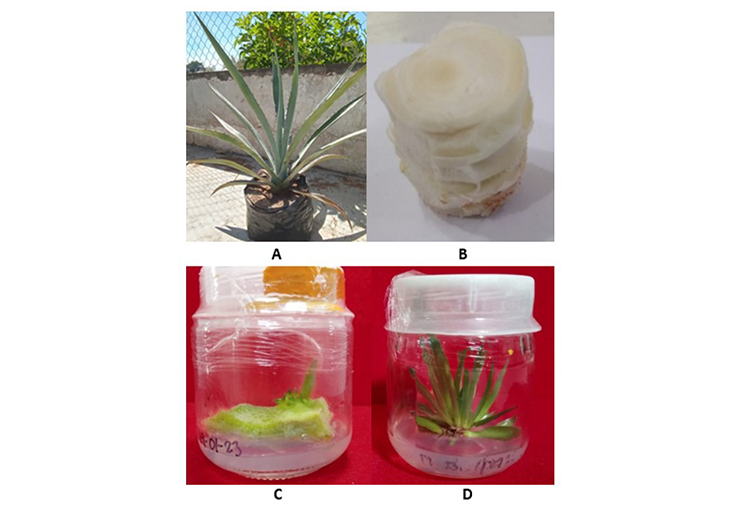
When Agave angustifolia stem tissues are established in vitro, microbial contamination frequently occurs; therefore, the use of antibiotics to solve this problem was evaluated. The purpose of this work was to determine the percentage of stem tissues that had an aseptic establishment and exhibited morphogenetic response in three situations: 1) during in vitro establishment (stage I); 2) in explants in which organogenesis with shoot formation occurred in stage I but were contaminated with bacteria, and these were treated with antibiotics to eliminate contamination; and 3) in aseptic adventitious shoots obtained in stage I and transferred to propagule multiplication medium (stage II). The percentages of aseptic cultures, viable tissues, and organogenic response were evaluated. The results showed that only between 3.68 and 8.73% of stem tissues were aseptic during stage I. However, by applying antibiotics to shoots already formed but contaminated with bacteria at this stage, asepsis was recovered in 52.5% of the cultures. On the other hand, adventitious shoots that were aseptic from stage I and transferred to the multiplication medium (stage II) maintained asepsis at 89.88%; all were viable and showed formation of new shoots. These results indicate that antibiotic treatment in already induced stem tissues is an effective strategy to rescue contaminated cultures, and that transferring aseptic shoots to the multiplication stage allows maintaining aseptic cultures with morphogenetic response.
Downloads
References
Abreu, E.; Sosa-Castillo, M.; Ascunce-Sol G. y González, G. 2016. Efecto de antibióticos en la propagación in vitro de Agave fourcroydes Lem. Biotecnología Vegetal. 16(1):31-36. https://revista.ibp.co.cu/index.php/BV/article/view/507.
Altan, F.; Bürün, B. and Sahin, N. 2010. Fungal contaminants observed during micropropagation of Lilium candidum L. and the effect of chemotherapeutic substances applied after sterilization. African Journal of Biotechnology. 9(7):991-995.
Azofeifa, A. 2009. Problemas de oxidación y oscurecimiento de explantes cultivados in vitro. Agronomía Mesoamericana. 20(1):153-175. https://archivo.revistas.ucr.ac.cr/index.php/agromeso/article/view/4990/4799.
Cruz-Hernández, H.; Enríquez-Valle, J. R.; Velasco-Velasco, V. A.; Ruiz-Luna, J.; Campos-Ángeles, G. V. y Aquino, D. E. 2013. Nutrimentos y carbohidratos en plantas de Agave angustifolia Haw. y Agave karwinskii Zucc. Revista Mexicana de Ciencias Agrícolas. 6(4):1161-1173. https://www.scielo.org.mx/pdf/remexca/v4nspe6/v4spe6a8.pdf.
Debergh, P. C. and Maene, L. J. 1981. A Scheme for commercial propagation of ornamental plants by tissue culture. Scientia Horticulturae. 14(4):335-345. https://doi.org/10.1016/0304-4238(81)90047-9.
DGSIAP. 2024. Dirección General del Servicio de Información Agroalimentaria y Pesquera. Anuario estadístico de la producción agrícola. https://nube.agricultura.gob.mx/cierre-agricola/.
Domínguez-Rosales, M. S.; González-Jiménez, M. L.; Rosales-Gómez, C.; Quiñones-Valles, C.; Delgadillo, D. S.; Mireles-Ordaz, S. J. y Pérez-Molphe, B. E. 2008. El cultivo in vitro como herramienta para el aprovechamiento, mejoramiento y conservación de especies del género agave. Investigación y Ciencia. Universidad Autónoma de Aguascalientes. 41:53-62. https://dialnet.unirioja.es/servlet/articulo?codigo=6104556.
Enjalric, F.; Carron, M. P. and Lardet, L. 1988. Contamination of primary cultures in tropical areas: the case of Hevea brasiliensis. Acta Horticulturae. 225:57-66. https://doi.org/10.17660/ActaHortic.1988.225.6.
Enríquez-Valle, J. R. 2008. La propagación y crecimiento de agaves. Fundación Produce Oaxaca, AC. Instituto Tecnológico del Valle de Oaxaca (ITVO). Oaxaca. México. ISBN: 978-607-00. 46 p.
Fortes, A. M. and Pais, M. S. 2000. Organogenesis from intemode-derived nodules of Humulus lupulus var. Nugget (Cannabinaceae): histoligical studies and changes in the starch content. American Journal of Botanic. 87(7):971-979. https://doi.org/10.2307/2656996.
George, E. F. and Debergh, P. C. 2008. Micropropagation: uses and methods. In: George, E. F.; Hall, M. and De Klerk, G. Plant propagation by tissue culture. 3er Ed. The Bacground. Springer. 29-64 pp.
González-González, L. R.; García-Pérez, M. I. B.; Gutiérrez, L. K. y García, A. 2007. Obtención de azúcares fermentables a partir de inulinasas inmovilizadas por el método del sol-gel. Rev. Cienc. Tecnol. 6(6):106-111.
Jarquín-Rosales, D.; Enríquez-Valle, J. R.; Alpuche-Osorno, J. J.; Rodríguez-Ortiz, G.; Martin, M. P. and Campos-Ángeles, G. V. 2022. The effects of fertirrigation and Azospirillum brasilense inoculation on photosynthetic compounds of Agave angustifolia. Australian Journal of Crop Science. 16:162-168. Doi: http://doi.org/10.21475/ajcs.22.16.01.p3280.
Leifert, C. and Cassells, A. C. 2001. Microbial hazards in plant tissue and cell cultures. In Vitro Cellular & Developmental Biology Plant. 37(2):133-138. https://doi.org/10.1007/s11627-001-0025-y.
Leifert, C. and Waites, W. M. 1992. Bacterial growth in plant tissue culture media. Journal of Applied Bacteriology. 72:460-466. https://doi.org/10.1111/j.1365-2672.1992.tb01859.x.
Leifert, C.; Ritchie, J. Y. and Waites, W. M. 1991. Contaminants of plant tissue cultures. World Journal of Microbiology and Biotechnology. 37(2):133-138. https://doi.org/10.1007/BF00303371.
López-Acevedo, L.; Merino-Pérez, Y. E.; Enríquez-Valle J. R.; Rodríguez-Ortiz, G. and Lagunas-Sánchez, Z. C. 2018. Organogénesis in vitro en tejidos de tallo de Agave marmorata y Agave angustifolia. Revista Mexicana de Agroecosistemas. 5(2):20-27. https://revistaremaeitvo.mx/index.php/remae/article/view/165.
Miguel-Luna, M. E.; Enríquez-Valle, J. R.; Velasco-Velasco, V. A.; Villegas-Aparicio, Y.; Carrillo-Rodríguez, J. C. y Rodríguez-Ortíz, G. 2013. Composición del medio de cultivo y la incubación para enraizar brotes de Agave. Revista Mexicana de Ciencias Agrícolas. 4(6):1151-1159. https://www.scielo.org.mx/pdf/remexca/v4nspe6/v4spe6a7.pdf.
Millán-Soto, G.; Gutiérrez, A.; Esqueda, M.; Gardea, A.; Tiznado, M. and Orozco, J. A. 2016. Respiratory metabolism of Agave angustifolia Haw. Clonal lines at different temperatures. Plant Cell Tissue Organ Cult. 125(1):71-80. https://doi.org/10.1007/s11240-015-0930-0.
Morales-González, B. and Núñez-Palenius, H. G. 2015. Micropropagación de Agave tequilana Weber variedad Azul ‘El coronel’ en un sistema de inmersión temporal (SIT). Jóvenes en la Ciencia. 1(2):77 82. http://repositorio.ugto.mx/handle/20.500.12059/2307.
Murashige, T. and Skoog, F. 1962. A Revised medium for rapid growth and bioassays with tobacco tissue cultures. Physiologia Plantarum. 15(3):473-497. https://doi.org/10.1111/j.1399-3054.1962.tb08052.x.
Obledo-Vázquez, E. N.; Flores-Verduzco, N. y Cervantes-Martínez, J. 2004. Detección del efecto de un extracto vegetal antimicrobiano sobre plantas de agave (Agave tequilana Weber var. azul) Cultivadas in vitro utilizando fluorescencia inducida por láser (LIF). Revista Mexicana de Fitopatología. 22(3):328-332. https://www.redalyc.org/pdf/612/61222302.pdf.
Pancaningtyas, S. 2015. Study on the presence and influence of phenolic compounds in callogenesis and somatic embryo development of cocoa (Theobroma cacao L.). Pelita Perkebunan. 31(1):14-20.
Pérez-Pazos, J.; Rosero, A.; Cardinale, M. and Gámez, R. 2023. Development of control strategies for bacteria and fungi associated with a micropropagated new cultivar of orange-fleshed sweet potato (Ipomoea batatas cv. Agrosavia-Aurora). Hortic. Environ. Biotechnol. 64:859-875. https://doi.org/10.1007/s13580-023-00521-2.
Ríos-Ramírez, S. C.; Enríquez- Valle, J. R.; Rodríguez-Ortiz, G.; Ruíz-Luna, J. and Velasco-Velasco, V. A. 2018. In vitro formation of adventitious shoots on culinary tissue of physiologically contrasting Agave angustifolia plants. Emirates Journal of Food and Agriculture. 30(1):285-294.
Robert, M. L.; Herrera, J. L.; Chan, J. L. and Contreras, F. 1992. Micropropagation of Agave spp. In: Bajaj, Y. P. S. Ed. Biotechnology in agriculture and forestry. 19. Springer-Verlag. 306-329 pp. https://doi.org/10.1007/978-3-662-07770-2-19.
Sánchez, A.; Coronel-Lara, Z.; Gutiérrez, A.; Vargas, G.; Coronado, M. L. y Esqueda, M. 2020. Aclimatación y trasplante de vitro plantas de Agave angustifolia Haw. en condiciones silvestres. Revista Mexicana Ciencias Agrícolas. 11(7):1593-1605. https://doi.org/10.29312/remexca.v11i7.2403.
Sánchez-Cuevas, J. L. y Salaverria, J. 2004. Control de la oxidación y la contaminación en el cultivo in vitro de fresa (Fragaria x ananassa Duch. Revista Científica UDO Agrícola. 4(1):21- 26. https://dialnet.unirioja.es/servlet/articulo?codigo=2221549.
SAS/ETS® 9.4. 2019. SAS Institute Inc. Cary, North Carolina, USA.
SIAP. 2019. Servicio de Información Agroalimentaria y Pesquera. Anuario Estadístico de la Producción Agrícola. https://nube.siap.gob.mx/cierreagricola.
Steiner, A. A. 1961. A universal method for preparing nutrient solutions of a certain desired composition. Plant Soil. 15:134-154.
Zeng, F.; Zhang, X.; Cheng, L.; Hu, L.; Zhu, L.; Cao, J. and Guo, X. 2007. A draft gene regulatory network for celular totipotency reprogramming during plant somatic embryogenesis. Genomics. 90:620-628.
Downloads
Published
Issue
Section
License
Copyright (c) 2026 Revista Mexicana de Ciencias Agrícolas

This work is licensed under a Creative Commons Attribution-NonCommercial 4.0 International License.
The authors who publish in Revista Mexicana de Ciencias Agrícolas accept the following conditions:
In accordance with copyright laws, Revista Mexicana de Ciencias Agrícolas recognizes and respects the authors’ moral right and ownership of property rights which will be transferred to the journal for dissemination in open access. Invariably, all the authors have to sign a letter of transfer of property rights and of originality of the article to Instituto Nacional de Investigaciones Forestales, Agrícolas y Pecuarias (INIFAP) [National Institute of Forestry, Agricultural and Livestock Research]. The author(s) must pay a fee for the reception of articles before proceeding to editorial review.
All the texts published by Revista Mexicana de Ciencias Agrícolas —with no exception— are distributed under a Creative Commons License Attribution-NonCommercial 4.0 International (CC BY-NC 4.0), which allows third parties to use the publication as long as the work’s authorship and its first publication in this journal are mentioned.
The author(s) can enter into independent and additional contractual agreements for the nonexclusive distribution of the version of the article published in Revista Mexicana de Ciencias Agrícolas (for example include it into an institutional repository or publish it in a book) as long as it is clearly and explicitly indicated that the work was published for the first time in Revista Mexicana de Ciencias Agrícolas.
For all the above, the authors shall send the Letter-transfer of Property Rights for the first publication duly filled in and signed by the author(s). This form must be sent as a PDF file to: revista_atm@yahoo.com.mx; cienciasagricola@inifap.gob.mx; remexca2017@gmail.
This work is licensed under a Creative Commons Attribution-Noncommercial 4.0 International license.