Blue agave: a driver of deforestation, transformation of cropping patterns and soil erosion
DOI:
https://doi.org/10.29312/remexca.v17i5.4205Keywords:
Agave tequilana Weber., soil erosion, tequila regulatory councilAbstract
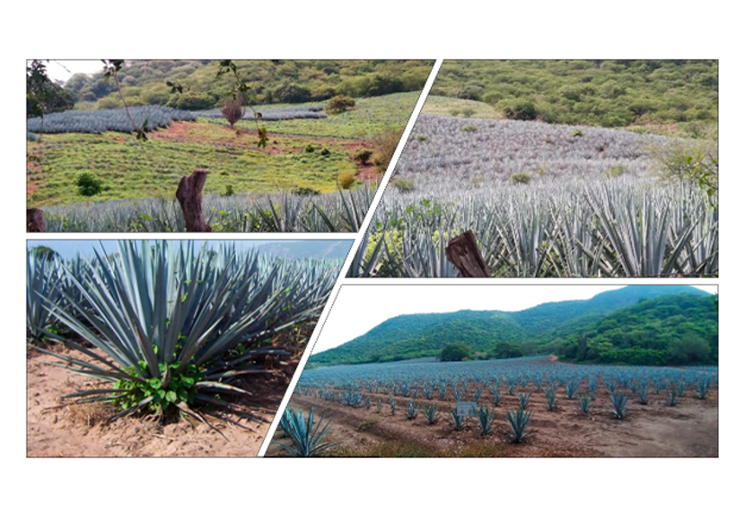
This study aimed to quantify and analyze the effects of the growth in the area cultivated with blue agave on deforestation, changes in cropping patterns, and soil erosion in Autlán de Navarro, Jalisco. Over the past 20 years, this crop has expanded intensively, driven by demand from the tequila industry and rising prices for a kilogram of agave hearts (from $21.00 to $30.00 pesos between 2021 and 2024). Through a census of plots, blue agave plantations belonging to tequila-producing companies and farmers were compared, recording changes in cropping patterns and deforestation, mainly of low deciduous tropical forest, as well as the presence of weeds, diseases and signs of soil erosion (visual evaluation). Results showed a deforestation rate of 39.7%; the conversion of cropping patterns represented 82%; 73% of plots received herbicides; 60% showed diseases treated with insecticides such as imidacloprid; and 90% showed moderate to severe erosion. Significant differences (p= 0.05) were observed in management between companies and farmers. It is concluded that the expansion of blue agave has led to changes in cropping patterns (from vegetables, corn and pastures to blue agave) and to deforestation, which responds to market volatility and a lack of contracts for the sale of the plantation.
Downloads
References
Aghsaei, H.; Mobarghaee, D. N.; Moridi, A.; Asadolahi, Z.; Delavar, M.; Fohrer, N. and Wagner, P. D. 2020. Effects of dynamic land use/land cover change on water resources and sediment yield in the Anzali wetland catchment, Gilan, Iran. Países Bajos. Science of the Total Environment. 712:136449. https://doi.org/10.1016/j.scitotenv.2019.136449.
Aka, K. S. R.; Dibi, H. N.; Koffi, J. N. and Bohoussou, C. N. 2022. Land cover dynamics and assessment of the impacts of agricultural pressures on wetlands based on earth observation data: case of the Azagny Ramsar site in Southern Côte d’Ivoire. Estados Unidos de América. Journal of Geoscience and Environment Protection. 10(5):43-61. https://doi.org/10.4236/gep.2022.105004.
Arista-Carmona, E.; González-Hernández, H.; Rodríguez-de la O, J. L. y Cibrián-Tovar, J. 2023. Incidencia, fluctuación poblacional y porcentaje de severidad de Scyphophorus acupunctatus en maguey pulquero en el noreste del Estado de México. Revista Fitotecnia Mexicana. 46(2):157-166. https://doi.org/10.35196/rfm.2023.2.157.
Bogaert, J.; Bamba, I.; Koffi, K. J.; Sibomana, S.; Djibu, J. K.; Champluvier, D. and Visser, M. N. 2008. Fragmentation of forest landscapes in Central Africa: causes, consequences and management. In: patterns and processes in forest landscapes: multiple use and sustainable management. Lafortezza, R.; Sanesi, G.; Chen, J. and Thomas, R. (Eds.). Estados Unidos de América. Springer. 67-68 pp.
Camacho-Sanabria, J. M.; Juan, P. J. I.; Pineda-Jaimes N. B.; Cadena, V. E. G.; Bravo, P. L. C. y Sánchez, L. M. 2015. Cambios de cobertura/uso del suelo en una porción de la Zona de Transición Mexicana de Montaña. México. Madera y Bosques. 21(1):93-112.
CCMSS. 2024. Consejo Civil Mexicano para la Silvicultura Sostenible. Los bosques y selvas en México: retos y perspectivas actuales del manejo forestal comunitario. CCMSS. https://ccmss.org.mx/wp-content/uploads/Informe-Los-bosques-y-selvas-mexico-CLUA-CCMSS-fn.pdf.
Chuma, G. B.; Mondo, J. M.; Ndeko, A. B.; Mugumaarhahama, B. E. M.; Blaise, M.; Valérie, M.; Jacques, K.; Karume, K. and Mushagalusa, G. N. 2021. Forest cover affects gully expansion at the tropical watershed scale: case study of Luzinzi in Eastern DR Congo. Paises Bajos. Trees, Forests and People. 4:100083. https://doi.org/10.1016/j.tfp.2021.100083.
CONAFOR. 2002. Comisión Nacional Forestal. Evaluación del programa nacional de reforestación (PRONARE, 2002). Universidad Autónoma Chapingo (UACH). 53 p.
CONAFOR. 2020a. Comisión Nacional Forestal. Inventario Nacional Forestal y de Suelos. https://snmf.cnf.gob.mx/principaleindicadoresforestalesciclo-2015-2020/.
CONAFOR. 2020b. Comisión Nacional Forestal. Estimación de la tasa de deforestación en México para el periodo 2001-2018 mediante el método de muestreo. Documento Técnico. Jalisco, México.
CRT. 2000. Consejo Regulador del Tequila. Anuario estadístico de producción del sistema agave-tequila. Guadalajara, Jalisco, México. CRT. 70 p.
Demissie, T. A. 2022. Land use and land cover change dynamics and its impact on watershed hydrological parameters: the case of Awetu watershed Ethiopia. Suiza. Journal of Sedimentary Environments. 7:79-94. https://doi.org/10.1007/s43217-021-00084-1.
Eastman, J. R. 1992. IDRISI. Worcester, MA, USA. Clark University. 213 p.
García-Montoya, J. P.; Giraldez-Cervera, J. V. and Vanwalleghem, T. 2021. Climate and land use change effects on sediment production in a dry tropical forest catchment. Suiza. Water. 13(16):2233-2244. https://doi.org/10.3390/w13162233.
Gerritsen, P. R. W.; Rosales, A. J. J.; Moreno, H. A. y Martínez, R. L. M. 2011. Agave azul y el desarrollo sustentable en la cuenca baja del río Ayuquila, Costa Sur de Jalisco (1994-2004). México. Región y Sociedad. 23(51):161-192.
Gómez-Pompa, A. and Burley, F. W. 1991. The management of natural tropical forests. In: rain forest regeneration and management. Man and the Biosphere Series. Vol. 6. UNESCO. The Parthenon Publishing Group. 3-10 pp.
Guevara, G. R. D.; Olguín, L. J. L.; Mancilla, V. O. R.; Rosales, A. M. P.; Barreto, G. O. A.; Palomera, C. y Avelar, R. J. U. 2024a. Prácticas sustentables, alternativas para la conservación del suelo en Agave tequilana Weber. México. Nova Scientia. 16(32):1-15. https://doi.org/10.21640/ns.v16i32.3450.
Guevara-Gutiérrez, R. D.; Palomera-García, C.; Olguin-López, J. L.; Mancilla-Villa, O. R.; Rosales-Almendra, M. P. and Barreto-García, O. A. 2024b. Effect of blue agave (Agave tequilana Weber.) management on soil erosion. Estados Unidos de América. Air, Soil and Water Research. 17:1-10. https://doi.org/10.1177/11786221241236632.
Herrera-Pérez, L.; Valtierra-Pacheco, E.; Ocampo-Fletes, I.; Tornero-Campante, M. A.; Hernández-Plascencia, J. A. y Rodríguez-Macías, R. 2017. Prácticas agroecológicas en Agave tequilana Weber bajo dos sistemas de cultivo en Tequila, Jalisco. México. Revista Mexicana de Ciencias Agrícolas. 18(esp):3711-3724.
Herrera-Pérez, L.; Valtierra-Pacheco, E.; Ocampo-Fletes, I.; Tornero-Campante, M. A.; Hernández-Plascencia, J. A. y Rodríguez-Macías, R. 2018. Esquemas de contratos agrícolas para la producción de Agave tequilana Weber en la región de Tequila, Jalisco. México. Agricultura, Sociedad y Desarrollo. 15(4):619-637.
Moreno-Hernández, A.; Estrella-Chulim, N.; Escobedo-Garrido, S.; Bustamante-González, A. y Gerritsen, P. W. 2011. Prácticas de manejo agronómico para la sustentabilidad: características y medición en Agave tequilana Weber en la región Sierra de Amula, Jalisco. México. Tropical and Subtropical Agroecosystems. 15(4):159-169.
OECD/FAO. 2018. OECD-FAO Agricultural Outlook 2018-2027. OECD Publishing. https://doi.org/10.1787/agr-outlook-2018-en.
Quesada-Román, A. y Díaz-Bolaños, R. 2019. Impactos ambientales de la colonización agrícola en Coto Brus, Costa Rica (1940-2018). Revista Geográfica de América Central, 63(2):171-203. https://doi.org/10.15359/rgac.63-2.8.
Ruíz, J. A.; Macías, A. y García, J. 2002. Expansión del agave tequilero en Jalisco, México y sus efectos en los recursos naturales. México. Instituto Nacional de Investigaciones Forestales, Agrícolas y Pecuarias (INIFAP). Guadalajara, Jalisco, México. Libro técnico núm. 1. 142 p.
Tena, T. M.; Mwaanga, P. and Nguvulu, A. 2019. Impact of land use/land cover changes on hydrological components in Chongwe River Catchment. Suiza. Sustainability. 11(22):6415-6428. https://doi.org/10.3390/su11226415.
Valenzuela, A. G. y Gaytán, M. A. 2009. La expansión del cultivo del agave tequilero y su impacto en la estructura agraria regional. México. Revista de Geografía Agrícola. (42-43):129-142.
Vélez, G. C.; Álvarez, de la C. A. P. y Rodríguez, G. B. 1996. Aislamiento de Erwinia del grupo Carotovora como patógeno del Agave Tequilana. In: Resúmenes del XXIII Congreso Nacional de la Sociedad Mexicana de Fitopatología. Guadalajara, Jalisco, México. 84 p.
Downloads
Published
Issue
Section
License
Copyright (c) 2026 Revista Mexicana de Ciencias Agrícolas

This work is licensed under a Creative Commons Attribution-NonCommercial 4.0 International License.
The authors who publish in Revista Mexicana de Ciencias Agrícolas accept the following conditions:
In accordance with copyright laws, Revista Mexicana de Ciencias Agrícolas recognizes and respects the authors’ moral right and ownership of property rights which will be transferred to the journal for dissemination in open access. Invariably, all the authors have to sign a letter of transfer of property rights and of originality of the article to Instituto Nacional de Investigaciones Forestales, Agrícolas y Pecuarias (INIFAP) [National Institute of Forestry, Agricultural and Livestock Research]. The author(s) must pay a fee for the reception of articles before proceeding to editorial review.
All the texts published by Revista Mexicana de Ciencias Agrícolas —with no exception— are distributed under a Creative Commons License Attribution-NonCommercial 4.0 International (CC BY-NC 4.0), which allows third parties to use the publication as long as the work’s authorship and its first publication in this journal are mentioned.
The author(s) can enter into independent and additional contractual agreements for the nonexclusive distribution of the version of the article published in Revista Mexicana de Ciencias Agrícolas (for example include it into an institutional repository or publish it in a book) as long as it is clearly and explicitly indicated that the work was published for the first time in Revista Mexicana de Ciencias Agrícolas.
For all the above, the authors shall send the Letter-transfer of Property Rights for the first publication duly filled in and signed by the author(s). This form must be sent as a PDF file to: revista_atm@yahoo.com.mx; cienciasagricola@inifap.gob.mx; remexca2017@gmail.
This work is licensed under a Creative Commons Attribution-Noncommercial 4.0 International license.