Effects of paclobutrazol on stomatal density and height in Chenopodium quinoa
DOI:
https://doi.org/10.29312/remexca.v17i6.4150Keywords:
área del poro estomático, células epidérmicas, número de estomas, Suyana, TunkahuanAbstract
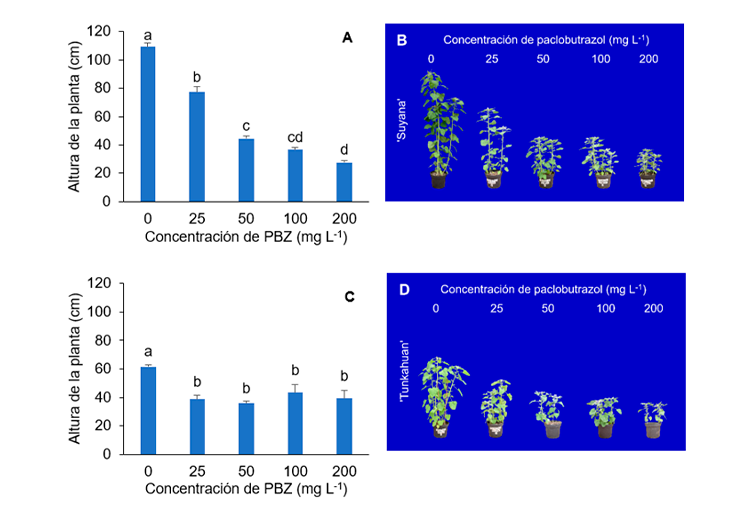
Paclobutrazol (PBZ) is a growth retardant that, in addition to reducing plant height, may increase stomatal density and pore area. This research evaluated the effects of five PBZ concentrations on the number of stomata, stomatal pore area, plant height, and the visual appearance of Chenopodium quinoa cv. Suyana and Tunkahuan. The experiment was conducted from July to December 2024 at the Iztacala Faculty of Higher Studies, UNAM. Sowing was carried out in 50 pots containing 2.5 L of peat moss:expanded perlite (1:1). After 25 days, thinning was performed, and the following treatments were applied foliarly: 0, 25, 50, 100 and 200 mg L-1 of PBZ. Single-factor analysis of variance and mean comparison tests (Tukey, p≤ 0.05) were applied to the number of stomata and pore area. The results showed that the epidermal cells of both leaf surfaces had anticlinal walls with sinuous contours and anomocytic stomata. ‘Suyana’ had greater height (109.25 cm), more stomata mm-2 (98.4), and larger pores (21.28 μm2) than ‘Tunkahuan’. The application of PBZ increased the number of stomata and the opening of the stomatal pore starting at 25 mg L-1, and its effect was more pronounced at 100 or 200 mg L-1. PBZ also reduced the height of the plants and made them more colorful for possible ornamental use.
Downloads
References
Aguilar-Rodríguez, S. 1998. Apéndice I. Técnicas de laboratorio para el estudio de las embriofitas. Plantae. Introducción al estudio de las plantas con embrión. Tejero, J. D.; Granillo, M. P. y Ávila, J. J. (Eds.). 2da. Ed. Universidad Nacional Autónoma de México (UNAM). México, DF. 247-272 pp.
Buedo, S. E.; Mercado, M. I. y González, J. A. 2024. Caracterización fotosintética y anatomía foliar de Chenopodium album y Ch. hircinum (Chenopodiaceae) en un valle de altura del noroeste Argentino. Boletín de la Sociedad Argentina de Botánica. 59(1):13-25. https://doi.org/10.31055/1851.2372.v59.n1.42881.
Espitia, R. E.; Rivas, V. P.; Valverde, R. M. G. y Sesma, H. F. 2023. Suyana, variedad de quinua para los valles altos de México. Reporte anual 2022 ciencia y tecnología para el campo mexicano. https://www.gob.mx/cms/uploads/attachment/file/836561/formato-reporte-anual-2022-edomex.pdf.
Gaafar, A. 2019. Morphology and stem anatomy of Chenopodium species from Egyptian Flora. Egyptian Journal of Botany. 59(1):53-58. https://doi.org/10.21608/ejbo.2018.4699.1193.
García-Parra, M. A.; Amado-Rodríguez J. L. and Hernández-Criado, J. C. 2024. Photosynthetic capacity, phenology, yield and chemical composition of seeds of three cultivars of quinoa (Chenopodium quinoa Willd.). Revista Colombiana de Ciencias Hortícolas. 18(2):e17524. https://doi.org/10.17584/rcch.2024v18i2.17524.
González, J. A.; Mercado, M. I.; Martínez-Calsina, L.; Erazzú, L. E.; Buedo, S. E.; González, D. A. and Ponessa, G. I. 2022. Plant density effects on quinoa yield, leaf anatomy, ultrastructure and gas exchange. The Journal of Agricultural Science. 160(5):349-359. https://doi.org/10.1017/S0021859622000533.
González, J. A.; Ponessa, G. I.; Buedo, S.; Mercado, M. I. and Prado, F. E. 2014. Asimilación fotosintética máxima en variedades de quinoa (Chenopodium quinoa) de diferentes orígenes geográficos y su relación con la morfología foliar. Lilloa. 51(2):177-193. https://ri.conicet.gov.ar/handle/11336/12428.
Hussain, M. I.; Farooq, M.; Syed, Q. A.; Ishaq, A.; Al-Ghamdi, A. A. and Hatamleh, A. A. 2021. Botany, nutritional value, phytochemical composition and biological activities of quinoa. Plants. 10(11):2258. https://doi.org/10.3390/plants10112258.
Martinez, R. M.; Melo, C. P.; Pinto, I. C.; Mendes-Pierotti, S.; Vignoli, J. A.; Verri, W. A. and Casagrande, R. 2024. Betalains: a narrative review on pharmacological mechanisms supporting the nutraceutical potential towards health benefits. Foods. 13(23):3909. https://doi.org/10.3390/foods13233909.
Martínez-Villaluenga, C.; Peñas, E. and Hernández-Ledesma, B. 2020. Pseudocereal grains: nutritional value, health benefits and current applications for the development of gluten-free foods. Food and Chemical Toxicology. 137:111178. https://doi.org/10.1016/j.fct.2020.111178.
Nowak, V.; Du, J. and Charrondière, R. 2016. Assessment of the nutritional composition of quinoa (Chenopodium quinoa Willd.). Food Chemistry. 193:47-54. https://doi.org/10.1016/j.foodchem.2015.02.111.
Panteris, E. and Adamakis, I. D. S. 2022. Double puzzle: morphogenesis of the bi-layered leaf adaxial epidermis of magnolia grandiflora. Plants. 11:3437. https://doi.org/10.3390/plants11243437.
Rademacher, W. 2000. Growth retardants: effects on gibberellin biosynthesis and other metabolic pathways. Annual review of plant biology. 51(1):501-531. https://doi.org/10.1146/annurev.arplant.51.1.501.
Rasouli, F.; Kiani-Pouya, A.; Movahedi, A.; Wang, Y.; Li, L.; Yu, M.; Pourkheirandish, M.; Zhou, M.; Chen, Z.; Zhang, H. and Shabala, S. 2023. Guard cell transcriptome reveals membrane transport, stomatal development and cell wall modifications as key traits involved in salinity tolerance in halophytic Chenopodium quinoa. Plant and Cell Physiology. 64(2):204-220. https://doi.org/10.1093/pcp/pcac158.
Rios-Florida, L. G.; De La Cruz-Guzmán, G. H.; Arriaga-Frías, A. and Mandujano-Piña, M. 2022. Efecto de Paclobutrazol y Glomus intraradices en el cultivo de Lilium cv. Armandale y Tresor. Siembra. 9(2):e3978. https://doi.org/10.29166/siembra.v9i2.3978.
Romero-Benavides, J. C.; Guaraca-Pino, E.; Duarte-Casar, R.; Rojas-Le-Fort, M. and Bailon-Moscoso, N. 2023. Chenopodium quinoa Willd. and Amaranthus hybridus L.: ancestral Andean food security and modern anticancer and antimicrobial activity. Pharmaceuticals. 16(12):1728. https://doi.org/10.3390/ph16121728.
Sapala, A.; Runions, A.; Routier-Kierzkowska, A. L.; Gupta, M. D.; Hong, L.; Hofhuis, H.; Verger, S.; Mosca, G.; Li, C. B.; Hay, A.; Hamant, O.; Roeder, A. H.; Tsiantis, M.; Prusinkiewicz, P. and Smith, R. S. 2018. Why plants make puzzle cells, and how their shape emerges. Elife. 27(7):e32794. https://doi.org/10.7554/eLife.32794.
SAS Institute Inc. 2013. Statistical Analysis Software. Versión 9.0 Cary, NC., USA. http://www.sas.com/en us/software/analytics/stat.html.
Shevchuk, O. A.; Tkachuk, O. O.; Kuryata, V. G.; Khodanitska, O. O. and Polyvanyi, S. V. 2019. Features of leaf photosynthetic apparatus of sugar beet under retardants treatment. Ukrainian Journal of Ecology. 9(1):115-120. https://vsau.vin.ua/repository/getfile.php/20152.pdf.
Srinivasan, A. 2017. Effect of pigments, phenol content and postharvest life on application of plant growth retardants in Celosia Spp. Chem. Sci. Rev. Lett. 6(23):1769-1772.
Steiner, A. A. 1961. A universal method for preparing nutrient solutions of a certain desired composition. Plant Soil. 15(2):134-154. https://doi.org/10.1007/BF01347224.
Taiz, L. and Zeiger, E. 2010. Plant physiology. 5th. Ed. Sinauer Associates Inc. Sunderland, UK. 782 p.
Tantawy, M. E.; Salim, M. A.; Bayoumy, A. and Mohamed, A. H. 2023. Taxonomic significance of stem, lamina and epidermal micro-characters in understanding Chenopodiaceae and Amaranthaceae alliance. Pakistan Journal of Botany. 55(1):277-289. https://doi.org/10.1007/BF01347224.
Torres-Pio, K.; De la Cruz-Guzmán, G. H.; Arévalo-Galarza, M. D. L.; Aguilar-Rodríguez, S.; Grego-Valencia, D.; Arriaga-Frías, A. and Mandujano-Piña, M. 2021. Morphological and anatomical changes in Lilium cv. Arcachon in response to plant growth regulators. Horticulture, Environment, and Biotechnology. 62(3):325-335. https://doi.org/10.1007/s13580-020-00319-6.
Velasco-Lara, D.; Cruz-Guzmán, G. H. D. L.; Mandujano-Piña, M.; Arriaga-Frías, A. y Ramírez-Santiago, D. 2024. Dosis de paclobutrazol para modificar el aspecto visual de Lilium cv. Litouwen. Revista Mexicana de Ciencias Agrícolas. 15(3): e3662. https://doi.org/10.29312/remexca.v15i3.3662.
Vőfély, R. V.; Gallagher, J.; Pisano, G. D.; Bartlett, M. and Braybrook, S. A. 2019. Of puzzles and pavements: a quantitative exploration of leaf epidermal cell shape. New Phytologist. 221(1):540-552. https://doi.org/10.1111/nph.15461.
Waqas, M.; Yaning, C.; Iqbal, H.; Shareef, M.; Rehman, H. and Bilal, H. M. 2021. Synergistic consequences of salinity and potassium deficiency in quinoa: Linking with stomatal patterning, ionic relations and oxidative metabolism. Plant Physiology and Biochemistry. 159:17-27. https://doi.org/10.1016/j.plaphy.2020.11.043.
Waqas, M.; Yaning, C.; Iqbal, H.; Shareef, M.; Rehman, H. and Yang, Y. 2017. Paclobutrazol improves salt tolerance in quinoa: beyond the stomatal and biochemical interventions. Journal of Agronomy and Crop Science. 203(4):315-322. https://doi.org/10.1111/jac.12217.
Xia, X.; Tang, Y.; Wei, M. and Zhao, D. 2018. Effect of paclobutrazol application on plant photosynthetic performance and leaf greenness of herbaceous peony. Horticulturae. 4(1):5. https://doi.org/10.3390/horticulturae4010005.
Xie, H.; Zeng, J.; Feng, W.; Gao, W.; Lai, Z. and Liu, S. 2025. Differential expression of amaranth AtrDODA gene family members in betalain synthesis and functional analysis of AtrDODA1-1 promoter. Plants. 14:454. https://doi.org/10.3390/plants14030454.
Xiong, D. and Flexas, J. 2020. From one side to two sides: the effects of stomatal distribution on photosynthesis. New Phytologist. 228(6):1754-1766. https://doi.org/10.1111/nph.16801.
Downloads
Published
Issue
Section
License
Copyright (c) 2026 Revista Mexicana de Ciencias Agrícolas

This work is licensed under a Creative Commons Attribution-NonCommercial 4.0 International License.
The authors who publish in Revista Mexicana de Ciencias Agrícolas accept the following conditions:
In accordance with copyright laws, Revista Mexicana de Ciencias Agrícolas recognizes and respects the authors’ moral right and ownership of property rights which will be transferred to the journal for dissemination in open access. Invariably, all the authors have to sign a letter of transfer of property rights and of originality of the article to Instituto Nacional de Investigaciones Forestales, Agrícolas y Pecuarias (INIFAP) [National Institute of Forestry, Agricultural and Livestock Research]. The author(s) must pay a fee for the reception of articles before proceeding to editorial review.
All the texts published by Revista Mexicana de Ciencias Agrícolas —with no exception— are distributed under a Creative Commons License Attribution-NonCommercial 4.0 International (CC BY-NC 4.0), which allows third parties to use the publication as long as the work’s authorship and its first publication in this journal are mentioned.
The author(s) can enter into independent and additional contractual agreements for the nonexclusive distribution of the version of the article published in Revista Mexicana de Ciencias Agrícolas (for example include it into an institutional repository or publish it in a book) as long as it is clearly and explicitly indicated that the work was published for the first time in Revista Mexicana de Ciencias Agrícolas.
For all the above, the authors shall send the Letter-transfer of Property Rights for the first publication duly filled in and signed by the author(s). This form must be sent as a PDF file to: revista_atm@yahoo.com.mx; cienciasagricola@inifap.gob.mx; remexca2017@gmail.
This work is licensed under a Creative Commons Attribution-Noncommercial 4.0 International license.