Bradyrhizobium sp. role in strengthening biochemical defense of trefoil under metal stress
DOI:
https://doi.org/10.29312/remexca.v17i5.3742Keywords:
biochemistry, cadmium, copper, germination, metal stress, PGPR, trefoilAbstract
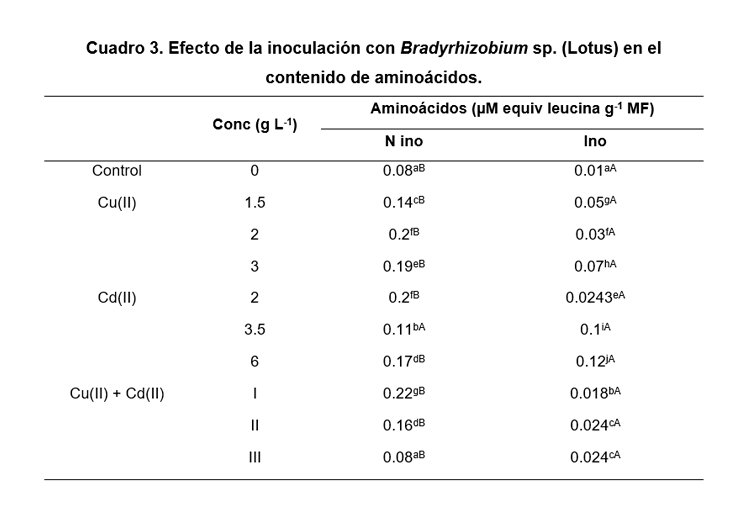
This study explores the role of Bradyrhizobium sp. (Lotus) in enhancing the biochemical resilience of Lotus ornithopodioïdes during germination under metal stress conditions. Specifically, the effects of cadmium (Cd) and copper (Cu) on germination and various biochemical parameters were assessed. Seeds were inoculated with Bradyrhizobium sp. (Lotus) and subjected to different concentrations of trace metals. Key biochemical parameters, including proline, amino acids, total soluble sugars, α-amylase activity, and DNA content, were analyzed. The results demonstrated that inoculation with Bradyrhizobium sp. (Lotus) significantly mitigated the adverse effects of metal stress, leading to improved germination rates and enhanced biochemical responses. Notably, proline and amino acid levels were reduced, while α-amylase activity and DNA content increased in inoculated seeds compared to non-inoculated controls. These findings suggest that Bradyrhizobium sp. (Lotus) plays a vital role in promoting resilience in Lotus ornithopodioïdes under metal stress, highlighting its potential for use in bioremediation and sustainable agricultural practices.
Downloads
References
Ahemad, M. and Kibret, M. 2014. Mechanisms and applications of plant growth promoting rhizobacteria: current perspective. Journal of King Saud University-Science. 26(1):1-20. https://doi.org/10.1016/j.jksus.2013.05.001. DOI: https://doi.org/10.1016/j.jksus.2013.05.001
Anuradha, S. and Rao, S. S. R. 2007. The effect of brassinosteroids on radish (Raphanus sativus) seedlings growing under cadmium stress. Plant Soil Environ. 53(11):465-472. https://doi.org/10.17221/2307-PSE. DOI: https://doi.org/10.17221/2307-PSE
Babu, P.; Bryan, J. D.; Panek, H. R.; Jordan, S. L.; Forbrich, B. M.; Kelley, S. C.; Colvin, R. T. and Robinson, L. C. 2002. Plasma membrane localization of the Yck2p yeast casein kinase 1 isoform requires the C-terminal extension and secretory pathway function. J. Cell Sci. 115(24):4957-4968. https://doi.org/10.1242/jcs.00203. DOI: https://doi.org/10.1242/jcs.00203
Biteur, N. 2012. Essais d’utilisation du radis (Raphanus sativus) dans la phytoremédiation (biodépollution) au niveau du sol contaminé par les métaux lourds (plomb): étude du stress oxydatif et quelques paramètres enzymatiques. Thèse de Doctorat, Oran, Alger. 110 p.
Bouzid, S. 2009. Étude de l’effet de la salinité et de la présence du molybdène sur le comportement écophysiologique de deux variétés de plantes de l’espèce Phaseolus vulgaris L. Thèse de Magister. 124 p.
Burton, K. 1956. A study of the conditions and mechanism of the diphenylamine reaction for the colorimetric estimation of deoxyribonucleic acid. Biochem. Journal. 62(2):315-322. https://doi.org/10.1042/bj0620315. DOI: https://doi.org/10.1042/bj0620315
Chatterjee, C.; Nautiyal, N. and Agarwala, S. C. 1985. Metabolic changes in mustard plant associated with molybdenum deficiency. New Phytologist. 100(4):511-518. https://doi.org/10.1111/j.1469-8137.1985.tb02797.x. DOI: https://doi.org/10.1111/j.1469-8137.1985.tb02797.x
Chen, C. T.; Chen, T. H.; Lo, K. F. and Chu, C. Y. 2004. Effects of proline on copper transport in rice seedlings under excess copper stress. Plant Sci. 166(1):103-111. https://doi.org/10.1016/j.plantsci.2003.08.015. DOI: https://doi.org/10.1016/j.plantsci.2003.08.015
Degaichia, H.; Boussahoua, A. R. and Bakria, T. 2024. Resistance of Bradyrhizobium sp. (Lotus) to metallic stress. Agropastoralis Scientia. 1(2):73-83. https://asjp.cerist.dz/index.php/en/article/262816.
Degaichia, H.; Hamas, F.; Boussahoua, A. R.; Bakria, T. and Bouchenak, F. 2025. Enhancing trefoil germination under metal stress through Bradyrhizobium sp. (Lotus) inoculation. Revista Mexicana de Ciencias Agrícolas. 16(4):1-11. https://doi.org/10.29312/remexca.v16i4.3658. DOI: https://doi.org/10.29312/remexca.v16i4.3658
Dubois, M.; Gilles, K. A.; Hamilton, J. K.; Rebers, P. A. and Smith. 1956. Colorimetric method for determination of sugars and related substances. Anal. Chem. J. 28(3):350-356. https://doi.org/10.1021/ac60111a017. DOI: https://doi.org/10.1021/ac60111a017
Etesami, H. and Maheshwari, D. K. 2018. Use of plant growth promoting rhizobacteria (PGPRs) with multiple plant growth promoting traits in stress agriculture: action mechanisms and future prospects. Ecotoxicology and Environmental Safety. 156(1):225-246. https://doi.org/10.1016/j.ecoenv.2018.03.013. DOI: https://doi.org/10.1016/j.ecoenv.2018.03.013
Hossain, M. A.; Piyatida, P.; da Silva, J. A. T. and Fujita, M. 2012. Molecular mechanism of heavy metal toxicity and tolerance in plants: central role of glutathione in detoxification of reactive oxygen species and methylglyoxal and in heavy metal chelation. Journal of Botany. 1:1-37. https://doi.org/10.1155/2012/872875. DOI: https://doi.org/10.1155/2012/872875
Lei, Y. B. Korpelainen, H. and Li, C. Y. 2007. Physiological and biochemical responses to high Mn concentrations in two contrasting Populus cathayana populations. Chemosphere. 68(4):686-694. https://doi.org/10.1016/j.chemosphere.2007.01.066. DOI: https://doi.org/10.1016/j.chemosphere.2007.01.066
Matysik, J.; Alia, Bhalu, B. and Mohanty, P. 2002. Molecular mechanisms of quenching of reactive oxygen species by proline under stress in plants. Current Science. 82(5):525-532. https://www.jstor.org/stable/24105959.
Mihoub, A.; Chaoui, A. and El Ferjani, E. 2005. Biochemical changes induced by cadmium and copper during germination of pea seeds (Pisum sativum L.). Comptes Rendus Biologies. 328(1):601-609. https://doi.org/10.1016/j.crvi.2004.10.003. DOI: https://doi.org/10.1016/j.crvi.2004.10.003
Naidu, B. P., Cameron, D. F. and Konduri, S. V. 1998. Improving drought tolerance of cotton by glycine betaine application and selection. Proceedings of the Australian Agronomy Conference. The Australian Society of Agronomy, Australia. 1-5 pp.
Rizwan, M.; Ali, S.; Adrees, M.; Rizvi, H.; Zia-ur-Rehman, M.; Hannan, F. and Ok, Y. S. 2016. Cadmium stress in rice: toxic effects, tolerance mechanisms and management: a critical review. Environmental Science and Pollution Research. 23(18):17859-17879. https://doi.org/10.1007/s11356-016-6436-4. DOI: https://doi.org/10.1007/s11356-016-6436-4
Shameer, S. and Prasad, T. N. V. K. V. 2018. Plant growth promoting rhizobacteria for sustainable agricultural practices with special reference to biotic and abiotic stresses. Plant Growth Regulation. 84(3):603-615. https://doi.org/10.1007/s10725-017-0365-1. DOI: https://doi.org/10.1007/s10725-017-0365-1
Sharma, S. S. and Dietz, K. J. 2006. The significance of amino acids and amino-derived molecules in plant responses and adaptation to heavy metal stress. J. Exp. Bot. 57(4):711-726. https://doi.org/10.1093/jxb/erj073. DOI: https://doi.org/10.1093/jxb/erj073
Sharmila, P. and Pardha, S. P. 2002. Proline accumulation in heavy metal stressed plants: an adaptative strategy. In: physiology and biochemistry of metal toxicity and tolerance in plants. Prasad, M. N. V. and Strzalka, K. (Eds.). 179-199 pp. https://doi.org/10.1007/978-94-017-2660-3-7. DOI: https://doi.org/10.1007/978-94-017-2660-3_7
Silini, A.; Cherif-Silini, H. and Yahiaoui, B. 2016. Growing varieties durum wheat (Triticum durum) in response to the effect of osmolytes and inoculation by Azotobacter chroococcum under salt stress. Afr. J. Microbiol. Res. 10(12):387-399. https://doi.org/10.5897/AJMR2015.7723. DOI: https://doi.org/10.5897/AJMR2015.7723
Singh, T. N.; Aspinall, D.; Paleg, L. G. and Bogges, S. F. 1973. Stress metabolism. II. Changes in proline concentration in excised plant tissues. Australian Journal of Biological Sciences. 26(1):57-63. DOI: https://doi.org/10.1071/BI9730057
Szafrariska, K.; Cvikrovsk, M.; Kowalska, U.; Gdrecki, R.; Martincova, I. and Janas, K. M. 2011. Influence of copper ions on growth, lipid peroxidation, proline and polyamines content in carrot rosettes obtained from another culture. Acta Physiol. Plant. 33(3):851-859. https://doi.org/10.1007/s11738-010-0610-y. DOI: https://doi.org/10.1007/s11738-010-0610-y
Xiao, Z.; Storms, R. and Tsang, A. 2006. A quantitative starch-iodine method for measuring alpha-amylase and glucoamylase activities. Anal. Biochem. 351(1):146-148. https://doi.org/10.1016/j.ab.2006.01.036. DOI: https://doi.org/10.1016/j.ab.2006.01.036
Downloads
Published
Issue
Section
License
Copyright (c) 2026 Revista Mexicana de Ciencias Agrícolas

This work is licensed under a Creative Commons Attribution-NonCommercial 4.0 International License.
The authors who publish in Revista Mexicana de Ciencias Agrícolas accept the following conditions:
In accordance with copyright laws, Revista Mexicana de Ciencias Agrícolas recognizes and respects the authors’ moral right and ownership of property rights which will be transferred to the journal for dissemination in open access. Invariably, all the authors have to sign a letter of transfer of property rights and of originality of the article to Instituto Nacional de Investigaciones Forestales, Agrícolas y Pecuarias (INIFAP) [National Institute of Forestry, Agricultural and Livestock Research]. The author(s) must pay a fee for the reception of articles before proceeding to editorial review.
All the texts published by Revista Mexicana de Ciencias Agrícolas —with no exception— are distributed under a Creative Commons License Attribution-NonCommercial 4.0 International (CC BY-NC 4.0), which allows third parties to use the publication as long as the work’s authorship and its first publication in this journal are mentioned.
The author(s) can enter into independent and additional contractual agreements for the nonexclusive distribution of the version of the article published in Revista Mexicana de Ciencias Agrícolas (for example include it into an institutional repository or publish it in a book) as long as it is clearly and explicitly indicated that the work was published for the first time in Revista Mexicana de Ciencias Agrícolas.
For all the above, the authors shall send the Letter-transfer of Property Rights for the first publication duly filled in and signed by the author(s). This form must be sent as a PDF file to: revista_atm@yahoo.com.mx; cienciasagricola@inifap.gob.mx; remexca2017@gmail.
This work is licensed under a Creative Commons Attribution-Noncommercial 4.0 International license.