Modelado predictivo del rendimiento de trigo bajo estrés por inundación: enfoque basado en el algoritmo Chaid
DOI:
https://doi.org/10.29312/remexca.v17i2.3895Palabras clave:
Triticum durum, agricultura de precisión, estrés hídrico, gestión de riesgosResumen
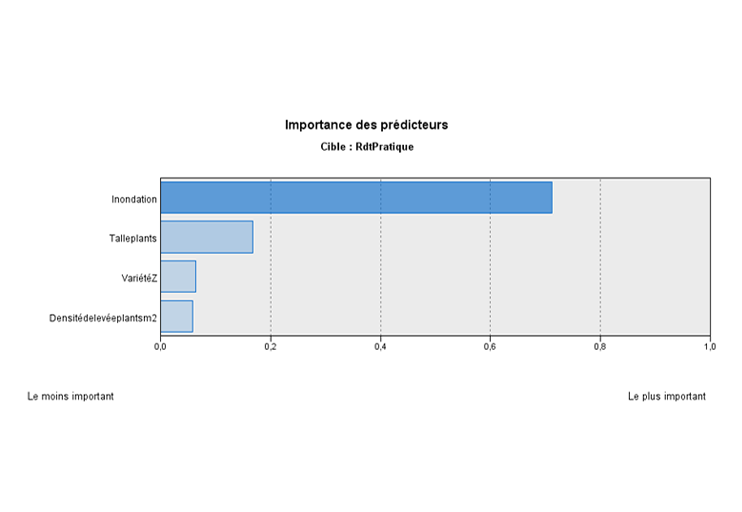
La investigación tuvo como objetivo examinar el impacto de las inundaciones en el rendimiento del trigo duro utilizando un enfoque de modelización predictiva basado en el análisis Chaid. Se llevaron a cabo ensayos en bloques completos al azar en dos localidades, con y sin inundación, utilizando cuatro cultivares de trigo duro (GTA dur, Citra, Simeto y Boussalem). La evaluación de la pérdida de rendimiento destacó una sensibilidad significativa de los cultivares al anegamiento, siendo Simeto el que mostró la mayor pérdida de rendimiento (64.33%). El análisis Chaid permitió identificar y jerarquizar los factores que influyen en el rendimiento, revelando que la inundación es el predictor más importante (71.14%), seguido por el número promedio de macollos por planta (16.74%), la variedad (6.32%) y la densidad de emergencia (5.8%). Más allá de la simple observación del impacto negativo, este modelo permite predecir las pérdidas de rendimiento en función de diversos parámetros agronómicos. Los resultados mostraron que la inundación reduce considerablemente el rendimiento (16.895 q ha-1); es importante mencionar que el macollaje y la variedad también juegan un papel importante en la respuesta del trigo a la inundación. El estudio subraya la importancia de la modelización predictiva para anticipar las pérdidas de rendimiento y orientar las decisiones de gestión de cultivos en áreas propensas a inundaciones.
Descargas
Referencias
Aslam, A.; Mahmood, A.; Ur-Rehman, H.; Li, C.; Liang, X.; Shao, J. Negm, S.; Moustafa, M.; Aamer, M. and Hassan, M. U. 2023. Plant adaptation to flooding stress under changing climate conditions: ongoing breakthroughs and future challenges. Plants. 12(22):1-23. https://doi.org/10.3390/plants12223824.
Bailey-Serres, J. and Voesenek, L. A. C. J. 2008. Flooding stress: acclimations and genetic responses. Annual Review of Plant Biology. 59(1):313-339. https://doi.org/10.1146/annurev.arplant.59.032607.092752.
Basso, B. and Liu, L. 2019. Seasonal crop yield forecast: methods, applications, and accuracies. Advances in agronomy. 154(1):201-255.
Bassu, S.; Asseng, S.; Motzo, R. and Giunta, F. 2009. Optimising sowing date of durum wheat in a variable Mediterranean environment. Field Crops Research. 111(1-2):109-118. https://doi.org/10.1016/j.fcr.2008.11.002.
Berry, P. M. and Spink, J. 2012. Predicting yield losses caused by lodging in wheat. Field Crops Research. 137(1):19-26. https://doi.org/10.1016/j.fcr.2012.07.019.
Collaku, A. and Harrison, S. A. 2002. Losses in wheat due to waterlogging. Crop Science. 42(2):444-450. https://doi.org/10.2135/cropsci2002.4440.
Dadrasi, A.; Chaichi, M.; Nehbandani, A.; Sheikhi, A.; Salmani, F. and Nemati, A. 2023. Addressing food insecurity: an exploration of wheat production expansion. Plos One. 18(12):e0290684. https://doi.org/10.1371/journal.pone.0290684.
Degaïchia, H.; Bouchenak, F.; Benrima, A. and Forti, J. A. 2019. Modeling of the linear extension of Verticillium dahliae Kleb. (Moniliaceae) in soil based on eggplant root exudates, Agrobiologia. 9(1):1284-1291.
Elbasi, E.; Zaki, C.; Topcu, A. E.; Abdelbaki, W.; Zreikat, A. I.; Cina, E.; Shdefat, A. and Saker, L. 2023. Crop prediction model using machine learning algorithms. Applied Sciences. 13(16):1-20. https://doi.org/10.3390/app13169288.
Gebbers, R. and Adamchuk, V. I. 2010. Precision agriculture and food security. Science. 327(5967):828-831. https://doi.org/10.1126/science.1183899.
Githui, F.; Beverly, C.; Aiad, M.; McCaskill, M.; Liu, K. and Harrison, M. T. 2022. Modelling waterlogging impacts on crop growth: a review of aeration stress definition in crop models and sensitivity analysis of APSIM. International Journal of Plant Biology. 13(3):180-200.
Herzog, M.; Striker, G. G.; Colmer, T. D. and Pedersen, O. 2016. Mechanisms of waterlogging tolerance in wheat a review of root and shoot physiology. Plant, Cell & Environment. 39(5):1068-1086. https://doi.org/10.1111/pce.12676.
Kass, G. V. 1980. An exploratory technique for investigating large quantities of categorical data. Journal of the Royal Statistical Society: series C. Applied Statistics. 29(2):119-127. https://doi.org/10.2307/2986296.
Kaur, G.; Singh, G.; Motavalli, P. P.; Nelson, K. A.; Orlowski, J. M. and Golden, B. R. 2020. Impacts and management strategies for crop production in waterlogged or flooded soils: a review. Agronomy Journal. 112(3):1475-1501. https://doi.org/10.1002/agj2.20093.
Lesk, C.; Rowhani, P. and Ramankutty, N. 2016. Influence of extreme weather disasters on global crop production. Nature. 529(7584):84-87. https://doi.org/10.1038/nature16467.
Li, J.; Xie, T.; Chen, Y.; Zhang, Y.; Wang, C.; Jiang, Z. and Zhang, J. 2022. High-throughput UAV-based phenotyping provides insights into the dynamic process and genetic basis of rapeseed waterlogging response in the field. Journal of Experimental Botany. 73(15):5264-5278.
Liakos, K. G.; Busato, P.; Moshou, D.; Pearson, S. and Bochtis, D. 2018. Machine learning in agriculture: a review. Sensors. 18(8):1-29. https://doi.org/10.3390/s18082674.
Liliane, T. N. and Charles, M. S. 2020. Factors affecting yield of crops. In: agronomy, climate change & food security. Johnson, R. P. and Wang, L. Ed. 2nd. Springer. New York, NY, USA. 9-24 pp.
Miralles, D. J.; Richards, R. A. and Slafer, G. A. 2000. Duration of the stem elongation period influences the number of fertile florets in wheat and barley. Functional Plant Biology. 27(10):931-940. https://doi.org/10.1071/PP00021.
Mustroph, A. 2018. Improving flooding tolerance of crop plants. Agronomy. 8(9):1-25. https://doi.org/10.3390/agronomy8090160.
Setter, T. L. and Waters, I. 2003. Review of prospects for germplasm improvement for waterlogging tolerance in wheat, barley and oats. Plant and soil. 253(1):1-34.
Shao, G. C.; Lan, J. J.; Yu, S. E.; Liu, N.; Guo, R. Q. and She, D. L. 2013. Photosynthesis and growth of winter wheat in response to waterlogging at different growth stages. Photosynthetica. 51(3):429-437.
Shen, C.; Yuan, J.; Ou, X.; Ren, X. and Li, X. 2021. Genome-wide identification of alcohol dehydrogenase (ADH) gene family under waterlogging stress in wheat (Triticum aestivum). PeerJ. 9(1):1-26. https://doi.org/10.7717/peerj.11861.
Slafer, G. A. and Araus, J. L. 2007. Physiological traits for improving wheat yield under a wide range of conditions. In: scale and complexity in plant systems research. Spiertz, J. H. J.; Struik, P. C. and Laar van, H. H. Ed. Springer. Dordrecht, Netherlands. 147-156 pp.
Steel, R. G. D.; Torrie, J. H. and Dickey, D. A. 1997. Principles and procedures of statistics: a biometrical approach. 3rd Ed. McGraw-Hill. New York, NY, USA. 666 p.
Trought, M. and Drew, M. C. 1980. The development of waterlogging damage in wheat seedlings (Triticum aestivum L.) II. Accumulation and redistribution of nutrients by the shoot. Plant and Soil. 56(2):187-199.
Zhang, J.; Pan, B.; Shi, W. and Zhang, Y. 2023. Monitoring waterlogging damage of winter wheat based on Hydrus-1D and Wofost coupled model and assimilated soil moisture data of remote sensing. Remote Sensing. 15(17):1-21.
Descargas
Publicado
Número
Sección
Licencia
Derechos de autor 2026 Revista Mexicana de Ciencias Agrícolas

Esta obra está bajo una licencia internacional Creative Commons Atribución-NoComercial 4.0.
Los autores(as) que publiquen en Revista Mexicana de Ciencias Agrícolas aceptan las siguientes condiciones:
De acuerdo con la legislación de derechos de autor, Revista Mexicana de Ciencias Agrícolas reconoce y respeta el derecho moral de los autores(as), así como la titularidad del derecho patrimonial, el cual será cedido a la revista para su difusión en acceso abierto.
Los autores(as) deben de pagar una cuota por recepción de artículos antes de pasar por dictamen editorial. En caso de que la colaboración sea aceptada, el autor debe de parar la traducción de su texto al inglés.
Todos los textos publicados por Revista Mexicana de Ciencias Agrícolas -sin excepción- se distribuyen amparados bajo la licencia Creative Commons 4.0 atribución-no comercial (CC BY-NC 4.0 internacional), que permite a terceros utilizar lo publicado siempre que mencionen la autoría del trabajo y a la primera publicación en esta revista.
Los autores/as pueden realizar otros acuerdos contractuales independientes y adicionales para la distribución no exclusiva de la versión del artículo publicado en Revista Mexicana de Ciencias Agrícolas (por ejemplo incluirlo en un repositorio institucional o darlo a conocer en otros medios en papel o electrónicos) siempre que indique clara y explícitamente que el trabajo se publicó por primera vez en Revista Mexicana de Ciencias Agrícolas.
Para todo lo anterior, los autores(as) deben remitir el formato de carta-cesión de la propiedad de los derechos de la primera publicación debidamente requisitado y firmado por los autores(as). Este formato debe ser remitido en archivo PDF al correo: revista_atm@yahoo.com.mx; revistaagricola@inifap.gob.mx.
Esta obra está bajo una licencia de Creative Commons Reconocimiento-No Comercial 4.0 Internacional.