Solarized bovine manure and PGPB inoculation optimize the yield and quality of Cucumis melo L.
DOI:
https://doi.org/10.29312/remexca.v17i6.4405Keywords:
Cucumis melo L., biofertilizers, organic amendments, sustainabilityAbstract
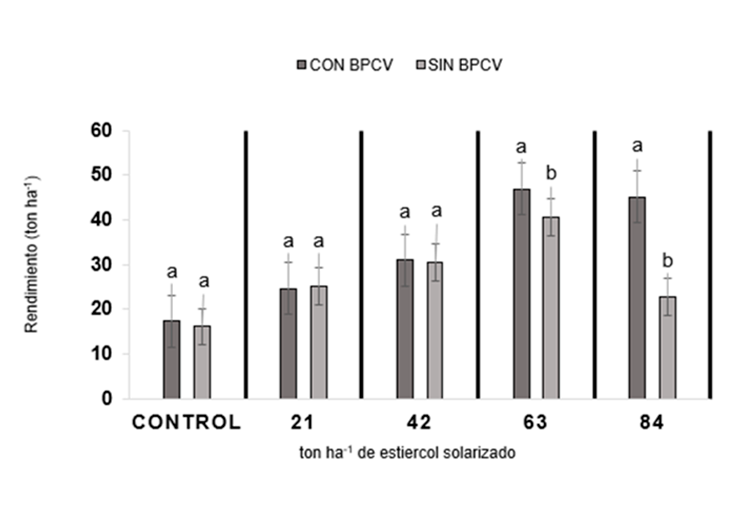
Modern agriculture demands strategies that integrate organic amendments and bioinputs to reduce dependence on synthetic fertilizers and restore soil health. This study aimed to evaluate the interaction between increasing doses of solarized bovine manure (0, 21, 42, 63 and 84 t ha-1) and inoculation with a consortium of plant growth-promoting bacteria (Azospirillum brasilense, Bacillus atrophaeus and Bacillus velezensis) on the yield and quality of melon (Cucumis melo L.). A randomized complete block design with a 5 × 2 factorial arrangement and four replications was used. A significant interaction was detected for yield; the dose of 63 t ha-1 with inoculation increased yield by 16.2% compared to the control, while the dose of 84 t ha-1 reduced productivity. Inoculation increased fruit and manure firmness and soluble solids. Integrating both bioinputs constitutes a viable biotechnological alternative for optimizing melon yield and commercial quality while promoting soil sustainability and crop profitability.
Downloads
References
Alrbaihat, M. R. 2023. Agricultural nano fertilizers: macronutrient types and applications review. In: Karkush, M.; Choudhury, D. and Han, J. (Eds.). Current trends in geotechnical engineering and construction. ICGECI 2022. Springer, Singapore. 325-340 pp. https://doi.org/10.1007/978-981-19-7358-1-26.
Barcia, T. A. Z.; Cevallos, J. C. M.; Vivas, J. R. M.; Almeida, J. A. A. y Macias, P. S. Z. 2025. Evaluación del efecto de la materia orgánica y iones sulfatos en suelos salinos sobre el crecimiento de Oryza sativa L. Recursos Naturales Producción y Sostenibilidad. 4(1):1-11. https://doi.org/10.61236/renpys.v4i1.999.
Cervantes-Vázquez, T. J. Á.; Preciado-Rangel, P.; Fortis-Hernández, M.; Valenzuela-García, A. A.; García-Hernández, J. L. y Cervantes-Vázquez, M. G. 2022. Efectos en el suelo por la aplicación de estiércol bovino y vermicompost en el cultivo de sandía (Citrullus lanatus). Terra Latinoamericana. 40(1):1-13. https://doi.org/10.28940/terra.v40i0.835.
Chen, X.; Ma, X.; Liu, Z.; Gu, H.; Fang, H.; Shen, Z. and Liu, J. 2025. Organic fertilizers increase microbial community diversity and stability, slowing down the transformation process of nutrient cycling. Environmental Microbiome. 20(130):1-14. https://doi.org/10.1186/s40793-025-00791-6.
Fletes, J. A. L.; Mancilla-Villa, O. R.; Martínez-Rodríguez, O. G. y Martínez-Martínez, R. 2025. Biofertilizantes como mitigadores de la degradación química y nutrimental del suelo con cultivo de melón. Agro-Divulgación. 5(6):e547. https://doi.org/10.54767/ad.v5i6.547.
Hernández-Ramírez, U.; Rojas-Hernández, S.; Gruintal-Santos, M. A.; Morales-Barrera, J.; Vázquez-Villamar, M. y Romero-Rosales, T. 2025. Efecto de tres fertilizantes orgánicos foliares en el crecimiento de Agastache mexicana subespecie mexicana (Lamiaceae). Polibotánica. 59(30):261-274. https://doi.org/10.18387/polibotanica.59.17.
Levario, E.; Saldivar, J.; Cobos-Mercado, I.; Torres-Montijo, L.; Álvarez, L. H. and Cervantes, F. J. 2025. Sustainable farming by implementing the water-energy-food nexus between piggery production and wheat cultivation. Energy for Sustainable Development. 85:101688. https://doi.org/10.1016/j.esd.2025.101688.
Li, J.; Zhao, X.; Su, X. and Wu, W. 2023. Lightweight detection networks for tea bud in complex agricultural environments via improved YOLO v4. Computers and Electronics in Agriculture. 211:107955. 12 p. https://doi.org/10.1016/j.compag.2023.107955.
López-Calderón, M. J.; Figueroa-Viramontes, U.; Fortis-Hernández, M.; Núñez-Hernández, G.; Ochoa-Martínez, E. y Sánchez-Duarte, J. I. 2015. Evaluación de dosis equivalentes de fertilizante y estiércol en la producción de maíz forrajero (Zea mays). Phyton. 84(1):8-13. https://doi.org/10.32604/phyton.2015.08408.
Lu, W.; Zhou, Y.; Ma, X.; Gao, J.; Guo, J.; Fan, X.; Xing, W.; Gao, W.; Lin, M. and Wang, R. 2025. Impacts of organic fertilizer substitution on soil ecosystem functions: synergistic effects of nutrients, enzyme activities, and microbial communities. Agronomy. 15(12):2798. https://doi.org/10.3390/agronomy15122798.
Luna-Fletes, J. A.; Mancilla-Villa, O. R.; Cruz-Crespo, E.; Can-Chulím, Á.; Martínez-Rodríguez, O. G. y Guevara-Gutiérrez, R. D. 2025. Enmiendas orgánicas en las características edáficas y el rendimiento de melón. Revista Mexicana de Ciencias Agrícolas. 16(5):e3773. https://doi.org/10.29312/remexca.v16i5.3773.
Luna-Fletes, J. A.; Ruiz-Andalón, C. A.; Mancilla-Villa, O. R.; Cruz-Crespo, E.; Can-Chulím, Á. y Martínez-Rodríguez, O. G. 2023. Inoculación de Metarhizium anisopliae, Beauveria bassiana y bacterias BPCV combinada con fertilizantes orgánicos en el cultivo de melón. Idesia (Arica). 41(4):73-82. https://doi.org/10.4067/S0718-34292023000400073.
Mayobre, C.; Gonzalo, M. J.; Vergés, M.; Guardia-Bersabé, G.; Jiménez-Sánchez, D.; Monforte, A. J.; García-Mas, J. and Pujol, M. 2025. Targeted editing and phenotypic profiling of CmOFP13 mutants reveal its role in melon fruit morphogenesis. Physiologia Plantarum 177(6):e70641. https://doi.org/10.1111/ppl.70641.
Mena-Violante, H. G.; Cruz-Hernández, A.; Paredes-López, O.; Gómez-Lim, M. Á. y Olalde-Portugal, V. 2009. Cambios relacionados con la textura de la fruta y mayor vida útil mediante la inoculación de la raíz de tomate con Bacillus subtilis BEB-13BS. Agrociencia. 43(6):559-567.
Pan, W.; Gao, L.; Xu, Y.; Guo, H.; Abdulla, A.; Abdurim, A.; Liu, X.; Gao, X. and Wu, H. 2026. Comparative effects of exogenous organic amendments on rhizosphere microbial communities and soil properties in continuous cropping watermelon. Microorganisms. 14(4):837. https://doi.org/10.3390/microorganisms14040837.
Quishpe-Franco, M. M.; Castillo-Pontón, M. S. y Zambrano-Álava, S. A. 2026. Rendimiento del cultivo de Cucumis sativus L. con la aplicación de bioestimulantes a base de algas marinas. Multidisciplinary Collaborative Journal. 4(1):261-284. https://doi.org/10.70881/mcj/v4/n1/125.
Reyes-Pérez, J. J.; Llerena-Ramos, L. T.; Jerez-Mompie, E. I.; López-Ortega, O. F.; Quinatoa-Lozada, E. F. y Espinosa-Palomeque, B. 2025. Respuesta agronómica a nanopartículas de quitosano e indicadores de calidad en frutos de pepino (Cucumis sativus L.). Chilean Journal of Agricultural y Animal Sciences. 41(2):250-263. https://doi.org/10.29393/CHJAAS41-23AGJU60023.
Shi, J.; Lu, Z.; Lu, T.; Luan, S. yang, Y.; Wu, Z.; Wang, Y. yang, J. and Han, X. 2026. Long-term differential fertilization strategies enhance soil quality and microbial metabolic functions: Evidence from a 45-year field experiment. Agriculture. 16(6):691. https://doi.org/10.3390/agriculture16060691.
Shi, T. S.; Collins, S. L. Yu, K.; Peñuelas, J.; Sardans, J.; Li, H. and Ye, J. S. 2024. A global meta-analysis on the effects of organic and inorganic fertilization on grasslands and croplands. Nature Communications. 15(1):3411-3421. https://doi.org/10.1038/s41467-024-47829-w.
Sun, T.; Zhao, Y.; Zhou, D.; Gao, Z. and Hu, X. 2023. Effects of amount, electric conductivity, and frequency of a nutrient solution on melon yield and flavor quality. Scientia Horticulturae. 310:111737. 10 p. https://doi.org/10.1016/j.scienta.2022.111737.
Vendruscolo, E. P.; Oliveira, P. R.; Campos, L. F. C.; Seleguini, A. y Lima, S. F. 2019. Método de siembra, fertilización nitrogenada e inoculación de bacterias diazotróficas para plantas de melón Cantaloupe. Revista Colombiana de Ciencias Hortícolas. 13(1):18-25. https://doi.org/10.17584/rcch.2019v13i1.9720.
Wen, M. Yang, S.; Huo, L.; He, P.; Xu, X.; Wang, C. and Zhou, W. 2022. Estimating nutrient uptake requirements for melon based on the QUEFTS model. Agronomy. 12(1):207. https://doi.org/10.3390/agronomy12010207.
Yu, X.; Liu, J.; Zhang, R.; Liu, E.; Fang, Z. and Yun, L. 2025. Characteristics of microbial communities at different soil depths in areas subjected to cattle manure application: A 1- and 10-year comparative study. Environmental Sciences Europe. 37(1):152-164. https://doi.org/10.1186/s12302-025-01161-2.
Zapata-Sarmiento, D. H.; Evangelista-Lozano, S.; Martínez-Ayala, A. L.; Rodríguez-Hernández, A. A.; Rodríguez-Monroy, M. y Sepúlveda-Jiménez, G. 2025. Mecanismos de tolerancia y respuesta antioxidante a metales pesados en Trichoderma. Terra Latinoamericana. 43(1):e1999. https://doi.org/10.28940/terra.v43i.1999.
Downloads
Published
Issue
Section
License
Copyright (c) 2026 Revista Mexicana de Ciencias Agrícolas

This work is licensed under a Creative Commons Attribution-NonCommercial 4.0 International License.
The authors who publish in Revista Mexicana de Ciencias Agrícolas accept the following conditions:
In accordance with copyright laws, Revista Mexicana de Ciencias Agrícolas recognizes and respects the authors’ moral right and ownership of property rights which will be transferred to the journal for dissemination in open access. Invariably, all the authors have to sign a letter of transfer of property rights and of originality of the article to Instituto Nacional de Investigaciones Forestales, Agrícolas y Pecuarias (INIFAP) [National Institute of Forestry, Agricultural and Livestock Research]. The author(s) must pay a fee for the reception of articles before proceeding to editorial review.
All the texts published by Revista Mexicana de Ciencias Agrícolas —with no exception— are distributed under a Creative Commons License Attribution-NonCommercial 4.0 International (CC BY-NC 4.0), which allows third parties to use the publication as long as the work’s authorship and its first publication in this journal are mentioned.
The author(s) can enter into independent and additional contractual agreements for the nonexclusive distribution of the version of the article published in Revista Mexicana de Ciencias Agrícolas (for example include it into an institutional repository or publish it in a book) as long as it is clearly and explicitly indicated that the work was published for the first time in Revista Mexicana de Ciencias Agrícolas.
For all the above, the authors shall send the Letter-transfer of Property Rights for the first publication duly filled in and signed by the author(s). This form must be sent as a PDF file to: revista_atm@yahoo.com.mx; cienciasagricola@inifap.gob.mx; remexca2017@gmail.
This work is licensed under a Creative Commons Attribution-Noncommercial 4.0 International license.