Growth and CO2 assimilation of Agave potatorum Zucc. supplied at different nutritional levels
DOI:
https://doi.org/10.29312/remexca.v17i4.4358Keywords:
área foliar, fotosíntesis, plantas micropropagadas, solución nutritivaAbstract
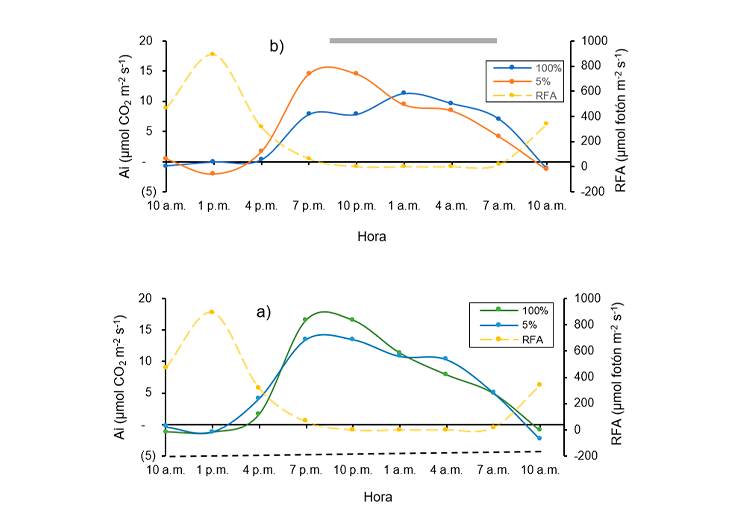
En el estado de Oaxaca, México, el Agave potatorum se colecta de poblaciones silvestres o se propaga mediante semillas en pequeñas extensiones y se utiliza para elaborar la bebida destilada mezcal. La especie se ha propagado in vitro y las plantas obtenidas se trasplantan a sustrato para su aclimatización durante 90 días y después se establecen en vivero durante 12 meses para alcanzar tamaño mayor, y al fertilizar las plantas se ha mejorado su crecimiento. El objetivo fue evaluar el área foliar y la tasa de asimilación de CO2 de plantas micropropagadas-aclimatizadas fertirrigadas con soluciones nutritivas California (Cal) o Steiner (St). Las plantas fertirrigadas con Cal-5% y con Cal-100% presentaron 20.8 y 27.7 hojas, 1 031.5 cm2 y 1 867.4 cm2 de área foliar, la roseta de 37 y 52.3 cm de diámetro, 19.5 y 29.5 cm de altura. La apertura estomática y asimilación de CO2 comenzó a las 16:00 h, al disminuir la radiación fotosintéticamente activa, alcanzando valores máximos de asimilación entre las 19:00 y 22:00 h. Las plantas fertirrigadas con Cal-100% y con St-100 % mostraron valores de asimilación de CO2, 17 y 11 µmol CO2 m-2 s-1, respectivamente.
Downloads
References
Badr, A. and Brüggemann, W. 2020. Comparative analysis of drought stress response of maize genotypes using chlorophyll fluorescence measurements and leaf relative water content. Photosynthetica. 58(SI):638-645. https://doi.org/10.32615/ps.2020.014.
Bautista-Castellanos, A. I.; Enríquez-del Valle, J. R.; Velasco-Velasco, V. A. y Rodríguez-Ortiz, G. 2020. Enraizado y aclimatación de Agave potatorum. Ecosistemas y Recursos Agropecuarios. 7(3):e2618. https://doi.org/10.19136/era.a7n3.2618.
Carrillo-Hernández, M. A.; Viguera, A. L. y Portillo, L. 2014. Observaciones sobre el comportamiento de estomas en plantas suculentas. Boletín Nakari. 25(2):27-30.
Cen-Cen, E.; Gómez-Merino, F. y Martínez- Hernández, A. 2015. Tolerancia de Agave tequilana a altas concentraciones de cationes metálicos divalentes. Polibotánica. 40(20):163-182.
Correa-Hernández, L.; Baltazar-Bernal, O.; Sánchez-Páez, R. and Bello-Bello, J. J. 2022. In vitro multiplication of agave tobala (Agave potatorum Zucc.) using ebb-and-flow bioreactor. South African Journal of Botany. 147:670-677. https://doi.org/10.1016/j.sajb.2022.03.009.
Cruz-García, H.; Campos-Ángeles, G. V.; Enríquez-del Valle, J. R.; Velasco-Velasco, V. A. y Rodríguez-Ortiz, G. 2017. Senescencia foliar en plantas micropropagadas de Agave americana durante su aclimatización. Revista Mexicana de Ciencias Agrícolas. 8(2):381-391.
Efthimiadou, A.; Bilalis, D.; Karkanis, A. and Froud-Williams, B. 2010. Combined organic/inorganic fertilization enhances soil quality and increased yield, photosynthesis and sustainability of sweet maize crops. Australian Journal of Crop Science. 4(9):722-729.
Enríquez-del Valle, J. R. 2008. La propagación y crecimiento de agaves. Fundación Produce Oaxaca AC. e Instituto Tecnológico del Valle de Oaxaca. México. 46 p.
Enríquez-del Valle, J. R.; Alcara-Vázquez, S. E.; Rodríguez-Ortiz, G.; Miguel-Luna, M. E. y Manuel-Vázquez, C. 2016. Fertirriego en vivero a plantas de Agave potatorum Zucc. micropropagadas-aclimatizadas. Revista Mexicana de Ciencias Agrícolas. 7(5):1167-1177.
Jarquín-Rosales, D.; Enríquez-del Valle, J. R.; Alpuche-Osorno, J. J.; Rodríguez-Ortiz, G.; Martin, M. P. and Campos-Ángeles, G. V. 2022. The effects of fertirrigation and Azospirillum brasilense inoculation on photosynthetic compounds of Agave angustifolia. Australian Journal of Crop Science. 16(01):162-168. https://doi.org/10.21475/ajcs.22.16.01.p3280.
Luna-Luna, S.; Enríquez-del Valle, J. R.; Rodríguez-Ortiz, G.; Carrillo-Rodríguez, J. C. y Velasco-Velasco, V. A. 2017. Anatomía y morfología de plantas micropropagadas-aclimatadas de Agave potatorum Zucc. fertirrigadas en vivero. Revista Fitotecnia Mexicana. 40(4):491-494.
Makino, A. 2011. Photosynthesis, grain yield, and nitrogen utilization in rice and wheat. Plant Physiology. 155(1):125-129.
Morales, I.; Martínez-Gutiérrez, G. A.; Cortés-Martínez, C. I.; Aquino-Bolaños, T.; Escamirosa-Tinoco, C. y Hernández-Tolentino, M. 2017. Crecimiento de Agave potatorum cultivado en ambientes contrastantes y fertirrigación. Revista Mexicana de Agroecosistemas. 4(2):18-27.
Nobel, P. S. 1976. Water relations and photosynthesis of a desert CAM plant, Agave deserti. Plant Physiol. 58(4):576-582.
Osipova, S. V.; Permyakov, A. V.; Permyakova, M. D.; Rudikovskaya, E. G.; Verchoturov, V. V. and Rudikovsky, A. V. 2019. Tolerance of the photosynthetic apparatus in recombinant lines of wheat adapting to water stress of varying intensity. Photosynthetica. 57(1):160-169. https://doi.org/10.32615/ps.2019.007.
Patishtán, P. J.; Rodríguez, G. R.; Zavala, G. F. y Jasso, C. D. 2010. Conductancia estomática y asimilación neta de CO2 en Sábila (Aloe vera Tourn.) bajo sequía. Revista Fitotecnia Mexicana. 33(4):305-314.
Pimienta-Barrios, E.; Zañudo-Hernández, J.; Nobel, P. y García-Galindo, J. 2005. Respuesta fisiológica a factores ambientales del agave azul (Agave tequilana Weber). Scientia-CUCBA. 7(2):85-97.
Pimienta-Barrios, E.; Zañudo-Hernández, J. y García-Galindo, J. 2006. Fotosíntesis estacional en plantas jóvenes de Agave tequilana. Agrociencia. 40(6):699-709.
Ramírez-Mosqueda, M. A.; Cárcamo-Corona, R. G.; Aguilar-Jiménez, D. and Bello-Bello J. J. 2022. Micropropagation of agave (Agave potatorum Zucc.) through direct organogénesis. Agrociencia. 56(6):1-11. https://doi.org/10.47163/agrociencia.v56i6.2823.
Sánchez-del Castillo, F. 1989. Hidroponia. Universidad Autónoma Chapingo. México. 194 p.
SAS Institute. 2022. The SAS system for Windows user´s guide. Release 9.4 SAS Institute. Cary, NC. USA. https://support.sas.com/en/documentation/install-center/94/installation-guide-forwindows.html.
Steiner, A. A. 1984. The universal nutrient solution. International society for soilless culture (ISOSC). In: Sixth International Congress on Soilless Culture Lunteren. 633-650 pp.
Downloads
Published
Issue
Section
License
Copyright (c) 2026 Revista Mexicana de Ciencias Agrícolas

This work is licensed under a Creative Commons Attribution-NonCommercial 4.0 International License.
The authors who publish in Revista Mexicana de Ciencias Agrícolas accept the following conditions:
In accordance with copyright laws, Revista Mexicana de Ciencias Agrícolas recognizes and respects the authors’ moral right and ownership of property rights which will be transferred to the journal for dissemination in open access. Invariably, all the authors have to sign a letter of transfer of property rights and of originality of the article to Instituto Nacional de Investigaciones Forestales, Agrícolas y Pecuarias (INIFAP) [National Institute of Forestry, Agricultural and Livestock Research]. The author(s) must pay a fee for the reception of articles before proceeding to editorial review.
All the texts published by Revista Mexicana de Ciencias Agrícolas —with no exception— are distributed under a Creative Commons License Attribution-NonCommercial 4.0 International (CC BY-NC 4.0), which allows third parties to use the publication as long as the work’s authorship and its first publication in this journal are mentioned.
The author(s) can enter into independent and additional contractual agreements for the nonexclusive distribution of the version of the article published in Revista Mexicana de Ciencias Agrícolas (for example include it into an institutional repository or publish it in a book) as long as it is clearly and explicitly indicated that the work was published for the first time in Revista Mexicana de Ciencias Agrícolas.
For all the above, the authors shall send the Letter-transfer of Property Rights for the first publication duly filled in and signed by the author(s). This form must be sent as a PDF file to: revista_atm@yahoo.com.mx; cienciasagricola@inifap.gob.mx; remexca2017@gmail.
This work is licensed under a Creative Commons Attribution-Noncommercial 4.0 International license.