Effects of citrulline and humic acids on germination, vigor and biomass in Cajanus cajan (L.) Millsp.
DOI:
https://doi.org/10.29312/remexca.v17i6.4264Keywords:
biostimulant, feasibility, fodder, germplasmAbstract
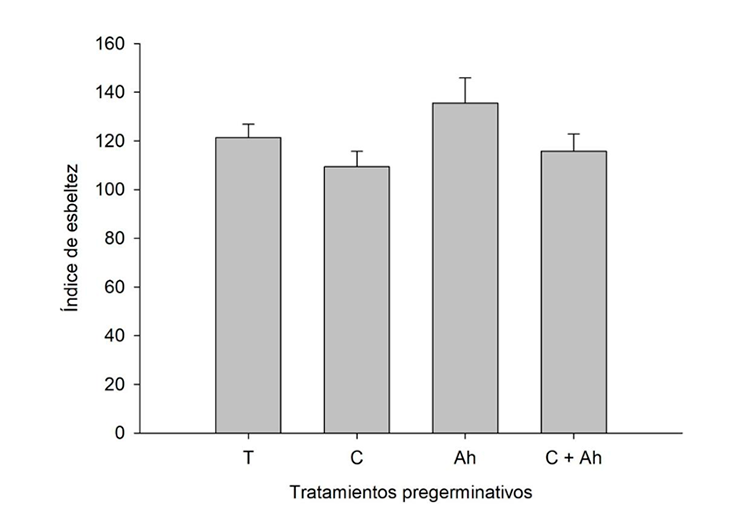
Pigeon peas, Cajanus cajan (L.) Millsp, are a legume of great nutritional importance due to their nutritional quality and ability to adapt to adverse conditions. The study was conducted in 2024 at the College of Postgraduates, Montecillo, Texcoco, State of Mexico, with the aim of evaluating the effects of citrulline and humic acids, applied as treatments, on germination, vigor and biomass accumulation in Cajanus cajan (L.) Millsp., under greenhouse conditions. Four treatments were evaluated: control without treatment, citrulline (1 g L-1), humic acids (1 ml L-1), and the combination of citrulline + humic acids, using a completely randomized design. The germination variables evaluated, such as the number of seeds germinated, germination percentage, mean germination time, mean germination rate, germination uncertainty index, and germination synchrony index, did not show significant differences between treatments, indicating that the seed had high viability. At 120 days after sowing, significant differences were observed in leaf dry matter accumulation, with greater values in treatments with citrulline and citrulline + humic acids. The slenderness index did not differ between treatments; however, the plant vigor index was higher in the combination of citrulline + humic acids compared to the control. The results indicate that, although pre-germination treatments did not affect germination, citrulline promoted the accumulation of leaf biomass and, when combined with humic acids, promoted greater plant vigor.
Downloads
References
Atuna, R. A.; Mensah, M. A. S.; Koomson, G.; Akabanda, F.; Dorvlo, S. Y. and Amagloh, F. K. 2023. Physico-functional and nutritional characteristics of germinated pigeon pea (Cajanus cajan) flour as a functional food ingredient. Reino Unido. Scientific Reports. 13(1):16627. https://doi.org/10.1038/s41598-023-43607-8.
Basahi, M. 2021. Humic acid improved germination rate, seedling growth and antioxidant system of pea Pisum sativum L. var. Alicia grown in water polluted with CdCl2; Estados Unidos. AIMS Environmental Science. 8(4):358-370.
Bopape, F. L.; Beukes, C. W.; Katlego, K.; Hassen, A. I.; Steenkamp, E. T. and Gwata, E. T. 2022. Symbiotic performance and characterization of pigeonpea Cajanus cajan L. Millsp. rhizobia occurring in South African Soils. Suiza. Agriculture. 13(1):30. https://doi.org/10.3390/agriculture13010030.
Canellas, L. P.; Canellas, N. O. A.; da Silva, R. M.; Spaccini, R.; Mota, G. P. and Olivares, F. L. 2022. Biostimulants using humic substances and plant-growth-promoting bacteria: effects on cassava Manihot esculentus and okra Abelmoschus esculentus yield. Suiza. Agronomy. 13(1):80- https://doi.org/10.3390/agronomy13010080.
Farcella, F.; Benech R. L.; Sánchez, R. A. and Ghersa, C. M. 2000. Modeling seedling emergence. Paises Bajos. Field Crops Research. 67(2):123-139. https://www.sciencedirect.com/science/article/abs/pii/S0378429000000885.
Farooq, U.; Ashraf, M. A.; Iqbal, M. and Rasheed, R. 2025. Effect of citrulline seed priming on growth, photosynthesis, redox equilibrium, secondary metabolic enzymes, metal sequestration and nutrient acquisition in sunflower Helianthus annuus L. under chromium toxicity. Suiza. BioMetals. 38(6):1991-2018. https://www.semanticscholar.org/paper/Effect-of-citrulline-seed-priming-on growth%2C-.
ISTA. 2018. International Seed Testing Association International rules for seed testing. International Association Seed Testing Association Suiza. 300 p.
Joshi, V. and Fernie, A. R. 2017. Citrulline metabolism in plants. Estados Unidos. Amino Acids. 49(9):1543-1559. https://link.springer.com/article/10.1007/s00726-017-2468-4.
Kim, S. H.; Choe, Z. R. and Kang, J. H. 1987. Vigor determination in barley seeds by the multiple criteria. Corea del sur. Korean Journal of Crop Science. 32(4):417-424. https://www.koreascience.or.kr/article/JAKO198711922896118.view.
Maguire, J. D. 1962. Speed of germination: aid in selection and evaluation for seedling emergence and vigor. Estados Unidos. Crop Science. 2(1):176-177. https://doi.org/10.2135/cropsci1962.0011183X000200020033xDigital.
Mapelli, S.; Brambilla, I. and Bertani, A. 2001. Free amino acids in walnut kernels and young seedlings. Reino Unido. Tree Physiology. 21(17):1299-1302. https://doi.org/10.1093/treephys/21.17.1299.
Mapelli, S.; Brambilla, I. y Bertani, A. 2001. Aminoácidos libres en nueces y plántulas jóvenes. Italia. Fisíologia del Árbol. 21(17):1299-1302. https://www.mendeley.com/catalogue/f116f090-d1be-3f0d-a2a6-3d2b0c453451/.
Nabi, F.; Sarfaraz, A.; Kama, R.; Kanwal, R. and Li, H. 2025. Structure-based function of humic acid in abiotic stress alleviation in plants: a review. Suiza. Plants. 14(13):1916. https://doi.org/10.3390/plants14131916.
Nardi, S.; Schiavon, M. and Francioso, O. 2021. Chemical structure and biological activity of humic substances define their role as plant growth promoters. Suiza. Molecules. 26(8):2256. https://www.mdpi.com/1420-3049/26/8/2256.
Nicchio, B.; Boer, C. A.; Siqueira, T. P.; Vasconcelos, A. C. P.; Resende, W. S. y Lana, R. M. Q. 2013. Ácido húmico e bioativador no tratamento de sementes de milho. Brasil. Journal of Agronomic Sciences. Umuarama. 2(2): 61-73.
Nunes, R. O.; Domiciano, G. A.; Alves, W. S.; Melo, A. C. A.; Nogueira, F. C. S.; Canellas, L. P.; Olivares, F. L.; Zingali, R. B. and Soares, M. R. 2019. Evaluation of the effects of humic acids on maize root architecture by label-free proteomics analysis. Reino Unido. Scientific Reports. 9(1):12019. https://doi.org/10.1038/s41598-019-48509-2.
Ranal, M. A. and Santana, D. G. de. 2006. How and why to measure the germination process? Brasil. Revista Brasileira de Botânica. 29(1):1-11. https://www.scielo.br/j/rbb/a/ZfHBJBGtpDcXzfknWfmNM4G/?format=html&lang=en.
Reed, R. C.; Bradford, K. J. and Khanday, I. 2022. Seed germination and vigor: ensuring crop sustainability in a changing climate. Reino Unido. Heredity. 128(6): 450-459. https://www.nature.com/articles/s41437-022-00497-2.
Rodrigues, L. A.; Alves, C. Z.; Rego, C. H. Q.; Silva, T. R. B. D. and Silva, J. B. D. 2017. Humic acid on germination and vigor of corn seeds. Brasil. Revista Caatinga. 30(1): 149-154. https://doi.org/10.1590/1983-21252017v30n116rc.
Santos, M. P.; Zupunski, M.; Monda, H.; Gralian, J.; James, A.; Grossmann, G.; Lamar, R. T. and Zandonadi, D. B. 2025. Humic acids modify root architecture in Arabidopsis through H⁺-ATPase-dependent target of rapamycin activation in concert with a²⁺ and ROS signaling. Italia. Chemical and Biological Technologies in Agriculture. 12(1):1-15. https://link.springer.com/article/10.1186/s40538-025-00764-4.
Santos, M. P.; Zupunski, M.; Monda, H.; Gralian, J.; James, A.; Grossmann, G.; Lamar, R. T. and Zandonadi, D. B. 2025. Humic acids modify root architecture in Arabidopsis through H+-ATPase-dependent target of rapamycin activation in concert with Ca2+ and ROS signaling. Suiza. Chemical and Biological Technologies in Agriculture. 12(47):1-19. https://doi.org/10.1186/s40538-025-00764-4.
Song, Q.; Joshi, M.; Di Piazza, J. and Joshi, V. 2020. Functional Relevance of citrulline in the vegetative tissues of watermelon during abiotic stresses. Suiza. Frontiers in Plant Science. 11(512):1-13. https://doi.org/10.3389/fpls.2020.00512.
Torres, A.; Cova, A. y Varela, D. 2008. Efecto del proceso de germinación de granos de Cajanus cajan en la composición nutricional, ácidos grasos, antioxidantes y bioaccesibilidad. Chile. Revista Chilena de Nutrición. 45(5):323-332. https://www.scielo.cl/scielo.php?script=sci-arttext&pid=S0717-75182018000500323.
Vendruscolo, E. P.; Santos, O. F. and Alves, C. Z. 2014. Substâncias húmicas na qualidade fisiológica de sementes de sorgo. Brasil. Journal of Agronomic Sciences. Umuarama. 3(2):169-177.
Vitti, A.; Coviello, L.; Nuzzaci, M.; Vinci, G.; Deligiannakis, Y.; Giannakopoulos, E.; Ronga, D.; Piccolo, A.; Scopa, A. and Drosos, M. 2024. Biostimulation of humic acids on Lepidium sativum L. regulated by their content of stable phenolic O⋅ radicals. Suiza. Chemical and Biological Technologies in Agriculture. 11(2):92. https://link.springer.com/article/10.1186/s40538-024-00613-w.
Wen, Z.; Lu, X.; Wen, J.; Wang, Z. and Chai, M. 2024. Physical seed dormancy in legumes: molecular advances and perspectives. Suiza. Plants. 13(11):1473. https://www.mdpi.com/2223-7747/13/11/1473.
Yang, F.; Yuan, Y.; Liu, Q.; Zhang, X.; Gai, S.; Jin, Y. and Cheng, K. 2023. Artificial humic acid promotes growth of maize seedlings under alkali conditions. Países Bajos. Environmental Pollution. 327:121588. https://doi.org/10.1016/j.envpol.2023.121588.
Downloads
Published
Issue
Section
License
Copyright (c) 2026 Revista Mexicana de Ciencias Agrícolas

This work is licensed under a Creative Commons Attribution-NonCommercial 4.0 International License.
The authors who publish in Revista Mexicana de Ciencias Agrícolas accept the following conditions:
In accordance with copyright laws, Revista Mexicana de Ciencias Agrícolas recognizes and respects the authors’ moral right and ownership of property rights which will be transferred to the journal for dissemination in open access. Invariably, all the authors have to sign a letter of transfer of property rights and of originality of the article to Instituto Nacional de Investigaciones Forestales, Agrícolas y Pecuarias (INIFAP) [National Institute of Forestry, Agricultural and Livestock Research]. The author(s) must pay a fee for the reception of articles before proceeding to editorial review.
All the texts published by Revista Mexicana de Ciencias Agrícolas —with no exception— are distributed under a Creative Commons License Attribution-NonCommercial 4.0 International (CC BY-NC 4.0), which allows third parties to use the publication as long as the work’s authorship and its first publication in this journal are mentioned.
The author(s) can enter into independent and additional contractual agreements for the nonexclusive distribution of the version of the article published in Revista Mexicana de Ciencias Agrícolas (for example include it into an institutional repository or publish it in a book) as long as it is clearly and explicitly indicated that the work was published for the first time in Revista Mexicana de Ciencias Agrícolas.
For all the above, the authors shall send the Letter-transfer of Property Rights for the first publication duly filled in and signed by the author(s). This form must be sent as a PDF file to: revista_atm@yahoo.com.mx; cienciasagricola@inifap.gob.mx; remexca2017@gmail.
This work is licensed under a Creative Commons Attribution-Noncommercial 4.0 International license.