Determination of sample size in polyembryonic citrus seeds using robust methods
DOI:
https://doi.org/10.29312/remexca.v17i2.4247Keywords:
apomixis, citrus, maximum distance method, nonparametric bootstrapAbstract
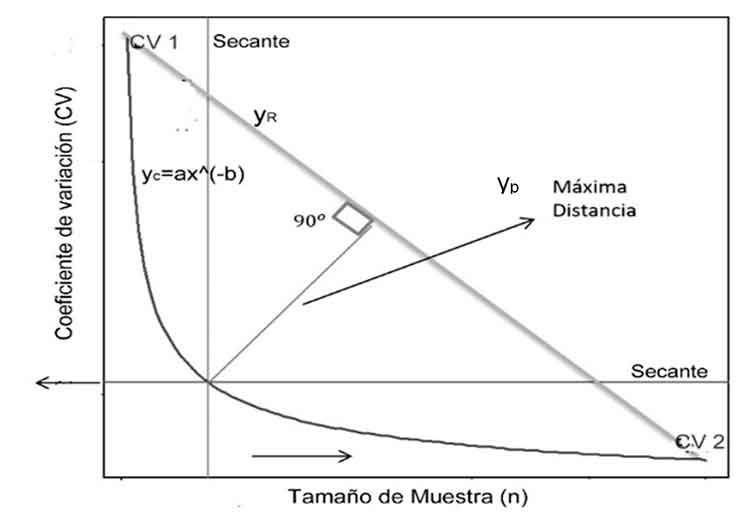
The percentage of polyembryonic seeds and the number of embryos per seed (NE) are variables commonly used to estimate the degree of polyembryony in citrus, a characteristic used as an indicator of clonal or vegetative propagation of selected genotypes. However, many studies omit the description of the methods used to determine the appropriate sample size in the quantification of these variables. The purpose of this work was to propose a robust statistical methodology for calculating the optimal sample size in polyembryonic studies in citrus using the maximum distance method and the F-test. Five citrus genotypes (C-35 citrange, Volkamer lemon, Amblicarpa mandarin, Valencia orange and Mineola tangelo) were evaluated over two harvest cycles (2020 and 2021) by counting the number of embryos in 100 seeds per genotype. Since the variable of the number of embryos per seed was not normally distributed, the maximum distance method was applied using coefficients of variation calculated with the winsorized mean and a nonparametric bootstrap procedure. The results indicated optimal sample sizes of 26 to 28 seeds, with coefficients of variation of 6% to 11%, depending on the genotype. It was concluded that, for the genotypes evaluated, analyzing samples of up to 50 seeds is sufficient to estimate the degree of polyembryony accurately.
Downloads
References
Andrade-Rodríguez, M.; Villegas-Monter, A. y García-Velázquez, A. 2003. Características morfológicas del fruto y poliembrionía de tres portainjertos de cítricos. Revista Chapingo Serie Horticultura. México. 9(2):255-263.
Arellano-Durán, N.; Villegas-Monter, A. and Muñoz-Orozco, A. 2018. Optimum simple size in quantitative characteristics on seed of polyembryonic mango. Revista Brasileira de Fruticultura. Jaboticabal. 40(3):(e-519). doi.org/10.1590/0100-29452018519.
Avanza, M. M.; Bramardi, S. J. y Mazza, S. M. 2010. Tamaño óptimo de muestra para evaluar el patrón de crecimiento de frutos de naranjo ‘Valencia late’. Revista Brasileira de Fruticultura. Jaboticabal. 32(4):1154-1163. doi.org/10.1590/S0100-29452010005000132.
Barnett, V. D. and Lewis, T. 1994. Outliers in statistical data. 3rd Ed. Chichester, UK. John Wiley & Sons. 69-72 pp.
Darlan-Ramos, J.; Neto, S. E.; Castro, N. E. A.; Martis, P. C. C. y Correia, M. G. 2006. Poliembrionia e caracterizaçao de frutos de citrumelo ‘Swingle’ e de Poncirus trifoliata. Ciência e Agrotecnologia, Lavras. 30(1):88-91. doi.org/10.1590/S1413-70542006000100012.
Davison, A. C. and Hinkley, D. V. 1997. Bootstrap methods and their application. 1st Ed. UK: Cambridge University Press. 45-54 pp.
Duarte, F. E. V.; Barros, D. R.; Girari, E. A.; Soares-Filho, W. Dos S. e Passos, O. S. 2013. Poliembrionia e atributos morfológicos de sementes de porta-enxertos de citros. Revista Brasileira de Fruticultura. Jaboticabal. 35(1):246-254. doi.org/10.1590/S0100-29452013000100028.
Efron, B. and Tibshirani, R. J. 1986. Bootstrap methods for standard errors, confidence intervals and other measures of statistical accuracy. Statistical Science. EE. UU. 1(1):54-75.
Erceg-Hurn, D. M. and Mirosevich, V. M. 2008. Modern robust statistical methods: an easy way to maximize the accuracy and power of your research. American Psychologist. EE. UU. 63(7):591-601. doi.org/10.1037/0003-066X.63.7.591.
Kepiro, J. L. and Roose, M. L. 2010. AFLP markers closely linked to a major gene essential for nucellar embryony (apomixis) in Citrus maxima × Poncirus trifoliata. Tree Genetics & Genomes. 6(1):1-11. doi.org/10.1007/s11295-009-0223-z.
Kishore, K.; Monika, N.; Rinchen, D.; Lepcha B. and Pandey, B. 2012. Polyembryony and seedling emergence traits in Apomitic citrus. Scientia Horticulturae. Amsterdam. 1(138):101-107.
Lessman, K. J. and Atkins, R. E. 1963. Comparisons of planning arrangements and estimates of optimum hill plot for grain sorghum yield tests. Crop Science. Madison. 3(1):477-481.
Leys, C.; Klein, O.; Bernard, P. and Licata, L. 2013. Detecting outliers: do not use standard deviation around the mean, use absolute deviation around the median. Journal of Experimental Social Psychology. EE. UU. 49(4):764-766. doi.org/10.1016/j.jesp.2013.03.013.
Lorentz, H. L.; Erichsen, R. E. y Lucio, A. D. 2012. Proposta de método para estimação de tamanho de parcela para culturas agrícolas. Revista Ceres. Brasil. 59(6):772-780.
Martínez-Ochoa. E. C.; Andrade, M. R.; Rocandio, M. R. and Villegas, M. A. 2012. Identification of zygotic and nucellar seedlings in polyembryonic mango cultivars. Pesquisa Agropecuária Brasileira. Brasilia. 47(11):1629-1636. doi.org/10.1590/S0100-204X2012001100010.
Paranaiba, P. F.; Ferreira, D. F. y De Morais, A. R. 2009. Tamanho ótimo de parcelas experimentais: proposicao de metodos de estimacao. Revista Brasileira de Biometria. São Paulo. 27(2):255-268.
Ramírez, I. C.; Barrera, C. J. y Correa, J. C. 2013. Efecto del tamaño de muestra y el número de réplicas bootstrap. Ingeniería y Competitividad. Colombia. 15(1):93-101.
Santos, C. Q.; De, J. E. A.; Girardi, E. L.; Vieira, C. A.; Da, S. L. y Soares-Filho, W. S. 2015. Tamanho ótimo de amostras de frutos e de sementes para determinação da poliembrionia em citros. Revista Brasileira de Fruticultura. Jaboticabal. 1(37):172-178. doi.org/10.1590/0100-2945-063/14.
SAS Institute. 2003. SAS (versión 9.4) [Software]. SAS Institute. www.sas.com.
Villegas-Monter, A.; Martínez-Ochoa, E. D. C.; Andrade-Rodríguez, M. and Villegas-Velásquez, I. 2023. Citrus polyembryony. In: Gonzatto-Pereira, M. and Santos, J. S. (Eds.). Advances in citrus research horticultural and human health aspects. London, UK. 1-15 pp. http://dx.doi.org/10.5772/intechopen.105994.
Downloads
Published
Issue
Section
License
Copyright (c) 2026 Revista Mexicana de Ciencias Agrícolas

This work is licensed under a Creative Commons Attribution-NonCommercial 4.0 International License.
The authors who publish in Revista Mexicana de Ciencias Agrícolas accept the following conditions:
In accordance with copyright laws, Revista Mexicana de Ciencias Agrícolas recognizes and respects the authors’ moral right and ownership of property rights which will be transferred to the journal for dissemination in open access. Invariably, all the authors have to sign a letter of transfer of property rights and of originality of the article to Instituto Nacional de Investigaciones Forestales, Agrícolas y Pecuarias (INIFAP) [National Institute of Forestry, Agricultural and Livestock Research]. The author(s) must pay a fee for the reception of articles before proceeding to editorial review.
All the texts published by Revista Mexicana de Ciencias Agrícolas —with no exception— are distributed under a Creative Commons License Attribution-NonCommercial 4.0 International (CC BY-NC 4.0), which allows third parties to use the publication as long as the work’s authorship and its first publication in this journal are mentioned.
The author(s) can enter into independent and additional contractual agreements for the nonexclusive distribution of the version of the article published in Revista Mexicana de Ciencias Agrícolas (for example include it into an institutional repository or publish it in a book) as long as it is clearly and explicitly indicated that the work was published for the first time in Revista Mexicana de Ciencias Agrícolas.
For all the above, the authors shall send the Letter-transfer of Property Rights for the first publication duly filled in and signed by the author(s). This form must be sent as a PDF file to: revista_atm@yahoo.com.mx; cienciasagricola@inifap.gob.mx; remexca2017@gmail.
This work is licensed under a Creative Commons Attribution-Noncommercial 4.0 International license.