Territorial potential for the reintegration of agricultural waste for the agroecological transition in Veracruz
DOI:
https://doi.org/10.29312/remexca.v17i5.4168Keywords:
diversidad agrícola, prácticas agroecológicas, territorializaciónAbstract
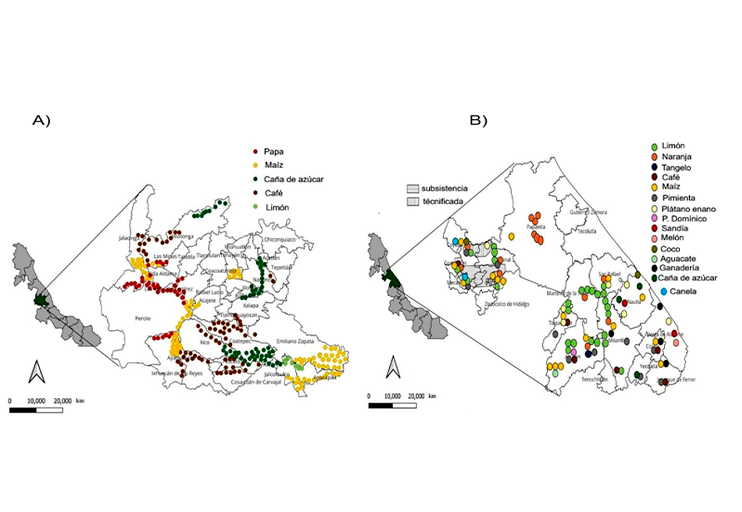
The agroecological transition at the territorial level must promote reconnection between the production of agricultural products, food, goods and waste in the environments where they are generated, so it is necessary to understand their potential for reintegration into agroecosystems. In 2023, territories with greater agricultural diversity were identified within the rural development districts of the state of Veracruz, and the availability of agricultural waste for territorial reintegration was estimated through the analysis of statistical information and knowledge from key informants. The rural development districts of Fortín, Coatepec and Martínez de la Torre showed high agricultural diversity (3.45, 2.83 and 2.53, respectively), associated with a greater variety of agricultural waste; in contrast, productive diversity (3.05, 2.52 and 2.28) is related to the potential for agricultural waste production. The rural development districts of Coatepec and Martínez de la Torre showed greater territorial potential to generate agricultural waste. Estimates of losses in Coatepec for coffee crops range from 3 to 5%; for its part, Martínez de la Torre showed 1.5-5% agricultural waste generation in lemon. This methodology represents a first step to identify the potential of agricultural waste in territories for its reintegration through agroecological practices.
Downloads
References
Asava, S.; Sharma, D.; Yadav, K. D.; Bansal, T.; Kamyab, H. y Haq, M. 2026. Evaluation of sugarcane residues and organic waste combinations in sustainable bin composting. Biomass and Bioenergy. 206(1):108662-108676. https://doi.org/10.1016/j.biombioe.2025.108662.
Castillo-González, E.; De Medina-Salas, L.; Giraldi-Díaz; M. R. and Sánchez-Noguez, C. 2021. Vermicomposting: a valorization alternative for corn cob waste. Applied Sciences.11(12):5692. https://doi.org/10.3390/app11125692.
Chauhan, A.; Islam, F.; Imran, A.; Ikram, A.; Zahoor, T.; Khurshid, S. and Shah, M. A. 2023. A review on waste valorization, biotechnological utilization, and management of potato. Food Science & Nutrition. 11(10):5773-5785. https://doi.org/10.1002/fsn3.3546.
De Medina-Salas, L.; Giraldi-Díaz, M. R.; Castillo-González, E. and Morales-Mendoza, L. E. 2020. Valorization of orange peel waste using precomposting and vermicomposting processes. Sustainability. 12(18):7626. https://doi.org/10.3390/su12187626.
Franco-Valderrama, A. M.; Caamal-Cauich, I.; Pat-Fernández, V. G. y Pérez-Soto, F. 2021. Characterization of Persian lime production (Citrus x latifolia; Tanaka ex Q. Jiménez). AgroProductividad. 3(1):1-9. https://doi.org/10.32854/agrop.v14i11.1883.
Gallardo-López, F.; Riestra-Díaz, D.; Schunemann, A. A. y Martínez-Dávila, J. P. 2002. Factores que determinan la diversidad agrícola y los propósitos de producción en los agroecosistemas del municipio de Paso de ovejas, Veracruz, México. Agrociencia. 36(4):495-505.
Gutiérrez-Briceño, I.; Pérez-Ramírez, I.; Yacamán-Ochoa, C.; Lucantoni, D.; Vizuete, B.; Hevia, V.; González, J. A.; Schwarz, G. and García-Llorente, M. 2025. Unravelling agroecological transitions: a multidimensional study of the horticultural sector in Madrid. International Journal of Agricultural Sustainability. 23(1):2551423. https://doi.org/10.1080/14735903.2025.2551423.
Landeros-Sánchez, C.; Moreno-Seceña, J. C.; Nikolskii-Gavrilov, L. y Bakhlaeva-Egorova, O. 2011. Impacto de la agricultura sobre la biodiversidad. In: la biodiversidad en Veracruz: estudio de estado. Cruz-Angón, A. (Ed). Consejo Nacional de la Biodiversidad (CONABIO). México. 477-491 pp.
Linares-Gabriel, A.; Gallardo-López, F.; Villarreal, M.; Landeros-Sánchez, C. y López-Romero, G. 2021. De actividades productivas a estrategias sociales: floricultores de la zona central de Veracruz. Agricultura, Sociedad y Desarrollo. 18(4):603-622. https://doi.org/10.22231/asyd.v18i4.1546.
Long, N. 2007. Sociología del desarrollo: una perspectiva centrada en el actor. In: una sociología del desarrollo orientada al actor. Horacia-Fajardo, V. M. y Rodríguez, P. (Eds.). Centro de Investigaciones y Estudios Superiores de Antropología Social (CIESAS) y el Colegio de San Luis (COLSAN). México. 33-73 pp.
Magrini, M. B.; Martin, G.; Magne, M. A.; Duru, M.; Couix, N.; Hazard, L. and Plumecocq, G. 2019. Agroecological transition from farms to territorialized agri-food systems: issues and drivers. In: agroecological transitions: from theory to practice in local participatory design. Bergez, J. E.; Audouin, E. and Therond, O. (Eds.). Springer: Cham. Switzerland. 69-98 pp. https://doi.org/10.1007/978-3-030-01953-2-5.
Monroy-Sais, A. S.; Tobin, D.; Bellon, M. R.; Astier, M.; Cibrián-Jaramillo, A.; Gálvez-Reyes, N.; Mastretta-Yanes, A; Ruiz-Arocho, J.; Wegier, A. and Chen, Y. H. 2024. Smallholder farmers’ diverse values in maize landrace conservation: a case study from Chiapas, Mexico. Journal of Rural Studies. 110 (1):103347-103359.
Page-Reeves, J.; Rivera, M.; Lozano, E.; Regino, L.; Tellez, M.; Mendivil-Aguayo, P.; Moore, M.; Rodríguez, D. P.; Kalves, A.; Crocker, R.; Aragon, A.; Vasquez, C.; Perez, J.; Thomas, R. J.; Bearer, E. L. and Murray-Krezan, C. 2025. Interpreting discordant results in mixed-method research: data triangulation, participant voices, and epistemic issues in health research. International Journal Of social research methodology. 1(1):1-22. https://doi.org/10.1080/13645579.2025.2569682.
Pérez, O. K. N. y Aguilar, R. N. 2019. Agroturismo cañero en Fortín de las Flores, Veracruz, México. Trayectorias. 21(49):28-48.
Romero, L. F. P.; Domínguez, J. K. R.; Pariona, L. D. P. y Soriano, E. M. C. 2020. Evaluación de pérdidas postcosecha de naranjas (Citrus sinensis) producidas en la selva central del Perú. Revista Iberoamericana de Tecnología Postcosecha. 21(2):01-15.
Shannon, C. E. and Weaver, W. 1963. The mathematical theory of communication. The Bell System Technical Journal. 21(3):379-423.
SIAP. 2023. Servicio de Información Agroalimentaria y Pesquera. Anuario estadístico de la producción agrícola del estado de Veracruz, México. https://nube.siap.gob.mx/cierreagricola.
Solano, A. H.; Reyes, M. H.; Lara, R. A. V.; Garrido, C. J. R. y Morán, A. C. 2023. Cosecha de la caña de azúcar y su impacto social en Veracruz. Revista Biológico-Agropecuaria Tuxpan. 11(1):13-20. https://doi.org/10.47808/revistabioagro.v11i1.456.
Tamilselvan, K.; Sundarajan, S.; Ramakrishna, S.; Amirul, A. A. A. and Vigneswari, S. 2024. Sustainable valorisation of coffee husk into value added product in the context of circular bioeconomy. Food and Bioproducts Processing. 145(1):187-202. https://doi.org/10.1016/j.fbp.2024.03.008.
Wezel, A.; Herren, B. G.; Kerr, R. B.; Barrios, E.; Gonçalves, A. L. R. and Sinclair, F. 2020. Agroecological principles and elements and their implications for transitioning to sustainable food systems. A review. Agronomy for Sustainable Development. 40(1):1-13. https://doi.org/10.1007/s13593-020-00646-z.
Widiastuti, Y.; Koestiono, D.; Setiawan, B. and Riana, F. D. 2024. Sustainability analysis of the robusta coffee supply chain in banyuwangi regency: a multidimensional approach with rap-robusta coffee method. Nongye Jixie Xuebao/transactions of the Chinese Society of Agricultural Machinery. 55(2):28-48. https://doi.org/10.62321/issn.1000-1298.2024.02.03.
Xu, R.; Chen, J.; Yan, N.; Xu, B.; Lou, Z. and Xu, L. 2025. High-value utilization of agricultural residues based on component characteristics: potentiality and challenges. Journal of Bioresources and Bioproducts. 10(3):271-294. https://doi.org/10.1016/j.jobab.2025.01.002.
Downloads
Published
Issue
Section
License
Copyright (c) 2026 Revista Mexicana de Ciencias Agrícolas

This work is licensed under a Creative Commons Attribution-NonCommercial 4.0 International License.
The authors who publish in Revista Mexicana de Ciencias Agrícolas accept the following conditions:
In accordance with copyright laws, Revista Mexicana de Ciencias Agrícolas recognizes and respects the authors’ moral right and ownership of property rights which will be transferred to the journal for dissemination in open access. Invariably, all the authors have to sign a letter of transfer of property rights and of originality of the article to Instituto Nacional de Investigaciones Forestales, Agrícolas y Pecuarias (INIFAP) [National Institute of Forestry, Agricultural and Livestock Research]. The author(s) must pay a fee for the reception of articles before proceeding to editorial review.
All the texts published by Revista Mexicana de Ciencias Agrícolas —with no exception— are distributed under a Creative Commons License Attribution-NonCommercial 4.0 International (CC BY-NC 4.0), which allows third parties to use the publication as long as the work’s authorship and its first publication in this journal are mentioned.
The author(s) can enter into independent and additional contractual agreements for the nonexclusive distribution of the version of the article published in Revista Mexicana de Ciencias Agrícolas (for example include it into an institutional repository or publish it in a book) as long as it is clearly and explicitly indicated that the work was published for the first time in Revista Mexicana de Ciencias Agrícolas.
For all the above, the authors shall send the Letter-transfer of Property Rights for the first publication duly filled in and signed by the author(s). This form must be sent as a PDF file to: revista_atm@yahoo.com.mx; cienciasagricola@inifap.gob.mx; remexca2017@gmail.
This work is licensed under a Creative Commons Attribution-Noncommercial 4.0 International license.