Spatiotemporal dynamics of the use of agricultural technologies in DDR 043 Durango
DOI:
https://doi.org/10.29312/remexca.v17i3.4065Keywords:
agricultural landscape, agricultural technification, rural development districtAbstract
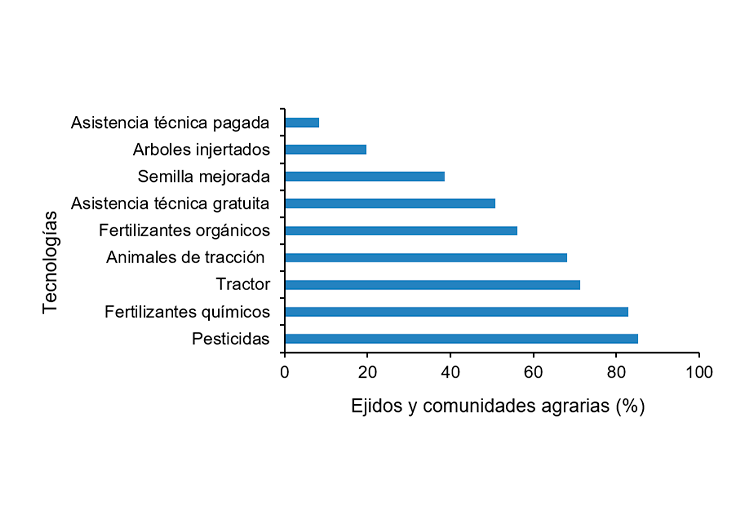
The study analyzed the evolution of agricultural technology use in the Rural Development District 043, Durango, from 1991 to 2019 and its impact on productivity and agricultural area. Based on spatiotemporal analyses using GISs and descriptive statistics, there was a more than 50% increase in the technified area with irrigation between 1991 and 2007, which remains stable until 2021, and a greater use of chemical fertilizers and herbicides. These results show rural modernization processes and sustainability challenges.
Downloads
References
Aguilar, R. N. y Ortiz, R. H. 2000. Generación, adopción y transferencia de tecnología: retos del desarrollo sustentable en el agro mexicano. Estudios Agrarios. 26:95-119.
CEDRSSA. 2020. Centro de Estudios para el Desarrollo Rural Sustentable y la Soberanía Alimentaria. Uso y regulación de herbicidas en México. Ciudad de México: Cámara de Diputados. 7-25 pp. http://www.cedrssa.gob.mx/files/b/13/76Herbicidas.pdf.
CONACYT y SAGARPA. 2018. “Anexo b. Demandas específicas del sector 2018”. Fondo Sectorial de Investigación en Materias, Agrícola, Pecuaria, Acuacultura, Agrobiotecnología y Recursos Fitogenéticos. 257-261 pp.
DOF. 1987. Diario Oficial de la Federación. Acuerdo por el que se establecen distritos de desarrollo rural. Cámara de Diputados del H. Congreso de la Unión.
DOF. 1988. Diario Oficial de la Federación. Ley de Distritos de Desarrollo Rural. Cámara de Diputados del H. Congreso de la Unión.
DOF. 2021. Diario Oficial de la Federación. Ley de Desarrollo Rural Sustentable. Cámara de Diputados del H. Congreso de la Unión.
FAO. 2015. Organización de las Naciones Unidas para la Alimentación y la Agricultura). El estado mundial de la agricultura y la alimentación: La innovación en la agricultura familiar. Roma, Italia. 39- 43 pp. http://www.fao.org/3/a-i4040s.pdf.
FAO. 2018. México Rural del siglo XXI. https://openknowledge.fao.org/server/api/core/bitstreams/295643c3-5c32-4dd6-84f9-4fd51f9b1949/content.
Gaitán-Cremaschi, D.; Palomo, I.; Molina, S. B.; Groot, R. y Gómez-Baggethun, E. 2017. Applicability of economic instruments for protecting ecosystem services from cultural agrarian landscapes in Doñana, SW Spain. Land Use Policy. 61:185-195. https://doi.org/10.1016/j.landusepol.2016.11.011.
Gutiérrez-Yurrita, P. J. 2007. La importancia del paisaje en la configuración ecológica del medio ambiental como bien jurídico. En: memorias en extenso del 2do. Foro Internacional Biológico-Agropecuario. Sección Biología.185-198 pp.
Hernández, J. M. 2014. Condiciones de trabajo e ingreso en la agricultura intensiva mexicana. Análisis Económico. 29(71):137-160.
Hernández, Ch. J.; González, L. I. y Galván-Ismael, M. Q. 2021. La Productividad en los distritos Agrícolas de Durango, México. Asian Journal of Latin American Studies. 34(3):1-32. https://doi.org/10.22945/ajlas.2021.34.3.1.
INEGI. 2007. Instituto Nacional de Estadística y Geografía. Unidades de producción con problemas para desarrollar la actividad agropecuaria o forestal según problemática principal. Tabulados Censo Agrícola, Ganadero y Forestal 2007.
INEGI. 2016. Actualización del marco censal agropecuario 2016. https://www.inegi.org.mx/programas/amca/2016/#Tabulados.
INEGI. 2020. Sistema de Cuentas Nacionales [Data set]. https://www.inegi.org.mx/temas/pib/default.html#Tabulados.
INEGI. 2023. Resultados definitivos del Censo Agropecuario 2022. https://www.inegi.org.mx/.
Jones, P. J.; Andersen, E.; Capitani, C.; Ribeiro, S. C.; Griffiths, G. H.; Loupa-Ramos, I. y Wascher, D. M. 2016. The EU societal awareness of landscape indicator: A review of its meaning, utility and performance across different scales. Land Use Policy. 53:112-122. https://doi.org/10.1016/j.landusepol.2015.01.038.
Kizos, T. and Spilanis, I. 2004. The transformation of landscape: modeling policy and social impacts on the agricultural landscape of Lesvos. Nat Resour Model. 17(4):321-358. https://doi.org/10.1111/j.1939-7445.2004.tb00140.x.
Molinero, H. F. 2013. Atlas de los paisajes agrarios de España. Ministerio de Agricultura, Alimentación y Medio Ambiente (MAGRAMA). 574 p.
Palacio-Prieto, J. L.; Sánchez-Salazar, M. T.; Casado, I. J. M.; Propin, F. E.; Delgado, C. J.; Velázquez, M. A. y Camacho, R. C. G. 2004. Indicadores para la caracterización y el ordenamiento territorial. Secretaría de desarrollo social; Secretaría de Medio Ambiente y Recursos Naturales; Instituto Nacional de Ecología; Universidad Nacional Autónoma de México. 23-37 pp.
Popa, A. 2014. Decoding Agricultural Landscape. In: Crăciun, C.; Bostenaru-Dan, M. Ed. Planning and designing sustainable and resilient landscapes. Springer Geography. Springer, Dordrecht. 33-41 pp. https://doi.org/10.1007/978-94-017-8536-5-3.
Rendón, M. R.; Roldán, S. E.; Hernández, H. B. y Cadena, Í. P. 2015. Los procesos de extensión rural en México. Revista Mexicana de Ciencias Agrícolas. 6(1):151-161.
Robles, B. H. M. 2016. La organización económica de los pequeños y medianos productores, presente y futuro del campo mexicano. Serie documento de trabajo núm. 232. Rimisp México. 42-45 pp.
Solleiro, R. J. L.; Aguilar, Á. J. y Sánchez, A. L. G. 2015. Configuración del sistema de innovación del sector agroalimentario mexicano. Revista Mexicana de Agronegocios. (36):1254-1264. https://doi.org/10.22004/ag.econ.200168.
Trucíos-Caciano, R.; Ramos-Cruz, C. M.; Miguel-Valle, E.; Moreno-Sepúlveda, Y.; Estrada-Ávalos, J. y Martínez- Sifuentes, A. R. 2022. Vegetación y uso de suelo en el estado Durango. Dinámica de cambios desde 2002 hasta 2016. Agrofaz. 4(2):27-34.
Trucíos-Caciano, R.; Valenzuela-Nuñez, L. M.; Ríos-Saucedo, J. C.; Rivera- González, M. y Estrada- Ávalos, J. 2012. cambio de uso de suelo en Coahuila y Durango. Revista Chapingo Serie Zonas Áridas. 11(2):68-74.
Urrutia-Cárdenas, A.; García-Barrios, L. y Calixto-Pérez, E. 2023. Manejo ecológico integral de arvenses en México. Publicaciones pronaces soberanía alimentaria. CONHACYT. Gaceta MEIA. 22:03-19.
Vázquez, O. L. y Cruz, G. Y. 2014. La importancia de la pequeña y mediana agricultura para garantizar el derecho a la alimentación. The hunger project México. https://thp.org.mx/2014/03/10/la-importancia-de-la-pequena-y-mediana-agricultura-para-garantizar-el-derecho-a-la-alimentacion/.
Yang, W.; Ventilador, B.; Tan, J.; Lin, J. y Shao, T. 2022. The spatial perception and spatial feature of rural cultural landscape in the context of rural tourism. Sustainability. 14(7):4370. https://doi.org/10.3390/su14074370.
Downloads
Published
Issue
Section
License
Copyright (c) 2026 Revista Mexicana de Ciencias Agrícolas

This work is licensed under a Creative Commons Attribution-NonCommercial 4.0 International License.
The authors who publish in Revista Mexicana de Ciencias Agrícolas accept the following conditions:
In accordance with copyright laws, Revista Mexicana de Ciencias Agrícolas recognizes and respects the authors’ moral right and ownership of property rights which will be transferred to the journal for dissemination in open access. Invariably, all the authors have to sign a letter of transfer of property rights and of originality of the article to Instituto Nacional de Investigaciones Forestales, Agrícolas y Pecuarias (INIFAP) [National Institute of Forestry, Agricultural and Livestock Research]. The author(s) must pay a fee for the reception of articles before proceeding to editorial review.
All the texts published by Revista Mexicana de Ciencias Agrícolas —with no exception— are distributed under a Creative Commons License Attribution-NonCommercial 4.0 International (CC BY-NC 4.0), which allows third parties to use the publication as long as the work’s authorship and its first publication in this journal are mentioned.
The author(s) can enter into independent and additional contractual agreements for the nonexclusive distribution of the version of the article published in Revista Mexicana de Ciencias Agrícolas (for example include it into an institutional repository or publish it in a book) as long as it is clearly and explicitly indicated that the work was published for the first time in Revista Mexicana de Ciencias Agrícolas.
For all the above, the authors shall send the Letter-transfer of Property Rights for the first publication duly filled in and signed by the author(s). This form must be sent as a PDF file to: revista_atm@yahoo.com.mx; cienciasagricola@inifap.gob.mx; remexca2017@gmail.
This work is licensed under a Creative Commons Attribution-Noncommercial 4.0 International license.