Intrinsic and extrinsic attributes influencing the selection of dehydrated fruits and vegetables in Mexico
DOI:
https://doi.org/10.29312/remexca.v17i4.4037Keywords:
conservation, demand, analytical hierarchical processAbstract
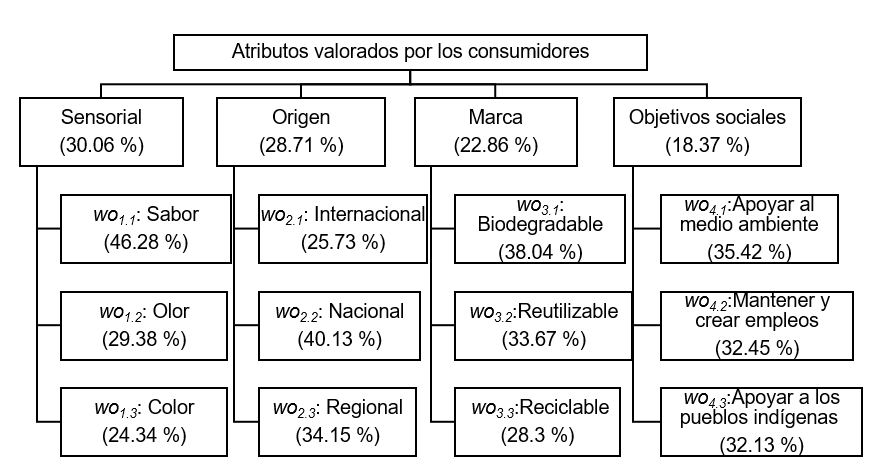
For dehydrated products to access new markets and for their production to generate economic development opportunities in rural production units, it is necessary to understand consumer demands. The objective was to analyze consumer behavior and identify the main attributes that lead consumers to make the decision to purchase dehydrated fruits and vegetables in Mexico in 2023. A survey was administered to 704 households nationwide and analyzed using Pearson correlation, cluster analysis and the analytic hierarchy process (AHP). It was identified that the most valued attributes were flavor (46.28%), being a national product (40.13%), biodegradable packaging (38.04%), and supporting environmental conservation (35.42%). In addition, four groups of consumers were identified who differed in the attributes valued when purchasing dehydrated products; however, flavor was the most important across all groups. Companies that produce dehydrated fruit and vegetable products can create generic promotion strategies that highlight the attributes of health, environmental care, product quality and social responsibility.
Downloads
References
Acosta-Medina, J. K; Contreras-Pacheco, O. E. y Pedraza-Avella, A. C. 2023. Empaques vs bioempaques para alimentos: una comparación a nivel técnica, comercial y normativa. Ingeniería y competitividad. 25(3):1-19. https://doi.org/10.25100/iyc.v25i3.13066. DOI: https://doi.org/10.25100/iyc.v25i3.13066
Al-Makhroumi, N.; Al-Khusaibi, M.; Al-Subhi, L.; Al-Bulushi, I. and Al-Ruzeiqi, M. 2022. Development and validation of a food safety knowledge, attitudes, and self-reported practices (KAP) questionnaire in Omani consumers. Journal of the Saudi Society of Agricultural Sciences. 21(7):485-492. https://doi.org/10.1016/j.jssas.2022.02.001. DOI: https://doi.org/10.1016/j.jssas.2022.02.001
Anggraeni, A. and Rachmanita. R. E. 2015. Effects of brand love, personality and image on word of mouth; the case of local fashion brands among young consumers. Procedia-Social and Behavioral Sciences. 211:442-447. https://doi.org/10.1016/j.sbspro.2015.11.058. DOI: https://doi.org/10.1016/j.sbspro.2015.11.058
Anigstein, M. S. 2019. Estrategias familiares de provisión de alimentos en hogares de mujeres-madres trabajadoras de la ciudad de Santiago de Chile. Revista Chilena de Nutrición. 46(2):129-136. http://dx.doi.org/10.4067/s0717-75182019000200129. DOI: https://doi.org/10.4067/s0717-75182019000200129
Arroyave-Ramírez, C. A. y Arrubla-Zapata, J. P. 2018. Tendencias de producción y consumo ecológico. Revista Espacios. 39(7):1-14.
Barbu, A.; Ion, V. A.; Frîncu, M.; Defta, N.; Lagunovschi-Luchian, V. and Bădulescu, L. A. 2023. Organic vegetable chips: exploring romanian consumers’ preferences in relation to socio-demographic factors. Foods. 12(18):1-18. https://doi.org/10.3390/foods12183374. DOI: https://doi.org/10.3390/foods12183374
Barragán-Hernández, W.; Mahecha-Ledesma, L.; Olivera-Ángel, M. y Angulo-Arizala, J. 2021. ¿Cómo los consumidores valoran atributos de calidad de carne bovina y su disposición a pago? Biotecnología en el sector agropecuario y agroindustrial. 19(1):167-179. https://doi.org/10.18684/bsaa. DOI: https://doi.org/10.18684/bsaa.v19.n1.2021.1622
Carroll, B. A; y Ahuvia, A. C. 2006. Algunos antecedentes y resultados del amor a la marca. Marketing Letters. 17(2):79-89. https://doi.org/10.1007/s11002-006-4219-2. DOI: https://doi.org/10.1007/s11002-006-4219-2
Castillejo, J. L.; Colom, A. J.; Pérez-Geta, P. M. A.; Neira, T. R.; Sarramona, J.; Touriñán, J. M. y Vázquez, G. 2011. Educación para el consumo. Educación XX1. 14(1):35-58. DOI: https://doi.org/10.5944/educxx1.14.1.262
Da Silva, R. D.; Harrar, D. A. y Paz, G. A. 2019. Selección de atributos de frutas deshidratadas: análisis conjunto de elección. Anales. 19(1):57-76.
Estrada-Domínguez, J. E.; Cantú-Mata, J. L.; Torres-Castillo, F. y Barajas-Ávila, E. 2020. Factores que influyen en el consumidor para la adquisición de productos sustentables. Interciencia. 45(1):36-41.
Gould, S. J. 1988. Consumer attitudes toward health and health care: a differential perspective. Journal of Consumer Affair. 22(1):96-118. https://doi.org/10.1111/j.1745-6606.1988.tb00215.x. DOI: https://doi.org/10.1111/j.1745-6606.1988.tb00215.x
Gutiérrez, C. J. y Martín, G. M. 1998. Atributos extrínsecos del producto: las señales de la calidad. In anales de estudios económicos y empresariales. Secretariado de Publicaciones. 13:81-116.
Hernández, J. G.; Espinosa, C. F.; Rodríguez, J. E.; Chacín, R. J. G.; Toloza, S. C. A.; Arenas, T M. K.; Carrillo, S. S. M. y Bermúdez. P. V. J. 2018. Sobre el uso adecuado del coeficiente de correlación de Pearson: definición, propiedades y suposiciones. Archivos Venezolanos de Farmacología y Terapéutica. 37(5):587-601.
INEGI. 2023. Instituto Nacional de Estadística y Geografía. México en cifras. https://www.inegi.org.mx/app/areasgeograficas/#collapse-Resumen.
Leyva-Hernández, S. N.; Terán-Bustamante, A. y Arango-Ramírez, P. M. 2024. Patrones de consume alimentario con enfoque socialmente responsable. Revista de Ciencias Sociales. 30(2):80-95.
López, G.; León, L. L. P. y Espejel, B. J. E. 2019. El camote deshidratado como una nueva alternativa de consumo saludable para los sonorenses. Revista Inclusiones. 6(esp):50-65.
Massaglia, S.; Borra, D.; Peano, C.; Sottile, F. and Merlino, V. M. 2019. Consumer preference heterogeneity evaluation in fruit and vegetable purchasing decisions using the best-worst approach. Foods. 8(7):1-16. https://doi.org/10.3390/foods8070266. DOI: https://doi.org/10.3390/foods8070266
Matiz, J. D. Á. 2025. Marketing 4.0: la clave de la transformación comercial para pequeños productores agrícolas en Colombia. In: los agronegocios y sus transiciones hacia la sostenibilidad. Correa, A. G. y Regino, V. J. (Eds.). Primera edición. Ediciones Unisalle. Bogotá, Colombia. 151-176 pp. https://doi.org/0000-0001-9090-3411.
Miramontes-Escobar H. A.; Prado-Guzmán G. A.; Toledo-Palomera M. J.; Báez-García J. E. y Sáyago-Ayerdi S. G. 2020. Perfil nutricional según niveles socioeconómicos y menús proporcionados en un comedor social de México. Universidad y Salud. 22(3):203-212. https://doi.org/10.22267/rus.202203.192. DOI: https://doi.org/10.22267/rus.202203.192
Mohd-Suki, N. 2016. Green product purchase intention: impact of green brands, attitude, and knowledge. British Food Journal. 118(12):2893-2910. https://doi.org/10.1108/BFJ-06-2016-0295. DOI: https://doi.org/10.1108/BFJ-06-2016-0295
Mónaco, F.; De Marinis, P. and Sali, G. 2024. Consumers’ attitudes towards whole dried figs attributes: a preliminary study in Italy. Agriculture. 14(12):1-15. https://doi.org/10.3390/agriculture14122163. DOI: https://doi.org/10.3390/agriculture14122163
Mora, V. A. P.; Díaz, R. M.; Lora, D. O. L. y Pérez, O. 2023. Validación por juicio de expertos de un cuestionario sobre conocimientos, actitudes y prácticas del consumo de frutas y verduras. Interciencia. 48(1):46-50.
Moreno-Colom, S. y Boràs-Català, V. 2021. Menos tiempo de cocina, más tiempo de consumo: ¿más igualdad de género? Revista de Economía Crítica. 31:121-138. DOI: https://doi.org/10.46661/rec.10543
Pocol, C. B.; Marinescu, V.; Amuza, A.; Cadar, R. L. and Rodideal, A. A. 2020. Sustainable vs unsustainable food consumption behaviour: a study among students from Romania, Bulgaria and Moldova. Sustainability. 12(11):1-21. https://doi.org/10.3390/su12114699. DOI: https://doi.org/10.3390/su12114699
Ríos, E. I. R.; Romero, A. E. M. y Aguilar, G. W. S. 2025. Amor de marca como mediador entre estímulos emocionales y lealtad en consumidores jóvenes de Machala, Ecuador. Sciencevolution. 4(2):72-80. https://doi.org/10.61325/ser.v4i2.182. DOI: https://doi.org/10.61325/ser.v4i2.182
Rivera, C.; Contreras, F.; Ariza, W.; Bonilla, S. y Cruz, A. 2019. Los empaques biodegradables, una respuesta a la consciencia ambiental de los consumidores. Realidad Empresarial. 7:2-8. https://doi.org/10.5377/reuca.v0i7.7830. DOI: https://doi.org/10.5377/reuca.v0i7.7830
Rodríguez, M. N. 2003. La bioestadística y su papel en la investigación en salud. Revista Colombiana de Estadística. 26(1):77-87.
Salinas, C. M. A. y Vílchez, S. E. P. 2024. Los empaques eco amigables de productos tecnológicos: una alternativa para reducir la contaminación. Revista Científica Cuidado y Salud Pública. 4(2):61-69. https://doi.org/10.53684/csp.v4i2.104.
Sánchez-Toledano, B. I.; Borja-Bravo, M.; Zegbe, J. A. and Quintero, S. X. A. 2024. Perception of dehydrated products by Mexican consumers. Future Foods. 10:1-9. https://doi.org/10.1016/j.fufo.2024.100491. DOI: https://doi.org/10.1016/j.fufo.2024.100491
Siró, I.; Kápolna, E.; Kápolna, B. and Lugasi, A. 2008. Functional food. Product development, marketing and consumer acceptance-a review. Appetite. 51(3):456-467. http://dx.doi.org/10.1016/j. appet.2008.05.06. DOI: https://doi.org/10.1016/j.appet.2008.05.060
Tabares, M. S. y Lochmuller, C. 2013. Propuesta de un espacio multidimensional para la gestión por procesos. Un estudio de caso. Estudios Gerenciales. 29(127):22-230. DOI: https://doi.org/10.1016/j.estger.2013.05.010
Tarancón, P.; Fernández-Serrano, P. y Besada, C. 2020. ¿Qué fruta elegir en cada momento? La percepción del consumidor relativa a la fruta fresca, cortada y deshidratada. Agrícola Vergel. 429:257-266.
Torres. L. L. E.; Barrantes, A. L. E.; Gómez, C. D. y Brenes, G. A. C. 2025. Preferencias de consumidores comerciales respecto a atributos extrínsecos de productos agrícolas. E-Agronegocios. 11(1):43-65. https://doi.org/10.18845/ea.v11i1.7081. DOI: https://doi.org/10.18845/ea.v11i1.7081
Vega, A.; Chacana, M. y Lemus, R. 2006. La Industria de los alimentos deshidratados y la importancia del control de procesos. Revista Chilena para la Industria de Alimentos. Indualimentos. 9(42):50-67.
Yuting, S. and Liang, C. 2020. Factors determining consumers´purchase intentions towards dried fruit. International Journal of Fruit Science. 20(2):1072-1096. https://doi.org/10.1080/15538362.2020.1774477. DOI: https://doi.org/10.1080/15538362.2020.1774477
Downloads
Published
Issue
Section
License
Copyright (c) 2026 Revista Mexicana de Ciencias Agrícolas

This work is licensed under a Creative Commons Attribution-NonCommercial 4.0 International License.
The authors who publish in Revista Mexicana de Ciencias Agrícolas accept the following conditions:
In accordance with copyright laws, Revista Mexicana de Ciencias Agrícolas recognizes and respects the authors’ moral right and ownership of property rights which will be transferred to the journal for dissemination in open access. Invariably, all the authors have to sign a letter of transfer of property rights and of originality of the article to Instituto Nacional de Investigaciones Forestales, Agrícolas y Pecuarias (INIFAP) [National Institute of Forestry, Agricultural and Livestock Research]. The author(s) must pay a fee for the reception of articles before proceeding to editorial review.
All the texts published by Revista Mexicana de Ciencias Agrícolas —with no exception— are distributed under a Creative Commons License Attribution-NonCommercial 4.0 International (CC BY-NC 4.0), which allows third parties to use the publication as long as the work’s authorship and its first publication in this journal are mentioned.
The author(s) can enter into independent and additional contractual agreements for the nonexclusive distribution of the version of the article published in Revista Mexicana de Ciencias Agrícolas (for example include it into an institutional repository or publish it in a book) as long as it is clearly and explicitly indicated that the work was published for the first time in Revista Mexicana de Ciencias Agrícolas.
For all the above, the authors shall send the Letter-transfer of Property Rights for the first publication duly filled in and signed by the author(s). This form must be sent as a PDF file to: revista_atm@yahoo.com.mx; cienciasagricola@inifap.gob.mx; remexca2017@gmail.
This work is licensed under a Creative Commons Attribution-Noncommercial 4.0 International license.