Loss of agricultural soil from 2009-2024 in Celaya, Guanajuato
DOI:
https://doi.org/10.29312/remexca.v16i8.3866Keywords:
Phaseolus vulgaris L., Zea mays L., disuse of agricultural land, VARIAbstract
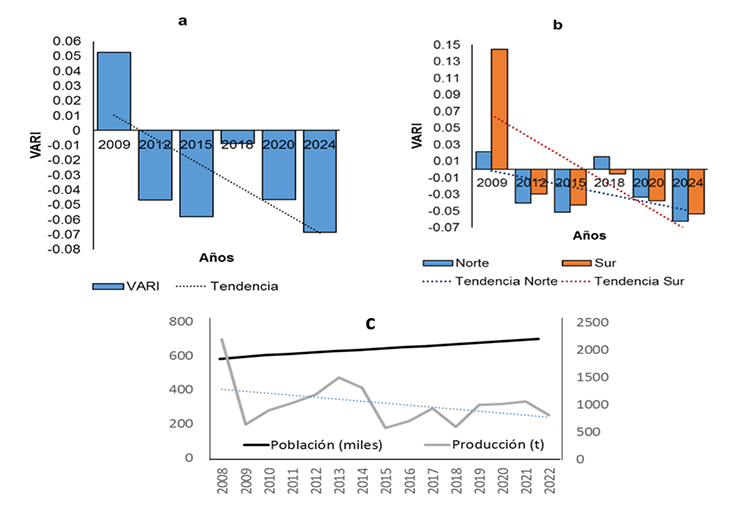
Urban and industrial growth, along with the abandonment of agricultural land, reduces the area to produce food, which compromises the food security of the population. Establishing the dynamics of land-use change allows actions to be applied to mitigate its negative impact. The research aimed to determine the change in land use to estimate the magnitude of the reduction in agricultural land area in the municipality of Celaya, Guanajuato. To this end, the outlines of the municipal agricultural area from 2009 were updated over high-resolution images from the Google Earth Geographic Information System of 2024; of the resulting polygons, their water use condition was determined, and based on this, the potential impact on corn and bean production was calculated. The results show that in 15 years, Celaya has lost 4 647 agricultural hectares; 41% were destined for urban use, 20% for industry, 7% for roads, and 32% remain unused. The loss of agricultural land use was confirmed by the decrease in the visible atmospherically resistant index from 0.05 to -0.02. Most of the change in land use from agricultural to urban and industrial originates from well-based irrigation, while the change to disuse originates from rainfed land. The impact on agricultural production is the loss of almost 8 000 t of beans. Nevertheless, corn has increased its area sown by nearly 4 000 ha at the expense of reductions in other crops.
Downloads
References
Adame-Martínez, S.; Sánchez-Nájera, R. M. y Hoyos-Castillo, G. D. C. 2020. Factores socioterritoriales de cambio de uso de suelo en el centro de México: caso oriente de la Zona Metropolitana de Toluca, México. Revista Universitaria de Geografía. 29(1):153-183. http://dx.doi.org/10.52292/j.rug.2020.29.1.0006.
Banco Mundial. 2024. Agricultura y alimentos. Obtenido de panorama general. https://www.bancomundial.org/es/topic/agriculture/overview.
Bautista-Robles, V.; Ken-Rodríguez, C. A. y Kaita, H. 2021. El papel de la agricultura en la seguridad alimentaria de las comunidades rurales de Quintana Roo: un ciclo autosostenido. Estud. Soc. Rev. Aliment. Contemp. Desarro. Reg. 30(56):1-31. http://www.scielo.org.mx/scielo.php?.
Bonilla, C. Y. 2024. El desarrollo agrario del Bajío, una visión regional de largo plazo: tendencias y transiciones. Oficio. Revista de Historia e Interdisciplina. 19:207-227. https://doi.org/10.15174/orhi.vi19.11.
Chuncho-Juca, L.; Uriguen-Aguirre, P. y Apolo-Vivanco, N. 2021. Ecuador: análisis económico del desarrollo del sector agropecuario e industrial en el periodo 2000-2018. Revista Científica y Tecnológica UPSE. 8(1):8-17. https://doi.org/10.26423/rctu.v8i1.547.
De Alba-Rosano, C. F.; Ceccon, E.; Romero-Calcerrada, R. y Rosete-Vergés, F. 2020. Revisión sistemática de cuarenta años de análisis de cambio de uso del suelo en México mediante sistemas de información geográfica. Revista de Geografía Espacios. 10(20):139-162. https://doi.org/10.25074/07197209.20.1740.
Espinosa-Espinosa, J. L.; Palacios-Vélez, E.; Tijerina-Chávez, L.; Ortiz-Solorio, C. A.; Exebio-García, A. y Landeros-Sánchez, C. 2018. Factores que afectan la producción agrícola bajo riego: cómo medirlos y estudiar su efecto. Tecnología y Ciencias del Agua. 9(2):175-191.
FAO. 2021. Organización de las Naciones Unidas para la Alimentación y la Agricultura (FAO). El estado de los recursos de tierras y aguas del mundo para la alimentación y la agricultura Sistemas al límite. Informe de síntesis 2021. Rome, Italia. 39 p. https://doi.org/10.4060/cb7654es.
García, M. E. 2004. Modificaciones al sistema de clasificación climática de Köppen. Instituto de Geografía-Universidad Nacional Autónoma de México (UNAM). Serie libros núm. 6. 90 p.
Gitelson, A. A.; Stark, R.; Grits, U.; Rundquist, D.; Kaufman, Y. and Derry, D. 2002. Vegetation and soil lines invisible spectral space: a concept and technique for remote estimation of vegetation fraction. International Journal of Remote Sensing. 23(13):2537-2562. https://doi.org/10.1080/01431160110107806.
Hernández-Cavazos, M. C.; Alanís-Rodríguez, E.; García, R. S.; Molina-Guerra, V. M.; Jiménez-Pérez, J.; Aguirre-Calderón, O. A. y Rodríguez, L. G. C. 2024. Análisis del cambio de uso de suelo en los bosques de galería de Linares, Nuevo León. Revista Mexicana de Ciencias Forestales. 15(83):155-167. https://doi.org/10.29298/rmcf.v15i83.1442.
Hernández-Pérez, E.; García-Franco, J. G.; Vázquez, G. y Cantellano-Rosas, E. 2022. Cambio de uso de suelo y fragmentación del paisaje en el centro de Veracruz, México (1989-2015). Madera y Bosques. 28(1):1-22. https://doi.org/10.21829/myb.2022.2812294.
INEGI. 2024. Instituto Nacional de Estadística, Geografía e Informática. Censos de población y vivienda 2010 y 2020. Tabulados interactivos. https://www.inegi.org.mx/sistemas/Olap/Proyectos/bd/censos/cpv2020/pt.asp.
Jiménez-Muñoz, J. C.; Sobrino, J. A.; Plaza, A.; Guanter, L.; Moreno, J. and Martínez, P. 2009. Comparison between fractional vegetation cover retrievals from vegetation indices and spectral mixture analysis: case study of proba/chris data over an agricultural area. Sensors. 9(02):768-793. https://doi.org/10.3390/s90200768.
Macrotrends. 2024. Celaya, México Metro Area Population 1950-2024. https://www.macrotrends.net/global-metrics/cities/21827/celaya/population.
Maxwell, S. 2025. Farmland abandonment worldwide: the detrimental factor of agricultural crisis. Science Insights. 46(2):1741-1748. https//doi.org/10.15354/si.25.re1150.
Municipio de Celaya. 2021. Programa de gobierno 2021-2024 Celaya con futuro. https://www.celaya.gob.mx/wpcontent/uploads/2022/04/programacelayacomprimido.pdf. 34-41 pp.
Oropeza-Sandoval, D. y Leyva-Picazo, V. 2020. El Crecimiento urbano y sus consecuencias en la movilidad. Anuario de Espacios Urbanos. 129-155 pp.
Pérez-Hernández, M. J.; Hernández-Acosta, E.; Sánchez-Jiménez, R.; González-Gervacio, C. y Madrigal Reyes, S. 2021. Dinámica de cambios de uso de suelo y vegetación por actividades antropogénicas en Zaachila, Oaxaca. Revista Mexicana de Ciencias Forestales. 12(66):26-45. https://doi.org/10.29298/rmcf.v12i66.894.
Paredes-Melesio, R.; Mandujano-Bueno, A.; Gámez-Vázquez, A. J. y García-Nieto, H. 2011. Actualización del mapa de uso del suelo agrícola en el estado de Guanajuato. Revista Mexicana de Ciencias Agrícolas. 2(1):85-96.
Sandoval-García, R.; González-Cubas, R. y Jiménez-Pérez, J. 2021. Análisis multitemporal del cambio en la cobertura del suelo en la Mixteca Alta Oaxaqueña. Revista Mexicana de Ciencias Forestales. 12(66):96-121. https://doi.org/10.29298/rmcf.v12i66.816.
SAGARPA. 2017a. Secretaría de Agricultura, Ganadería, Desarrollo Rural, Pesca y Alimentación. Frijol mexicano. Planeación Agrícola Nacional 2017-2030. Ciudad de México, DF. México. 20 p.
SAGARPA. 2017b. Secretaría de Agricultura, Ganadería, Desarrollo Rural, Pesca y Alimentación. Maíz grano blanco y amarillo. Planeación Agrícola Nacional 2017-2030, 22. Ciudad de México, DF. México. 28 p.
Schneider, C. A.; Rasband, W. S. and Eliceiri, K. W. 2012. NIH Image to ImageJ: 25 years of image analysis. Nature Methods. 97(7):671-675. https://doi.org/10.1038/nmeth.2089.
SIAP. 2014-2024. Servicio de Información Agroalimentaria y Pesquera. Anuario estadístico de la producción agrícola. Gobierno de México, SADER. https://nube.agricultura.gob.mx/cierre-agricola/.
Published
How to Cite
Issue
Section
License
Copyright (c) 2025 Revista Mexicana de Ciencias Agrícolas

This work is licensed under a Creative Commons Attribution-NonCommercial 4.0 International License.
The authors who publish in Revista Mexicana de Ciencias Agrícolas accept the following conditions:
In accordance with copyright laws, Revista Mexicana de Ciencias Agrícolas recognizes and respects the authors’ moral right and ownership of property rights which will be transferred to the journal for dissemination in open access. Invariably, all the authors have to sign a letter of transfer of property rights and of originality of the article to Instituto Nacional de Investigaciones Forestales, Agrícolas y Pecuarias (INIFAP) [National Institute of Forestry, Agricultural and Livestock Research]. The author(s) must pay a fee for the reception of articles before proceeding to editorial review.
All the texts published by Revista Mexicana de Ciencias Agrícolas —with no exception— are distributed under a Creative Commons License Attribution-NonCommercial 4.0 International (CC BY-NC 4.0), which allows third parties to use the publication as long as the work’s authorship and its first publication in this journal are mentioned.
The author(s) can enter into independent and additional contractual agreements for the nonexclusive distribution of the version of the article published in Revista Mexicana de Ciencias Agrícolas (for example include it into an institutional repository or publish it in a book) as long as it is clearly and explicitly indicated that the work was published for the first time in Revista Mexicana de Ciencias Agrícolas.
For all the above, the authors shall send the Letter-transfer of Property Rights for the first publication duly filled in and signed by the author(s). This form must be sent as a PDF file to: revista_atm@yahoo.com.mx; cienciasagricola@inifap.gob.mx; remexca2017@gmail.
This work is licensed under a Creative Commons Attribution-Noncommercial 4.0 International license.