Mapping the literature on the binomial tourism-education from a bibliometric approach
DOI:
https://doi.org/10.29312/remexca.v17i6.4241Keywords:
literature review, local development, research, scientific productionAbstract
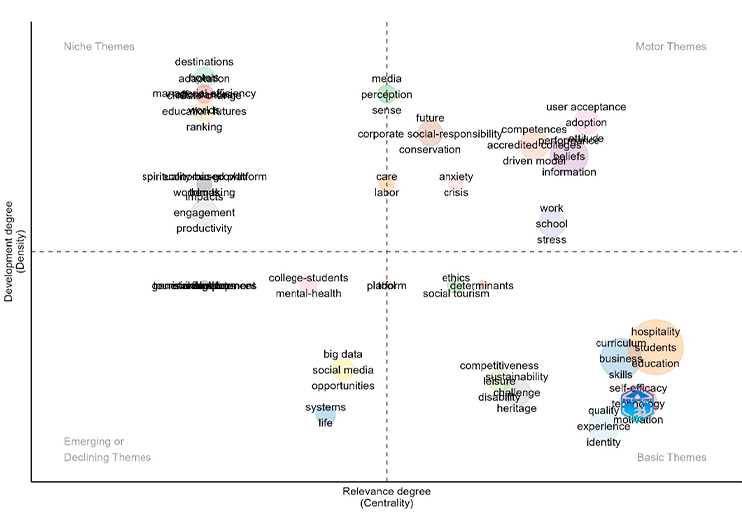
This article presents the results derived from a bibliometric review of scientific production on the tourism-education binomial. The research aimed to analyze the perspectives from which this relationship is approached, based on the literature published between 2014 and 2024, in order to identify the predominant approaches, quantify scientific production, recognize who publishes, determine which journals disseminate the knowledge, and identify which countries conduct the research. Likewise, the conceptual, intellectual and social structure that characterizes this field of study is examined. Methodologically, the research adopts a quantitative approach with a longitudinal design. The literature retrieval was carried out in the Web of Science database, using the search term ‘tourism education’, which allowed us to identify 490 documents. The information was analyzed using R software and the Bibliometrix package. Among the main findings, it is identified that the countries with the highest scientific production are China, the United States of America and Australia; contributions are concentrated mainly on motor themes such as performance, results-oriented models and competencies, with particular emphasis on educating students in tourism. In contrast, less attention was observed toward basic issues such as identity, sustainability, leisure, ethics and heritage, which opens the possibility for the tourism-education binomial to position itself as a new line of research focused on communities and their population.
Downloads
References
Airey, D. and Johnson, S. 1999. The content of tourism degree courses in the UK. Tourism Management-Tourism Manage. 20(2):229-235. https://doi.org/10.1016/S0261-5177(98)00079-X.
Ayikoru, M.; Tribe, J. and Airey, D. 2009. Reading tourism education: Neoliberalism Unveiled. Annals of Tourism Research. 36(2):191-221. https://doi.org/10.1016/j.annals.2008.11.001.
Benckendorff, P. y Moscardo, G. 2015. Educación para un futuro sostenible. In: Moscardo, G. y Benckendorff, P. (Eds.). Educación para la sostenibilidad en el turismo. RSC, sostenibilidad, ética y gobernanza. Springer, Berlín, Heidelberg. https://doi.org/10.1007/978-3-662-47470-9-17.
Cañellas, A.J.; y González, G. B. 1993. Turismo y educación: bases para una pedagogía del turismo. Revista Española de Pedagogía. 51(194):57-75. https://doi.org/10.22550/2174-0909.2035.
D’ Amato, D.; Droste, N.; Allen, B.; Kettunen, M.; Lähtinen, K.; Korhonen, J.; Leskinen, P.; Matthies, B. D. and Toppinen, A. 2017. Green, circular, bio economy: a comparative analysis of sustainability avenues. Journal of Cleaner Production. 168:716-734. https://doi.org/10.1016/j.jclepro.2017.09.053.
De Lima, F.; Cappellano, M. M. y Köche, J. C. 2020. Turismo pedagógico ou Atividade pedagógica pelo turismo? O binômio ‘turismo pedagógico’: concepções de turismo e pressupostos epistemológico-pedagógicos subjacentes. Investigaciones Turísticas. 19:139-162. https://doi.org/10.14198/inturi2020.19.07.
Deale, C. 2014. Student´s photo perceptions of hospitality and tourism in a community: a scholarship of teaching and learning case study. Journal of Teaching in Travel and Tourism. 14(1):1-21. https://doi.org/10.1080/15313220.2014.872892.
Donthu, N.; Kumar, S.; Mukherjee, D.; Pandey, N. and Marc, W. 2021. How to conduct a bibliometric analysis: an overview and guidelines. Journal of Business Research. 133:285-296.
Dredge, D.; Benckendorff, P.; Day, M.; Gross, M.; Walo, M.; Weeks, P. and Whitelaw, P. 2012. The philosophic practitioner and the curriculum space. Annals of Tourism Research. 39(4):2154-2176. https://doi.org/10.1016/j.annals.2012.07.017.
Edelheim, J. 2020. How should tourism education values be transformed after 2020? Tourism Geographies. 22(3):547-554. https://doi.org/10.1080/14616688.2020.1760927.
Fernández, M.; Barbosa, P. y Guerrero, A. 2010. Web of Science vs. Scopus: un estudio cuantitativo en Ingeniería Química. Anales de documentación. 13:159-175.
Hernández, A. L.; Hernández, J. R. y López, J. R. 2021. Análisis temático de la investigación, desarrollo e innovación dentro de la gestión empresarial y administración de empresas desde 2015 a 2019. Revista de Estudios Empresariales. Segunda Época. 1:89-106. https://doi.org/10.17561/ree.n1.2021.5602.
Hernández, L. S. and López, J. A. 2023. Accessible tourism: a bibliometric analysis from 2000 to 2021. International Journal of Sustainable Development and Planning. 18(7):2159-2165. https://doi.org/10.18280/ijsdp.180719.
Higgins, F. D. 2020. The ‘war over tourism’: challenges to sustainable tourism in the tourism academy after COVID-19. Journal of Sustainable Tourism. 29(3):1-19. https://doi.org/10.1080/09669582.2020.1803334.
Hsu, C. H. 2018. Tourism education on and beyond the horizon. Tourism Management Perspectives. 25:181-183. https://doi.org/10.1016/j.tmp.2017.11.022.
Inui, Y.; Wheeler, D. and Lankford, S. 2006. Rethinking tourism education: what should school teach? Journal of Hospitality, Leisure, Sport and Tourism Education. 5(2):25-35. https://doi.org//10.3794/johlste.52.122.
Lotka, A. J. 1926. The frequency distribution of scientific productivity. Journal of the Washington Academy of Sciences. 16(12):317-323. http://www.jstor.org/stable/24529203.
Mendoza, F. A. y Quintero, J. W. 2021. Nuevos campos de enseñanza e investigación en ciencias económicas: una aplicación bibliométrica. En: Pico, C. M.; Pérez, O. E.; Ramos, M. G.; Bello, S. P.; Mendoza, F. A. y Quintero, J. W. (Coord.). La formación de pensamiento crítico: reflexiones y métodos de confianza en economía. Catálogo Editorial. 1(152):1-137. https://doi.org/10.15765/poli.v1i152.2219.
Mora, J. A.; Nieto, A. and León, A. 2023. A bibliometric analysis and systematic review of dark tourism: trends, impact and prospects. Administrative Sciences. 13(11):238-259. https://doi.org/10.3390/admsci13110238.
Ramos, A. and Ruíz, J. 2004. Changes in the intellectual structure of strategic management research: a bibliometric study of the strategic management journal. 1980-2000. Strategic Management Journal. 25(10):981-1004.
Santa, Y.; Álvarez, J. y Molina, J. 2024. El turismo educativo: un enfoque de aprendizaje para alumnos y maestros y en beneficio de la atención a la diversidad en la escuela. Cuadernos de Turismo. 53:119-132. http://doi.org/10.6018/turismo.616411.
Sheldon, P.; Fesenmaier, D. y Tribe, J. 2011. La iniciativa para el futuro de la educación turística (TEFI): impulsando el cambio en la educación turística. Revista de Enseñanza en Viajes y Turismo. 11(1):2-23. https://doi.org/10.1080/15313220.2011.548728.
Small, H. 1973. Co‐citation in the scientific literature: a new measure of the relationship between two documents. Journal of the American Society for Information Science. 24(4):265-269. https://doi.org/10.1002/asi.4630240406.
Tamayo, A. L. y Peñaloza, L. 2005. Investigación en turismo y educación en la Universidad Autónoma del Estado de México (UAEM). Teoría y Praxis. 1:87-95.
Tribe, J. 2002. El profesional filosófico. Annals of Tourism Research. 29(2):338-357. https://doi.org/10.1016/S0160-7383(01)00038-X.
Urbizagástegui, R. y Restrepo, C. 2018. La red de co-autores en la Bibliometría mexicana. Encontros Bibli: Revista Eletrônica de Biblioteconomia e Ciência da Informação. 23(51:74-94. https://doi.org/10.5007/1518-2924.2018v23n51p74.
Downloads
Published
Issue
Section
License
Copyright (c) 2026 Revista Mexicana de Ciencias Agrícolas

This work is licensed under a Creative Commons Attribution-NonCommercial 4.0 International License.
The authors who publish in Revista Mexicana de Ciencias Agrícolas accept the following conditions:
In accordance with copyright laws, Revista Mexicana de Ciencias Agrícolas recognizes and respects the authors’ moral right and ownership of property rights which will be transferred to the journal for dissemination in open access. Invariably, all the authors have to sign a letter of transfer of property rights and of originality of the article to Instituto Nacional de Investigaciones Forestales, Agrícolas y Pecuarias (INIFAP) [National Institute of Forestry, Agricultural and Livestock Research]. The author(s) must pay a fee for the reception of articles before proceeding to editorial review.
All the texts published by Revista Mexicana de Ciencias Agrícolas —with no exception— are distributed under a Creative Commons License Attribution-NonCommercial 4.0 International (CC BY-NC 4.0), which allows third parties to use the publication as long as the work’s authorship and its first publication in this journal are mentioned.
The author(s) can enter into independent and additional contractual agreements for the nonexclusive distribution of the version of the article published in Revista Mexicana de Ciencias Agrícolas (for example include it into an institutional repository or publish it in a book) as long as it is clearly and explicitly indicated that the work was published for the first time in Revista Mexicana de Ciencias Agrícolas.
For all the above, the authors shall send the Letter-transfer of Property Rights for the first publication duly filled in and signed by the author(s). This form must be sent as a PDF file to: revista_atm@yahoo.com.mx; cienciasagricola@inifap.gob.mx; remexca2017@gmail.
This work is licensed under a Creative Commons Attribution-Noncommercial 4.0 International license.