Life cycle assessment in coffee systems in Veracruz
DOI:
https://doi.org/10.29312/remexca.v17i6.4238Keywords:
agroforestry systems, climate change, environmental impactAbstract
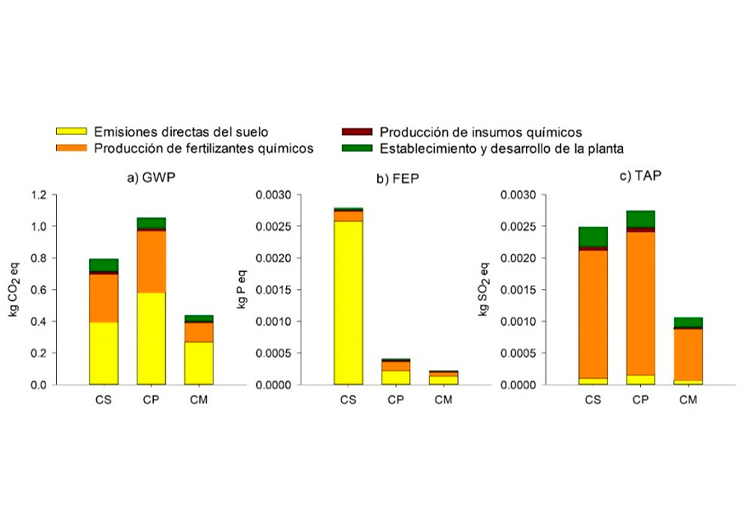
Coffee production is an important economic activity worldwide, as it generates employment for more than 20 million people engaged in growing, transforming, processing and marketing the product. This research evaluated and compared the environmental performance of agricultural production in three coffee (Coffea arabica) production systems in La Tinaja, Veracruz -coffee with banana (Musa paradisiaca), coffee with mango (Mangifera indica), and full-sun coffee- in 2024. Using the life cycle assessment methodology and the ReCiPe 2016 method (H), the impacts per functional unit of 1 kg of cherry coffee were analyzed, considering the stages of establishment, development, and agricultural management. The results indicated that producing 1 kg of coffee generates global warming of 0.79, 1.05 and 0.44 kg of CO2eq in the full-sun coffee, coffee-banana, and coffee-mango systems, respectively. Direct soil emissions from fertilizer application contributed to most of the categories assessed. The coffee-banana system registered the highest environmental loads, followed by the full-sun coffee system. The coffee-mango system presented the lowest environmental impacts in all categories, proving to be the system with the best environmental performance compared to the systems studied.
Downloads
References
Acosta-Alba, I.; Boissy, J.; Chia, E. and Andrieu, N. 2020. Integrating diversity of smallholder coffee cropping systems in environmental analysis. The International Journal of Life Cycle Assessment. 25(2):252-266. https://doi.org/10.1007/s11367-019-01689-5.
Alishah, A.; Motevali, A.; Tabatabaeekoloor, R. and Hashemi, S. J. 2019. Multiyear life energy and life cycle assessment of orange production in Iran. Environmental Science and Pollution Research. 26(31):32432-32445. https://doi.org/10.1007/s11356-019-06344-y.
Basavalingaiah, K.; Paramesh, V.; Parajuli, R.; Girisha, H. C.; Shivaprasad, M.; Vidyashree, G. V.; Thoma, G.; Hanumanthappa, M.; Yogesh, G. S.; Misra, S. D.; Bhat, S.; Irfan, M. M. and Rajanna, G. A, 2022. Energy flow and life cycle impact assessment of coffee-pepper production systems: An evaluation of conventional, integrated and organic farms in India. Environmental Impact Assessment Review. 92:06687. https://doi.org/10.1016/j.eiar.2021.106687.
Clark, C.; Bai, Y.; Bowman, W.; Cowles, J.; Fenn, M.; Gilliam, F.; Phoenix, G. K.; Siddique, I.; Stevens, C. J.; Sverdrup, H. U. and Throop, H. L. 2013. Nitrogen deposition and terrestrial biodiversity. In Encyclopedia of Biodiversity. Levin, SA. Second Edition. Academic Press. 519-536 pp. https://doi.org/10.1016/B978-0-12-384719-5.00366-X.
Dollinger, J. and Jose, S. 2018. Agroforestry for soil health. Agroforestry systems. 92(2):213-219. https://doi.org/10.1007/s10457-018-0223-9.
FAO. 2025. Coffee. MarketsAndTrade. https://www.fao.org/markets-and-trade/commodities-overview/beverages/coffee/.
Guinée, J. B. 2002. Handbook on life cycle assessment: operational guide to the ISO Standards. Eco-efficiency in industry and science. Vol. 7. Springer Science and Business Media. 692 p.
Hasan, Y.; Roy, P. and Abbassi, B. 2024. Comparative life cycle assessment (LCA) in the agri-food industry, focusing on organic and conventional coffee. Sustainability. 16(24):10819. https://doi.org/10.3390/su162410819.
Hasler, K.; Bröring, S.; Omta, S. W. F. and Olfs, H. W. 2015. Life cycle assessment (LCA) of different fertilizer product types. European Journal of Agronomy. 69:41-51. https://doi.org/10.1016/j.eja.2015.06.001.
Huijbregts, M. A. J.; Steinmann, Z. J. N.; Elshout, P. M. F.; Stam, G.; Verones, F.; Vieira, M.; Zijp, M.; Hollander, A. and van Zelm, R. 2017. ReCiPe2016: a harmonised life cycle impact assessment method at midpoint and endpoint level. The International Journal of Life Cycle Assessment. 22(2):138-147. https://doi.org/10.1007/s11367-016-1246-y.
INEGI. 2021. Marco geoestadístico-catálogo único de claves de áreas geoestadísticas estatales, municipales y localidades. https://www.inegi.org.mx/app/ageeml/.
ISO. 2006a. ISO 14040:2006. Environmental management - life cycle assessment - Principles and framework. https://www.iso.org/obp/ui/#iso:std:iso:14040:ed-2:v1:en.
ISO. 2006b. ISSO 14044:2006. Environmental management -Life cycle assessment-Requirements and guidelines. https://www.iso.org/cms/render/live/en/sites/isoorg/contents/data/standard/03/84/38498.html.
Mengesha, T.; Berhanu, Y. and Teshale, A. 2026. Impact of shifting to full-sun coffee plantations on soil bacterial diversity in the Kafa Forest Biosphere Reserve. Ethiopia. Total Environment Microbiology. 2(1):100060. https://doi.org/10.1016/j.temicr.2026.100060.
Moguel, P. and Toledo, V. 1999. Biodiversity conservation in traditional coffee systems of Mexico. Conservation Biology. 13(1):11-21.
Moguel, P. y Toledo, V. M. 2004. Conservar produciendo: Biodiversidad, café orgánico y jardines productivos. Biodiversitas. 55:2-7.
Nemecek, T. and Schnetzer, J. 2011. Methods of assessment of direct field emissions for LCIs of agricultural production systems. Agroscope Reckenholz-Tänikon Research Station. Zurich. 34 p.
Noponen, M. R. A.; Edwards-Jones, G.; Haggar, J. P.; Soto, G.; Attarzadeh, N. and Healey, J. R. 2012. Greenhouse gas emissions in coffee grown with differing input levels under conventional and organic management. Agriculture, Ecosystems and Environment. 151:6-15. https://doi.org/10.1016/j.agee.2012.01.019.
Parra-Paitan, C. and Verburg, P. H. 2022. Accounting for land use changes beyond the farm-level in sustainability assessments: The impact of cocoa production. Science of The Total Environment. 825:154032. https://doi.org/10.1016/j.scitotenv.2022.154032.
Pazmiño, M. L.; Mero-Benavides, M.; Aviles, D.; Blanco-Marigorta, A. M.; Tinoco, D. L. and Ramírez, A. D. 2024. Life cycle assessment of instant coffee production considering different energy sources. Cleaner Environmental Systems. 12:100174. https://doi.org/10.1016/j.cesys.2024.100174.
Rahmah, D. M.; Putra, A. S.; Ishizaki, R.; Noguchi, R. and Ahamed, T. 2022. A life cycle assessment of organic and chemical fertilizers for coffee production to evaluate sustainability toward the energy-environment-economic nexus in Indonesia. Sustainability. 14(7):3912. https://doi.org/10.3390/su14073912.
Ratchawat, T.; Panyatona, S.; Nopchinwong, P.; Chidthaisong, A. and Chiarakorn, S. 2020. Carbon and water footprint of Robusta coffee through its production chains in Thailand. Environment, Development and Sustainability. 22(3):2415-2429. https://doi.org/10.1007/s10668-018-0299-4.
Romero-Fernández, A. de J.; González-Chávez, Ma. del C. Á.; Herrera-Cabrera, B. E.; Corona-Sánchez, J. E. and Carrillo-González, R. 2023. The coffee-mango association promotes favorable soil conditions for better-nourished and higher-yielding plants. Agriculture, Ecosystems and Environment. 354:108589. https://doi.org/10.1016/j.agee.2023.108589.
SIAP. 2024. Panorama Agroalimentario, 2018-2024: la ruta de la transformación agroalimentaria. Servicio de Información Agroalimentaria y Pesquera. Ciudad de México, México. 210 p.
Valdés-Velarde, E.; Vázquez-Domínguez, L. P.; Tinoco-Rueda, J. Á.; Sánchez-Hernández, R.; Salcedo-Pérez, E. y Lagunes-Fortiz, E. 2022. Servicio ecosistémico de carbono almacenado en cafetales bajo sombra en sistema agroforestal. Revista Mexicana de Ciencias Agrícolas. 28(esp):287-297. https://doi.org/10.29312/remexca.v13i28.3283.
Van der Feen, L.; Verweij, P. A.; Vermeulen, W. J. V.; Montagnon, C. and Sheibani, F. 2025. Life cycle assessment of seed-to-cup specialty coffee cultivated by smallholders in Yemen. The International Journal of Life Cycle Assessment. 30(8):1761-1775. https://doi.org/10.1007/s11367-025-02495-y.
Downloads
Published
Issue
Section
License
Copyright (c) 2026 Revista Mexicana de Ciencias Agrícolas

This work is licensed under a Creative Commons Attribution-NonCommercial 4.0 International License.
The authors who publish in Revista Mexicana de Ciencias Agrícolas accept the following conditions:
In accordance with copyright laws, Revista Mexicana de Ciencias Agrícolas recognizes and respects the authors’ moral right and ownership of property rights which will be transferred to the journal for dissemination in open access. Invariably, all the authors have to sign a letter of transfer of property rights and of originality of the article to Instituto Nacional de Investigaciones Forestales, Agrícolas y Pecuarias (INIFAP) [National Institute of Forestry, Agricultural and Livestock Research]. The author(s) must pay a fee for the reception of articles before proceeding to editorial review.
All the texts published by Revista Mexicana de Ciencias Agrícolas —with no exception— are distributed under a Creative Commons License Attribution-NonCommercial 4.0 International (CC BY-NC 4.0), which allows third parties to use the publication as long as the work’s authorship and its first publication in this journal are mentioned.
The author(s) can enter into independent and additional contractual agreements for the nonexclusive distribution of the version of the article published in Revista Mexicana de Ciencias Agrícolas (for example include it into an institutional repository or publish it in a book) as long as it is clearly and explicitly indicated that the work was published for the first time in Revista Mexicana de Ciencias Agrícolas.
For all the above, the authors shall send the Letter-transfer of Property Rights for the first publication duly filled in and signed by the author(s). This form must be sent as a PDF file to: revista_atm@yahoo.com.mx; cienciasagricola@inifap.gob.mx; remexca2017@gmail.
This work is licensed under a Creative Commons Attribution-Noncommercial 4.0 International license.