Análisis de ciclo de vida en sistemas cafetaleros de Veracruz
DOI:
https://doi.org/10.29312/remexca.v17i6.4238Palabras clave:
cambio climático, impacto ambiental, sistemas agroforestalesResumen
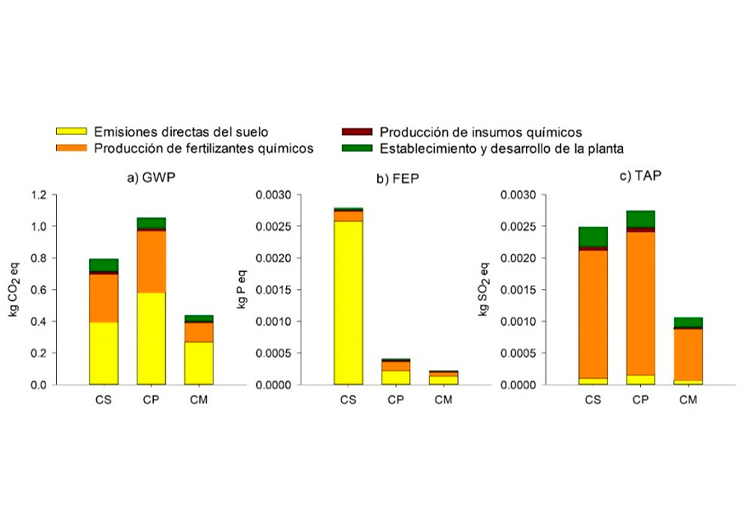
La producción de café es una actividad económica importante a nivel mundial, ya que genera empleo a más de 20 millones de personas dedicadas al cultivo, transformación, procesamiento y comercialización del producto. Esta investigación evaluó y comparó el desempeño ambiental de la producción agrícola en tres sistemas de producción de café (Coffea arabica) en La Tinaja, Veracruz: café con plátano (Musa paradisiaca), café con mango (Mangifera indica) y café a pleno sol, en el año 2024. Mediante la metodología del análisis del ciclo de vida y el método ReCiPe 2016 (H), se analizaron los impactos por unidad funcional de 1 kg de café cereza, considerando las etapas de establecimiento, desarrollo y manejo agrícola. Los resultados indicaron que producir 1 kg de café genera un calentamiento global de 0.79, 1.05 y 0.44 kg de CO2 eq en los sistemas café a pleno sol y café con plátano y café con mango, respectivamente. Las emisiones directas del suelo derivadas de la aplicación de fertilizantes contribuyeron en la mayoría de las categorías evaluadas. El sistema café con plátano registró las mayores cargas ambientales, seguido del sistema café a pleno sol. El sistema café con mango presentó los impactos ambientales más bajos en todas las categorías, demostrando ser el sistema con mejor desempeño ambiental en comparación con los sistemas estudiados.
Descargas
Referencias
Acosta-Alba, I.; Boissy, J.; Chia, E. and Andrieu, N. 2020. Integrating diversity of smallholder coffee cropping systems in environmental analysis. The International Journal of Life Cycle Assessment. 25(2):252-266. https://doi.org/10.1007/s11367-019-01689-5.
Alishah, A.; Motevali, A.; Tabatabaeekoloor, R. and Hashemi, S. J. 2019. Multiyear life energy and life cycle assessment of orange production in Iran. Environmental Science and Pollution Research. 26(31):32432-32445. https://doi.org/10.1007/s11356-019-06344-y.
Basavalingaiah, K.; Paramesh, V.; Parajuli, R.; Girisha, H. C.; Shivaprasad, M.; Vidyashree, G. V.; Thoma, G.; Hanumanthappa, M.; Yogesh, G. S.; Misra, S. D.; Bhat, S.; Irfan, M. M. and Rajanna, G. A, 2022. Energy flow and life cycle impact assessment of coffee-pepper production systems: An evaluation of conventional, integrated and organic farms in India. Environmental Impact Assessment Review. 92:06687. https://doi.org/10.1016/j.eiar.2021.106687.
Clark, C.; Bai, Y.; Bowman, W.; Cowles, J.; Fenn, M.; Gilliam, F.; Phoenix, G. K.; Siddique, I.; Stevens, C. J.; Sverdrup, H. U. and Throop, H. L. 2013. Nitrogen deposition and terrestrial biodiversity. In Encyclopedia of Biodiversity. Levin, SA. Second Edition. Academic Press. 519-536 pp. https://doi.org/10.1016/B978-0-12-384719-5.00366-X.
Dollinger, J. and Jose, S. 2018. Agroforestry for soil health. Agroforestry systems. 92(2):213-219. https://doi.org/10.1007/s10457-018-0223-9.
FAO. 2025. Coffee. MarketsAndTrade. https://www.fao.org/markets-and-trade/commodities-overview/beverages/coffee/.
Guinée, J. B. 2002. Handbook on life cycle assessment: operational guide to the ISO Standards. Eco-efficiency in industry and science. Vol. 7. Springer Science and Business Media. 692 p.
Hasan, Y.; Roy, P. and Abbassi, B. 2024. Comparative life cycle assessment (LCA) in the agri-food industry, focusing on organic and conventional coffee. Sustainability. 16(24):10819. https://doi.org/10.3390/su162410819.
Hasler, K.; Bröring, S.; Omta, S. W. F. and Olfs, H. W. 2015. Life cycle assessment (LCA) of different fertilizer product types. European Journal of Agronomy. 69:41-51. https://doi.org/10.1016/j.eja.2015.06.001.
Huijbregts, M. A. J.; Steinmann, Z. J. N.; Elshout, P. M. F.; Stam, G.; Verones, F.; Vieira, M.; Zijp, M.; Hollander, A. and van Zelm, R. 2017. ReCiPe2016: a harmonised life cycle impact assessment method at midpoint and endpoint level. The International Journal of Life Cycle Assessment. 22(2):138-147. https://doi.org/10.1007/s11367-016-1246-y.
INEGI. 2021. Marco geoestadístico-catálogo único de claves de áreas geoestadísticas estatales, municipales y localidades. https://www.inegi.org.mx/app/ageeml/.
ISO. 2006a. ISO 14040:2006. Environmental management - life cycle assessment - Principles and framework. https://www.iso.org/obp/ui/#iso:std:iso:14040:ed-2:v1:en.
ISO. 2006b. ISSO 14044:2006. Environmental management -Life cycle assessment-Requirements and guidelines. https://www.iso.org/cms/render/live/en/sites/isoorg/contents/data/standard/03/84/38498.html.
Mengesha, T.; Berhanu, Y. and Teshale, A. 2026. Impact of shifting to full-sun coffee plantations on soil bacterial diversity in the Kafa Forest Biosphere Reserve. Ethiopia. Total Environment Microbiology. 2(1):100060. https://doi.org/10.1016/j.temicr.2026.100060.
Moguel, P. and Toledo, V. 1999. Biodiversity conservation in traditional coffee systems of Mexico. Conservation Biology. 13(1):11-21.
Moguel, P. y Toledo, V. M. 2004. Conservar produciendo: Biodiversidad, café orgánico y jardines productivos. Biodiversitas. 55:2-7.
Nemecek, T. and Schnetzer, J. 2011. Methods of assessment of direct field emissions for LCIs of agricultural production systems. Agroscope Reckenholz-Tänikon Research Station. Zurich. 34 p.
Noponen, M. R. A.; Edwards-Jones, G.; Haggar, J. P.; Soto, G.; Attarzadeh, N. and Healey, J. R. 2012. Greenhouse gas emissions in coffee grown with differing input levels under conventional and organic management. Agriculture, Ecosystems and Environment. 151:6-15. https://doi.org/10.1016/j.agee.2012.01.019.
Parra-Paitan, C. and Verburg, P. H. 2022. Accounting for land use changes beyond the farm-level in sustainability assessments: The impact of cocoa production. Science of The Total Environment. 825:154032. https://doi.org/10.1016/j.scitotenv.2022.154032.
Pazmiño, M. L.; Mero-Benavides, M.; Aviles, D.; Blanco-Marigorta, A. M.; Tinoco, D. L. and Ramírez, A. D. 2024. Life cycle assessment of instant coffee production considering different energy sources. Cleaner Environmental Systems. 12:100174. https://doi.org/10.1016/j.cesys.2024.100174.
Rahmah, D. M.; Putra, A. S.; Ishizaki, R.; Noguchi, R. and Ahamed, T. 2022. A life cycle assessment of organic and chemical fertilizers for coffee production to evaluate sustainability toward the energy-environment-economic nexus in Indonesia. Sustainability. 14(7):3912. https://doi.org/10.3390/su14073912.
Ratchawat, T.; Panyatona, S.; Nopchinwong, P.; Chidthaisong, A. and Chiarakorn, S. 2020. Carbon and water footprint of Robusta coffee through its production chains in Thailand. Environment, Development and Sustainability. 22(3):2415-2429. https://doi.org/10.1007/s10668-018-0299-4.
Romero-Fernández, A. de J.; González-Chávez, Ma. del C. Á.; Herrera-Cabrera, B. E.; Corona-Sánchez, J. E. and Carrillo-González, R. 2023. The coffee-mango association promotes favorable soil conditions for better-nourished and higher-yielding plants. Agriculture, Ecosystems and Environment. 354:108589. https://doi.org/10.1016/j.agee.2023.108589.
SIAP. 2024. Panorama Agroalimentario, 2018-2024: la ruta de la transformación agroalimentaria. Servicio de Información Agroalimentaria y Pesquera. Ciudad de México, México. 210 p.
Valdés-Velarde, E.; Vázquez-Domínguez, L. P.; Tinoco-Rueda, J. Á.; Sánchez-Hernández, R.; Salcedo-Pérez, E. y Lagunes-Fortiz, E. 2022. Servicio ecosistémico de carbono almacenado en cafetales bajo sombra en sistema agroforestal. Revista Mexicana de Ciencias Agrícolas. 28(esp):287-297. https://doi.org/10.29312/remexca.v13i28.3283.
Van der Feen, L.; Verweij, P. A.; Vermeulen, W. J. V.; Montagnon, C. and Sheibani, F. 2025. Life cycle assessment of seed-to-cup specialty coffee cultivated by smallholders in Yemen. The International Journal of Life Cycle Assessment. 30(8):1761-1775. https://doi.org/10.1007/s11367-025-02495-y.
Descargas
Publicado
Número
Sección
Licencia
Derechos de autor 2026 Revista Mexicana de Ciencias Agrícolas

Esta obra está bajo una licencia internacional Creative Commons Atribución-NoComercial 4.0.
Los autores(as) que publiquen en Revista Mexicana de Ciencias Agrícolas aceptan las siguientes condiciones:
De acuerdo con la legislación de derechos de autor, Revista Mexicana de Ciencias Agrícolas reconoce y respeta el derecho moral de los autores(as), así como la titularidad del derecho patrimonial, el cual será cedido a la revista para su difusión en acceso abierto.
Los autores(as) deben de pagar una cuota por recepción de artículos antes de pasar por dictamen editorial. En caso de que la colaboración sea aceptada, el autor debe de parar la traducción de su texto al inglés.
Todos los textos publicados por Revista Mexicana de Ciencias Agrícolas -sin excepción- se distribuyen amparados bajo la licencia Creative Commons 4.0 atribución-no comercial (CC BY-NC 4.0 internacional), que permite a terceros utilizar lo publicado siempre que mencionen la autoría del trabajo y a la primera publicación en esta revista.
Los autores/as pueden realizar otros acuerdos contractuales independientes y adicionales para la distribución no exclusiva de la versión del artículo publicado en Revista Mexicana de Ciencias Agrícolas (por ejemplo incluirlo en un repositorio institucional o darlo a conocer en otros medios en papel o electrónicos) siempre que indique clara y explícitamente que el trabajo se publicó por primera vez en Revista Mexicana de Ciencias Agrícolas.
Para todo lo anterior, los autores(as) deben remitir el formato de carta-cesión de la propiedad de los derechos de la primera publicación debidamente requisitado y firmado por los autores(as). Este formato debe ser remitido en archivo PDF al correo: revista_atm@yahoo.com.mx; revistaagricola@inifap.gob.mx.
Esta obra está bajo una licencia de Creative Commons Reconocimiento-No Comercial 4.0 Internacional.