Dry matter and harvest index as production indicators in cassava accessions
DOI:
https://doi.org/10.29312/remexca.v17i6.4207Keywords:
adaptability, biomass production, mycorrhizal fungi, specific gravity, starchAbstract
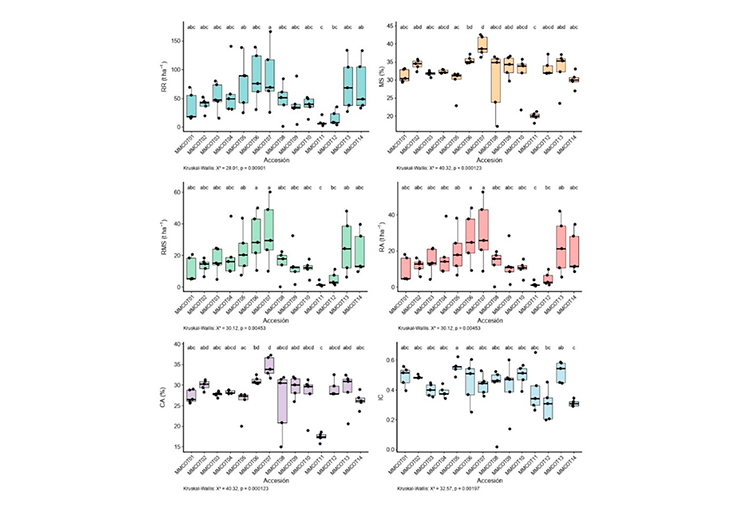
Cassava (Manihot esculenta Crantz) is a strategically important crop in Mexico; however, germplasm characterization has been based mainly on fresh root yield, which limits the physiological interpretation of its production. This study aimed to analyze dry matter yield and harvest index as indicators of productive variability among Mexican cassava accessions. A total of 14 accessions were evaluated under field conditions using a completely randomized design, determining root yield, root dry matter content and yield (DM, DMY), starch content and yield (SC, SY) and harvest index. The nonparametric analysis showed highly significant differences among accessions for all variables evaluated (p< 0.01). Accession MMCOT07 presented the most outstanding performance, with the highest values of RY (88.01 t ha-1), DMY (34.37 t ha-1) and SY (30.08 t ha-1), associated with high DM (39.39%) and SC (34.46%) contents. Other accessions showed contrasting combinations of yield and quality, reflecting differential biomass partitioning strategies. The correlation analysis confirmed strong associations among RY, DMY and SY (p≥ 0.98), whereas the harvest index provided complementary information on physiological efficiency. These results demonstrate that DMY and harvest index are key variables for a more accurate functional characterization of Mexican cassava germplasm.
Downloads
References
Adiele, J. G.; Schut, A. G. T.; Van Den Beuken, R. P. M.; Ezui, K. S.; Pypers, P.; Ano, A. O. and Giller, K. E. 2020. Towards closing cassava yield gap in West Africa: agronomic efficiency and storage root yield responses to NPK fertilizers. Field Crops Research. 253:107820. https://doi.org/10.1016/j.fcr.2020.107820.
Adjebeng-Danquah, J.; Asante, I. K.; Manu-Aduening, J.; Agyare, R. Y.; Gracen, V. E. and Offei, S. K. 2020. Genotypic variability in some morpho‐physiological traits in different environments and their relationship with cassava (Manihot esculenta Crantz) root yield. International Journal of Agronomy. 2020:5871351. https://doi.org/10.1155/2020/5871351.
Burbano-Figueroa, O.; Pérez-Pazos, J. V. and Moreno-Moran, M. 2022. Assessing NPK use efficiency of commercial inoculants in cassava (Manihot esculenta Crantz): an application of data envelopment analysis. Journal of Crop Science and Biotechnology. 25(3):253-267. https://doi.org/10.1007/s12892-021-00128-y.
Chaiprasert, P.; Sdoodee, S.; Kaveeta, L.; Kulrut, N.; Sansayawichai, T.; Sanitchon, J. and Whankaew, S. 2022. Effective metabolic carbon utilization and shoot-to-root partitioning modulate distinctive yield in high yielding cassava variety. Frontiers in Plant Science. 13:832304. https://doi.org/10.3389/fpls.2022.832304.
Codjia, E. D.; Olasanmi, B.; Udemba, I. O. and Rabbi, I. Y. 2025. Variability for cassava root yield and yield components among half-sib cassava progenies. Journal of Crop Improvement. 39(3):192-207. https://doi.org/10.1080/15427528.2025.2470444.
De Souza, A. P.; Massenburg, L. N.; Jaiswal, D.; Cheng, S.; Shekar, R. and Long, S. P. 2017. Rooting for cassava: insights into photosynthesis and associated physiology as a route to improve yield potential. New Phytologist. 213(1):50-65. https://doi.org/10.1111/nph.14250.
Del Rosario-Arellano, J. L.; Meneses-Márquez, I.; Cruz-Moreno, F. Z.; Serna-Lagunes, R.; Leyva-Ovalle, O. R.; Andrés-Meza, P.; Verdejo-Lara, R. A.; Llarena-Hernández, C. R. and Diaz-José, J. 2025. Morpho-agronomic diversity of Manihot esculenta Crantz accessions: implications for conservation and genetic management. Revista Bio Ciencias. 12:e1719. https://doi.org/10.15741/revbio.12.e1719.
Durán-Prado, A.; Vásquez-Hernández, A.; Meneses-Márquez, I.; Rodríguez-Cuevas, M.; Ramírez-Guillermo, M. Á. y Martínez-Herrera, J. 2023. Impacto económico del biofertilizante micorrízico INIFAPMR en el cultivo de yuca (Manihot esculenta Crantz) en Veracruz. In: López-Vázquez, M. E.; Tosquy-Valle, O. H.; Peralta-Antonio, N.; Rebolledo-García, R. L.; Capetillo-Burela, Á. y Perdomo-Montes, C. (Comps.). XXXV Reunión Científica-Tecnológica, Forestal y Agropecuaria Veracruz. Año 5, Núm. 1. INIFAP. Ciudad de México, México. 23 p. https://rctveracruz.org/assets/img/publicaciones/publicacion_2023/publicacion/publicacion-2023.pdf.
Enesi, R. O.; Hauser, S.; Pypers, P.; Kreye, C.; Tariku, M. and Six, J. 2022. Understanding changes in cassava root dry matter yield by different planting dates, crop ages at harvest, fertilizer application and varieties. European Journal of Agronomy. 133:126448. https://doi.org/10.1016/j.eja.2021.126448.
Gili, O. R. S.; Suwarto, B.; Hartono, A. and Herdiyeni, Y. 2025. Biomass partitioning of cassava (Manihot esculenta Crantz) at various doses of nitrogen fertilization. Journal of Tropical Crop Science. 12(01):10-17. https://doi.org/10.29244/jtcs.12.01.10-17.
González-Valdivia, N. A.; Matos-Pech, G.; García-Acedo, C.; Arcocha-Gómez, E.; López-Hernández, M. y Puertovannetti-Arroyo, A. 2023. Estimación del rendimiento de harina seca de yuca (Manihot esculenta Crantz) en un luvisol férrico de Campeche, México. Journal of the Selva Andina Biosphere. 11(1):3-19. https://doi.org/10.36610/j.jsab.2023.110100073.
Menegucci, N. C.; Leonel, M.; Fernandes, A. M.; Nunes, J. G. da S. and Nunes, J. G. da S. 2023. Biomass yield and chemical composition of the cassava plant over two vegetative growth cycles. Acta Scientiarum. Agronomy. 46(1):e63719. https://doi.org/10.4025/actasciagron.v46i1.63719.
Meneses-Márquez, I.; Vásquez-Hernández, A.; Rosas-González, X. and Becerra-Leor, E. N. 2014. Contenido de materia seca y almidón en clones de yuca (Manihot esculenta Crantz). Revista Biológico Agropecuaria Tuxpan. 2(1):107-110. https://doi.org/10.47808/revistabioagro.v2i1.268.
Muktar, H.; Beshir, H. M.; Tadesse, T. and Haile, A. 2024. Rooting performance of cassava cuttings due to the number of nodes and rooting media. Food and Energy Security. 13(1):e512. https://doi.org/10.1002/fes3.512.
NOM-021-SEMARNAT-2000. 2002. Norma oficial mexicana. Antes NOM-021-RECNAT-2000, que establece las especificaciones de fertilidad, salinidad y clasificación de suelos. Estudio, muestreo y análisis. Diario oficial de la federación. México, D. F.: SEGOB. https://n9.cl/a85no.
Okoma, P. M.; Kayondo, S. I.; Rabbi, I. Y.; Moreno-Cadena, P. L.; Hoogenboom, G. and Jannink, J. L. 2025. Evaluating a cassava crop growth model by optimizing genotype-specific parameters using multienvironment trial breeding data. Frontiers in Plant Science. 16:1535058. https://doi.org/10.3389/fpls.2025.1535058.
Olayinka, A. F.; Dzidzienyo, D. K.; Mbanjo, E. G. N.; Offei, S. K.; Tongoona, P. B.; Danquah, E. Y. and Rabbi, I. Y. 2025. Genome-wide association study identifies novel genes for plant architecture and yield traits in cassava (Manihot esculenta Crantz). Frontiers in Plant Science. 16:1660789. https://doi.org/10.3389/fpls.2025.1660789.
Onyenali, T. C.; Ogwuche, T. O.; Onyeka, J.; Diebiru-Ojo, E. M.; Ikechukwu, I.; Abah, S. P.; Okwuonu, I.; Ameh, E. A.; Sanni, L.; Kulakow, A. P. and Egesi, C. N. 2025. Evaluation of improved cassava genotypes for fresh root yield and yield components in demand creation trial. Frontiers in Plant Science. 16:1564393. https://doi.org/10.3389/fpls.2025.1564393.
Pérez-Fons, L.; Ovalle, T. M.; Drapal, M.; Ospina, M. A.; Gkanogiannis, A.; Bohorquez-Chaux, López-Lavalle, L. A. B. and Fraser, P. D. 2023. Integrated genetic and metabolic characterization of Latin American cassava (Manihot esculenta) germplasm. Plant Physiology. 192(4):2672-2686. https://doi.org/10.1093/plphys/kiad269.
Phanthanong, P.; Promnikorn, K.; Kongsil, P.; Kraichak, E.; Jenweerawat, S.; Vuttipongchaikij, S. and Kittipadakul, P. 2025. Variety-specific responses to climatic and edaphic factors in cassava productivity. Frontiers in Agronomy. 7:1476033. https://doi.org/10.3389/fagro.2025.1476033.
Phun-iam, M.; Anusontpornperm, S.; Thanachit, S. and Kheoruenromne, I. 2018. Yield response of cassava Huay Bong 80 variety grown in an Oxyaquic paleustult to cassava starch waste and nitrogen fertilizer. Agriculture and Natural Resources. 52(6):573-580. https://doi.org/10.1016/j.anres.2018.11.026.
R Core Team. 2020. R: a language and environment for statistical computing (version 4.4.3). R Foundation for Statistical Computing, Vienna, Austria. https://www.R-project.org/.
Rebolledo-García, R. L.; Rebolledo-Martínez, A.; López-Vázquez, M. E.; Peralta-Antonio, N. and Ramírez-García, R. 2025. Production and quality of cassava (Manihot esculenta Crantz) organically and chemically fertilized and intercropped with sapodilla. Agroproductividad. 18(2):233-240. https://doi.org/10.32854/agrop.v18i2.3259.
Rosas-González, X.; Meneses-Márquez, I.; Becerra-Leor, E. N. y Vásquez Hernández, A. 2014. Efecto de la posición de estacas sobre el rendimiento de raíz de yuca (Manihot esculenta Crantz.) en Veracruz. Revista Biológico Agropecuaria Tuxpan. 2(1):172-177. https://doi.org/10.47808/revistabioagro.v2i1.283.
Sampaio Filho, J. S.; De Souza Campos, M. and De Oliveira, E. J. 2024. Stability and genetic parameters for cassava yield attributes in the tropical humid region of Brazil. Euphytica. 220(8):127. https://doi.org/10.1007/s10681-024-03384-5.
Silva, R. M. D.; Fernandes, A. M.; Leonel, M.; Pelvine, R. A.; Figueiredo, R. T. D.; Rangel, M. A. S.; Ringenberg, R.; Oliveira, L. A. D.; Santos, V. D. S. and Vieira, E. A. 2023. Measurement of dry matter and starch in modern cassava genotypes during long harvest cycles. Horticulturae. 9(7):733. https://doi.org/10.3390/horticulturae9070733.
Downloads
Published
Issue
Section
License
Copyright (c) 2026 Revista Mexicana de Ciencias Agrícolas

This work is licensed under a Creative Commons Attribution-NonCommercial 4.0 International License.
The authors who publish in Revista Mexicana de Ciencias Agrícolas accept the following conditions:
In accordance with copyright laws, Revista Mexicana de Ciencias Agrícolas recognizes and respects the authors’ moral right and ownership of property rights which will be transferred to the journal for dissemination in open access. Invariably, all the authors have to sign a letter of transfer of property rights and of originality of the article to Instituto Nacional de Investigaciones Forestales, Agrícolas y Pecuarias (INIFAP) [National Institute of Forestry, Agricultural and Livestock Research]. The author(s) must pay a fee for the reception of articles before proceeding to editorial review.
All the texts published by Revista Mexicana de Ciencias Agrícolas —with no exception— are distributed under a Creative Commons License Attribution-NonCommercial 4.0 International (CC BY-NC 4.0), which allows third parties to use the publication as long as the work’s authorship and its first publication in this journal are mentioned.
The author(s) can enter into independent and additional contractual agreements for the nonexclusive distribution of the version of the article published in Revista Mexicana de Ciencias Agrícolas (for example include it into an institutional repository or publish it in a book) as long as it is clearly and explicitly indicated that the work was published for the first time in Revista Mexicana de Ciencias Agrícolas.
For all the above, the authors shall send the Letter-transfer of Property Rights for the first publication duly filled in and signed by the author(s). This form must be sent as a PDF file to: revista_atm@yahoo.com.mx; cienciasagricola@inifap.gob.mx; remexca2017@gmail.
This work is licensed under a Creative Commons Attribution-Noncommercial 4.0 International license.