Effect of different temperatures on the germination of two Dahlia species
DOI:
https://doi.org/10.29312/remexca.v17i7.4204Keywords:
Dahlia campanulata, Dahlia coccinea, cardinal temperatures, germination speedAbstract
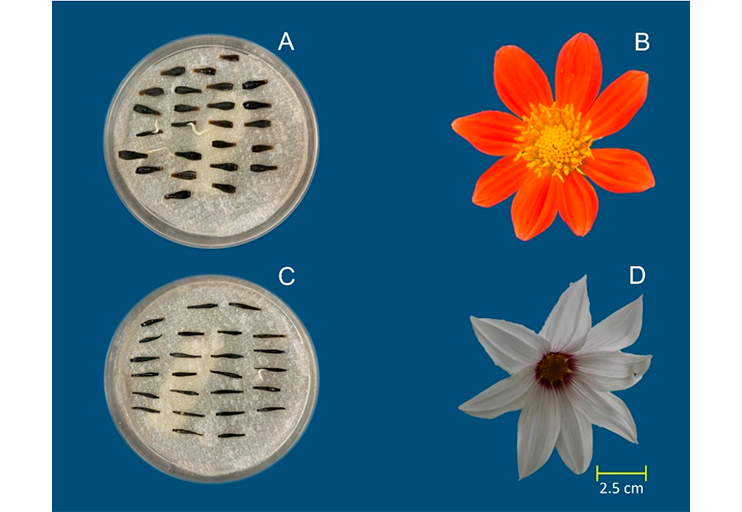
The temperature values at which seeds germinate can serve as a reference for proposing planting or establishment sites. This research evaluated the effect of eight temperatures on the germination of Dahlia coccinea Lehm. and Dahlia campanulata Saar, P. D. Sørensen and Hjert. The hypothesis was that, because the Dahlia species studied have contrasting distributions, it is expected that one of them will show the widest temperature range for the germination of its seeds. The collection was carried out in the Tlalpuente Ecological Reserve, Tlalpan, Mexico City, in 2023. The experimental units were Petri dishes containing two absorbent paper discs moistened with distilled water and 25 seeds of D. coccinea or D. campanulata. The treatments were incubation temperatures (5, 10, 15, 20, 25, 30, 35 and 40 ±2 °C). The number of germinated seeds was recorded for 15 days. D. coccinea had the highest germination percentage (93.6%) and speed (4 seeds day-1) at 25 °C, with cardinal temperatures of 3.3, 24.1 and 35.3 °C. In contrast, D. campanulata had a wider range, as it had an average germination of 90% from 10 to 25 °C, with 8 seeds day-1 and cardinal temperatures of 2.3, 22.5 and 38.4 °C. D. campanulata seeds were the ones that germinated over a wider range of temperatures, so this species has a better chance of success when grown outside its natural habitat.
Downloads
References
Brondum, J. J. and Heins, R. D. 1993. Modeling temperature and photoperiod effects on growth and development of Dahlia. Journal of the American Society Horticultural Science. 118(1):36-42. https://doi.org/10.21273/jashs.118.1.36.
Calzada-López, S. G.; Kohashi-Shibata, J.; Uscanga-Mortera, E.; García-Esteva, A. and Yáñez-Jiménez, P. 2014. Cardinal temperatures and germination rate in husk tomato cultivars. Revista Mexicana de Ciencias Agrícolas. 8:1451-1458. https://www.scielo.org.mx/pdf/remexca/v5nspe8/2007-0934-remexca-5-spe8-1451-en.pdf.
Caroca, R.; Zapata, N. and Vargas, M. 2016. Temperature effect on the germination of four peanut genotypes (Arachishypogaea L.). Chilean journal of agricultural and animal sciences. 32(2):94-101. https://doi.org/10.4067/S0719-38902016000200002.
Carrasco-Ortiz, M.; Munguía-Lino, G.; Castro-Castro, A.; Vargas-Amado, G.; Harker, M. y Rodríguez, A. 2019. Riqueza, distribución geográfica y estado de conservación del género Dahlia (Asteraceae) en México. Acta Botánica Mexicana. 126:e1354 https://doi.org/10.21829/abm126.2019.1354.
Castro-Castro, A.; Rodríguez, A.; Vargas-Amado, G. y Harker, M. 2012. Diversidad del género Dahlia (Asteraceae: coriopsidae) en Jalisco, México y descripción de una especie nueva. Revista Mexicana de Biodiversidad. 83(2):347-358. https://www.scielo.org.mx/pdf/rmbiodiv/v83n2/v83n2a5.pdf.
Chaudhary, S.; Roy, S.; Mishra, S. K.; Tiwari, P. and Pandey, J. 2020. Effect of integrated nutrient management on flowering and flower yield of dahlia (Dahlia variabilis L.) Cv. Kenya Orange. Journal of Pharmacognosy and Phytochemistry. 9(6):1782-1786. https://bepls.com/special(1)2018/2.pdf.
Ciobanu, E. C.; Bădulescu, L.; Badea, M. L. and Toma, F. 2021. Studies and research on the species and varieties of dahlia in cultivation. Scientific Papers. Series B, Horticulture. 65(1):683-688. https://horticulturejournal.usamv.ro/pdf/2021/issue-1/Art93.pdf.
Dastvan, B.; Pate, J.; Dole, J. and Precht, T. 2022. Growing Dahlias, Dahlia coccinea Cav., for commercial cut flower production in aquaponics and AutoPots. Journal of Floriculture and Landscaping. 8:1-7. https://doi.org/10.25081/jfcls.2022.v8.7510.
Ellis, R. H.; Covell, S.; Roberts, E. H. and Summerfield, R. J. 1986. The influence of temperature on seed germination rate in grain legumes. II. Intraspecific variation in chickpea (Cicer arietinum L.) at constant temperatures. Journal of Experimental Botany. 37(10):1503-1515. https://doi.org/10.1093/jxb/37.10.1503.
García-Diaz, M. E.; Peña-Valdivia, C. B.; Padilla-Chacón, D. y Soto-Hernández, M. 2025. El estrés por calor afecta diferente la germinación de semillas de chile verde de distinta altitud. Botanical Sciences. 103(3):610-624. Doi: 10.17129/botsci.3630.
Garzón-Solis, C.; Mejía-Muñoz, J. M.; Trejo-Calzada, R.; Gómez-Lorence, F.; Espinosa-Flores, A. y Sánchez-Abarca, C. 2009. Fenología de la dalia campanulata (Dahlia campanulata Saar.): nueva especie para la horticultura ornamental. Revista Chapingo Serie Zonas Áridas. 8(1):19-24. https://www.redalyc.org/articulo.oa?id=455545064003.
Ghío, N.; Marinoni, L.; Castro, D.; Zabala, M.; Micheloud, N. G. y Buyatti, M. 2021. Evaluación del comportamiento germinativo de tres especies vegetales nativas con potencial ornamental del centro-norte santafesino. Fave. Sección Ciencias Agrarias. 20(1):175-188. https://www.scielo.org.ar/pdf/fave/v20n1/1666-7719-fave-20-01-175.pdf.
Hardegree, S. P. 2006. Predicting germination response to temperature. I. Cardinal temperature models and subpopulation-specific regression. Annals of Botany. 97(6):1115-1125. https://doi.org/10.1093/aob/mcl071.
ISTA. 2005. International seed testing association. International rules for seed testing. international seed testing association. Zurich, Switzerland. 243 p.
Mamedi, A.; Afshari, R. T. and Oveisi, M. 2017. Cardinal temperatures for seed germination of three Quinoa (Chenopodium quinoa Willd.) cultivars. Iranian Journal of Field Crop Science. 48:89-100. https://doi:10.22059/ijfcs.2017.206204.654106.
Manfreda, V. T.; Alcaraz, M. L. y Scaramuzzino, R. L. 2020. Germinación de Baccharis dracunculifolia subsp. tandilensis: caracterización basada en la temperatura, la luz y la salinidad. Rodriguésia. 71:e02642017. http://dx.doi.org/10.1590/2175-7860202071035.
Mejía-Muñoz, J. M.; De Luna-García I.; Jiménez-Ruiz, E. F.; Sosa-Montes, E.; Flores-Espinosa, C.; Treviño-De Castro, G. and Reyes-Santiago, J. 2020. Research on dahlia, the national flower of Mexico. Acta Horticulturae. 1288:103-107. https://doi.org/10.17660/ActaHortic.2020.1288.15.
Munareto, J. D.; Medeiros, S. P.; Menegaes, J. F. y Nunes, U. R. 2021. Estimación de temperatura base y filocrono en quinua. Revista Brasileira Multidisciplinar. 24(1):143-152. https://doi.org/10.25061/2527-2675/ReBraM/2021.v24i1.1066.
Ordoñez-Salanueva, C. A.; Seal, C. E.; Pritchard, H. W.; Orozco-Segovia, A.; Canales-Martínez, M. and Flores-Ortíz, C. M. 2015. Cardinal temperatures and thermal time in Polaskia Beckeb (Cactaceae) species: effect of projected soil temperature increase and nurse interaction on germination timing. Journal of Arid Environments. 115:73-80. https://doi.org/10.1016/j.jaridenv.2015.01.006.
Ramírez-Santiago, D.; De La Cruz-Guzmán, G. H.; Espitia-Rangel, E.; Sampayo-Maldonado, S.; Mandujano-Piña, M. y Arriaga-Frías A. 2020. Velocidad de germinación y temperaturas cardinales en Chenopodium quinoa Suyana y Tunkahuan. Revista Bio Ciencias. 7:e880. https://doi.org/10.15741/revbio.07.e880.
Rosa, M.; Hilal, M.; González, J. A. and Prado, F. E. 2004. Changes in soluble carbohydrates and related enzymes induced by low temperature during early developmental stages of quinoa (Chenopodium quinoa) seedlings. Journal of Plant Physiology. 161(6):683-689. https://doi.org/10.1078/0176-1617-01257.
Salinas-Rodríguez, M. M.; Hernández-Sandoval, L.; Carrillo-Reyes, P.; Castillo-Gómez, H. A.; Castro-Castro, A.; Estrada-Castillón, E.; Figueroa-Martínez, D. S.; Gómez-Escamilla, I. N.; González-Elizondo, M; Gutiérrez-Ortega, J. S.; Hernández-Rendón, J.; Munguía-Lino, G.; De- Nova, J. A.; Ortiz-Brunel J. P.; Rubio-Méndez, G.; Ruiz-Sánchez, E.; Sánchez-Sánchez, C.; Sandoval-Mata, T. N.; Soltero-Quintana, R.; Steinmann, V.; Valencia A. S. y Zamudio-Ruíz, S. 2022. Diversidad de plantas vasculares de la provincia fisiográfica de la Sierra Madre Oriental, México. Botanical Sciences. 100(2):469-492. https://doi.org/10.17129/botsci.2864.
Sampayo-Maldonado, S.; Castillo-Martínez, C. R.; Jiménez-Casas, M.; Sánchez-Monsalvo, V.; Jasso-Mata, J. y López-Upton, J. 2017. Germinación in vitro de semillas de Cedrela odorata L. de genotipos extintos. Agro Productividad. 10(8):53-58. https://revista-agroproductividad.org/index.php/agroproductividad/es/article/view/1075/921.
Sánchez-Chávez, E.; Munguía-Lino, G.; López-Pérez, J. D. and Morales-Ramírez, S. 2026. Beyond ornamentals: ethnobotany of Mexican Dahlia (Asteraceae), the national flower of Mexico. Botanical Sciences. 104(2):447-465. https://doi.org/10.17129/botsci.3827.
Singh, S. K.; Kakani, V. G.; Brand, D.; Baldwin, B. and Reddy K. R. 2008. Assessment of cold and heat tolerance of winter-grown canola (Brassica napus L.) cultivars by pollen-based parameters. Journal of Agronomy and Crop Science. 194(3):225-236. https:// doi.org/:10.1111/j.1439-037X.2008.00309.x.
Taiz, L. and Zeiger, E. 2010. Plant physiology. Sinauer associates 5th Ed. Massachusetts, USA. 782 p.
Windauer, L.; Altuna, A. and Benech-Arnold, R. 2007. Hydrotime analysis of seed germination in Dahlia pinnata L. and D. coccinea Cav. Environmental and Experimental Botany. 61(1):1-9.
Downloads
Published
Issue
Section
License
Copyright (c) 2026 Revista Mexicana de Ciencias Agrícolas

This work is licensed under a Creative Commons Attribution-NonCommercial 4.0 International License.
The authors who publish in Revista Mexicana de Ciencias Agrícolas accept the following conditions:
In accordance with copyright laws, Revista Mexicana de Ciencias Agrícolas recognizes and respects the authors’ moral right and ownership of property rights which will be transferred to the journal for dissemination in open access. Invariably, all the authors have to sign a letter of transfer of property rights and of originality of the article to Instituto Nacional de Investigaciones Forestales, Agrícolas y Pecuarias (INIFAP) [National Institute of Forestry, Agricultural and Livestock Research]. The author(s) must pay a fee for the reception of articles before proceeding to editorial review.
All the texts published by Revista Mexicana de Ciencias Agrícolas —with no exception— are distributed under a Creative Commons License Attribution-NonCommercial 4.0 International (CC BY-NC 4.0), which allows third parties to use the publication as long as the work’s authorship and its first publication in this journal are mentioned.
The author(s) can enter into independent and additional contractual agreements for the nonexclusive distribution of the version of the article published in Revista Mexicana de Ciencias Agrícolas (for example include it into an institutional repository or publish it in a book) as long as it is clearly and explicitly indicated that the work was published for the first time in Revista Mexicana de Ciencias Agrícolas.
For all the above, the authors shall send the Letter-transfer of Property Rights for the first publication duly filled in and signed by the author(s). This form must be sent as a PDF file to: revista_atm@yahoo.com.mx; cienciasagricola@inifap.gob.mx; remexca2017@gmail.
This work is licensed under a Creative Commons Attribution-Noncommercial 4.0 International license.