Radiosensitivity of buds and effect of gamma radiation (Co60) in sugar cane variety Mayarí 55-14
DOI:
https://doi.org/10.29312/remexca.v17i5.4123Keywords:
Saccharum officinarum, induced mutagenesis, genetic variationAbstract
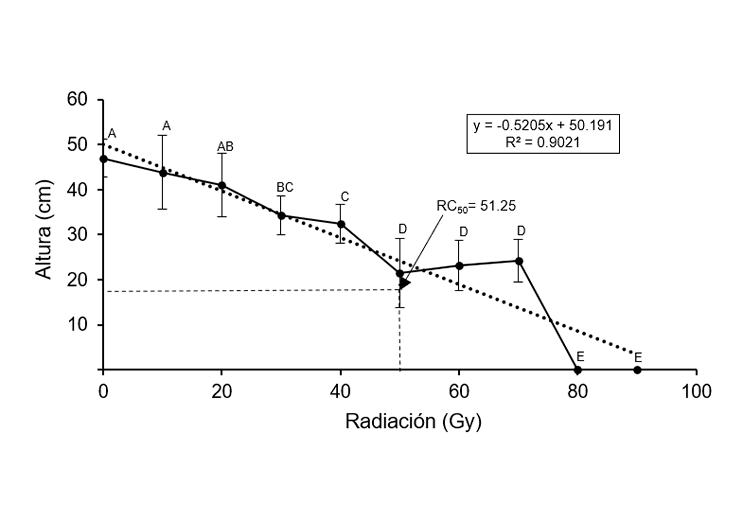
Sugarcane is an important grass because it produces sucrose, which is used as a raw material in numerous industrial and agrifood processes. Gamma-ray-induced mutagenesis has proven to be an efficient alternative method for obtaining plant varieties with desirable characteristics in a short time, so knowing the radiosensitivity of genotypes is a crucial step. The objective was to determine the radiosensitivity curve in sugarcane buds and plants of the Mayarí 55-14 variety with gamma radiation to induce variation. A total of 10 radiation treatments, ranging from 0 to 90 Gy, were established, with 100 buds per treatment. The buds were irradiated at the National Institute for Nuclear Research during 2022. Later, the buds were planted at the Higher Technological Institute of Los Reyes. The median lethal dose and the median growth reduction were analyzed by regression, yielding 50.16 and 51.25 Gy, respectively. Starting at 60 Gy, radiation significantly reduced shoot emergence and survival. In variables such as stem thickness, plant height, number of leaves, and number of tillers, there was a reduction between 30 and 70 Gy, according to the analysis of variance and Tukey’s test (p≤ 0.05). It is suggested to irradiate buds of the Mayarí 55-14 variety with doses between 40 and 60 Gy to cause variation and detect possible outstanding mutants with traits of interest.
Downloads
References
Ariharasutharsan, G.; Negi, P.; Vinoth, P.; Malarvizhi, A.; Senthilrajan, P.; Appunu, C.; Srivastava, A. K. and Valarmathi, R. 2025. Gamma ray induced significant phenotypic and metabolite changes in sugarcane variants derived through in vitro mutagenesis. Applied Radiation and Isotopes. 217(3):111597. https://doi.org/10.1016/j.apradiso.2024.111597. DOI: https://doi.org/10.1016/j.apradiso.2024.111597
Barrientos-Alfaro, F. C.; Echeverría-Beirute, F.; Hernández-Soto, A.; Gatica-Arias, A.; Hernández-García, C. M.; Carvajal-Quesada, P.; Rodríguez-Morales, A. and Pérez, J. 2025. Mutation breeding strategies and advances for sugarcane (Saccharum spp.) improvement. Plant Cell, Tissue and Organ Culture. 162(66):3-8. https://doi.org/10.1007/s11240-025-03188-y. DOI: https://doi.org/10.1007/s11240-025-03188-y
CIDCA. 2025. Catálogo de variedades mexicanas de caña de azúcar, AC (CIDCA). https://metodologia.cidca.mx/#.
De Souza, A. P.; Grandis, A.; Arenque-Musa, B. C. and Buckeridge, M. S. 2018. Diurnal variation in gas exchange and nonstructural carbohydrates throughout sugarcane development. Functional Plant Biology. 45(8):865-876. https://doi.org/10.1071/FP17268. DOI: https://doi.org/10.1071/FP17268
Díaz-Juárez, R. de la C.; Hernández-Arenas, M.; Santacruz-Varela, A.; Silva-Cifuentes, E. G.; De la Cruz-Torres, E.; Barrios-Gómez, E. J.; Trejo-Pastor, V. y Muñoz-Orozco, A. 2022. Dosis altas de radiación gamma (Cobalto60) disminuyen la expresión fenotípica de caracteres en caña de azúcar (Saccharum officinarum L.). Brazilian Journal of Animal and Environmental Research. 5(4):3694-3709. https://doi.org/10.34188/bjaerv5n4-021. DOI: https://doi.org/10.34188/bjaerv5n4-021
Djumali, H. A.; Purwati, R. D.; Riajaya, P. D.; Machfud, M. S. and Yulaikah, S. 2024. Improving sugarcane stem length through biparental crossing for higher sugarcane yield and sugar yield. Russian Journal of Agricultural and Socio-Economic Sciences. 155(11):109-117.
Lamichhane, S. and Thapa, S. 2022. Advances from conventional to modern plant breeding methodologies. Plant Breeding and Biotechnology. 10(1):1-14. https://doi.org/10.9787/pbb.2022.10.1.1. DOI: https://doi.org/10.9787/PBB.2022.10.1.1
Leanasawat, N.; Kosittrakun, M.; Lontom, W. and Songsri, P. 2021. Physiological and agronomic traits of certain sugarcane genotypes grown under field conditions as influenced by early drought stress. Agronomy. 11(11):2319. https://doi.org/10.3390/agronomy11112319. DOI: https://doi.org/10.3390/agronomy11112319
Madala, H. V.; Lesmes-Vesga, R. A.; Odero, C. D.; Sharma, L. K. and Sandhu H. S. 2023. Effects of planting pre-germinated buds on stand establishments in sugarcane. Agronomy. 13(4):1001. https://doi.org/10.3390/agronomy13041001. DOI: https://doi.org/10.3390/agronomy13041001
Minitab. 2019. Minitab (Version 19) [Software estadístico]. Minitab LLC. https://www.minitab.com.
Patade, V. Y. and Suprasanna, P. 2008. Radiation induced in vitro mutagenesis for sugarcane improvement. Sugar Tech.10:14-19 https://doi.org/10.1007/s12355-008-0002-4. DOI: https://doi.org/10.1007/s12355-008-0002-4
Pires, W. M.; Teixeira, M. B.; Soares, F. A. L.; Morais, W. A.; Costa, A. C.; Filho, L. C. L. and de Moura, J. B. 2024. Agronomic performance and technological quality of sugarcane submitted to different poultry litter dosages. Scientific Reports. 14(1):15435. https://doi.org/10.1038/s41598-024-66340-2. DOI: https://doi.org/10.1038/s41598-024-66340-2
Preciado, J. F. C.; Ruíz, A. E. C.; Mexicano, M. M. y Burela, A. C. 2022. Evaluación agroindustrial de ocho híbridos de caña de azúcar (Saccharum spp.) cultivados en la zona de abastos del ingenio quesería, Colima, México. Studies in Environmental and Animal Science. 3(4):818-831. https://doi.org/10.54020/seasv3n4-001. DOI: https://doi.org/10.54020/seasv3n4-001
Reyes-Hernández, J.; Torres-de los Santos, R.; Hernández-Torres, H.; Hernández-Robledo, V.; Alvarado-Ramírez, E. y Joaquín-Cancino, S. 2022. Rendimiento y calidad de siete variedades de caña de azúcar en El Mante, Tamaulipas. Revista Mexicana de Ciencias Agrícolas. 13(5):883-892. https://doi.org/10.29312/remexca.v13i5.3232. DOI: https://doi.org/10.29312/remexca.v13i5.3232
Riaz, A.; Alqudah, A. M.; Kanwal, F.; Pillen, K.; Ye, L.-Z.; Dai, F. and Zhang, G. 2023. Advances in studies on the physiological and molecular regulation of barley tillering. Journal of Integrative Agriculture. 22(1):1-13. https://doi.org/10.1016/j.jia.2022.08.011. DOI: https://doi.org/10.1016/j.jia.2022.08.011
Riviello-Flores, M. de la L.; Cadena-Iñiguez, J.; Ruiz-Posadas, L. del. M.; Arévalo-Galarza, M. de L.; Castillo-Juárez, I.; Soto-Hernández, M. and Castillo-Martínez, C. R. 2022. Use of gamma radiation for the genetic improvement of underutilized plant varieties. Plants. 11(9):1161-1169. https://doi.org/10.3390/plants11091161. DOI: https://doi.org/10.3390/plants11091161
Rubio-Ochoa, E.; De la Cruz-Torres, E.; Olalde-Portugal, V.; Pérez-Sánchez, R. E.; Gómez-Leyva, J. F. y García-Saucedo, P. A. 2024. Mutagénesis por radiación gamma para mejora genética de plantas de importancia alimentaria. Revista Mexicana de Ciencias Agrícolas. 15(5):e3747. https://doi.org/10.29312/remexca.v15i5.3747. DOI: https://doi.org/10.29312/remexca.v15i5.3747
Suhesti, S.; Syukur, M.; Husni, A. and Hartati, R. S. 2021. Increased genetic variability of sugarcane through gamma ray irradiation. IOP conference series: Earth and Environmental Science. 653:012134. https://doi.org/10.1088/1755-1315/653/1/012134. DOI: https://doi.org/10.1088/1755-1315/653/1/012134
Valdez-Balero, A. 2023. Nuevas variedades de caña de azúcar (Saccharum spp.) liberadas en Tabasco, México. Agro-Divulgación. 3(3):3-6. https://doi.org/10.54767/ad.v3i3.191. DOI: https://doi.org/10.54767/ad.v3i3.191
Wu, Q.; Li, A.; Zhao, P.; Xia, H.; Zhang, Y. and Que, Y. 2024. Theory to practice: success in breeding sugarcane variety YZ08-1609 known as the king of sugar. Frontiers in Plant Science. 15:1413108. https://doi.org/10.3389/fpls.2024.1413108. DOI: https://doi.org/10.3389/fpls.2024.1413108
Downloads
Published
Issue
Section
License
Copyright (c) 2026 Revista Mexicana de Ciencias Agrícolas

This work is licensed under a Creative Commons Attribution-NonCommercial 4.0 International License.
The authors who publish in Revista Mexicana de Ciencias Agrícolas accept the following conditions:
In accordance with copyright laws, Revista Mexicana de Ciencias Agrícolas recognizes and respects the authors’ moral right and ownership of property rights which will be transferred to the journal for dissemination in open access. Invariably, all the authors have to sign a letter of transfer of property rights and of originality of the article to Instituto Nacional de Investigaciones Forestales, Agrícolas y Pecuarias (INIFAP) [National Institute of Forestry, Agricultural and Livestock Research]. The author(s) must pay a fee for the reception of articles before proceeding to editorial review.
All the texts published by Revista Mexicana de Ciencias Agrícolas —with no exception— are distributed under a Creative Commons License Attribution-NonCommercial 4.0 International (CC BY-NC 4.0), which allows third parties to use the publication as long as the work’s authorship and its first publication in this journal are mentioned.
The author(s) can enter into independent and additional contractual agreements for the nonexclusive distribution of the version of the article published in Revista Mexicana de Ciencias Agrícolas (for example include it into an institutional repository or publish it in a book) as long as it is clearly and explicitly indicated that the work was published for the first time in Revista Mexicana de Ciencias Agrícolas.
For all the above, the authors shall send the Letter-transfer of Property Rights for the first publication duly filled in and signed by the author(s). This form must be sent as a PDF file to: revista_atm@yahoo.com.mx; cienciasagricola@inifap.gob.mx; remexca2017@gmail.
This work is licensed under a Creative Commons Attribution-Noncommercial 4.0 International license.