Behavior of hybrids, improved varieties and native varieties of yellow corn in Chiapas
DOI:
https://doi.org/10.29312/remexca.v17i3.4268Keywords:
elite trials, genetic improvementAbstract
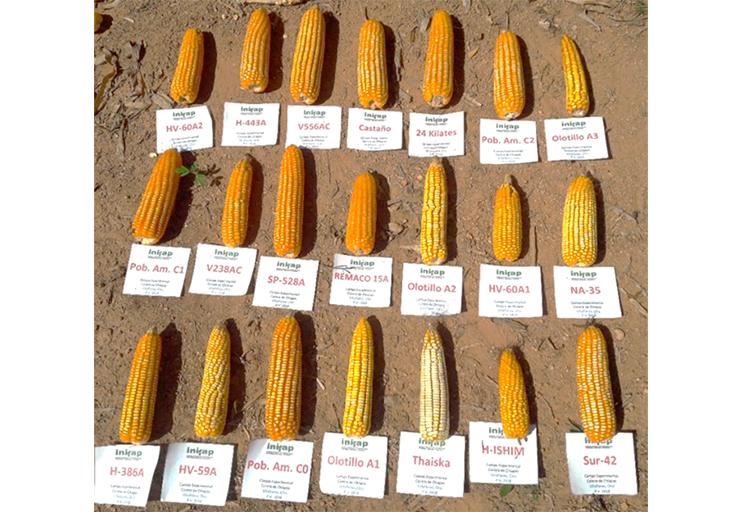
In 2016, Mexico imported almost 13 million tons of yellow corn, valued at more than 2.3 billion dollars. However, imports could be reduced or eliminated if the yellow-grained varieties and hybrids generated by the National Institute of Forestry, Agricultural and Livestock Research were grown. The study aimed to identify the best hybrid and the best variety of yellow corn that the National Institute of Forestry, Agricultural and Livestock Research has released for the Mexican tropics, where more than 420 000 ha are planted, and 2.1 million tons of yellow corn are produced. During the spring-summer agricultural cycle of 2018, 21 genotypes were evaluated in three localities in Chiapas; the hybrids H-443A, REMACO15A and H-386A stood out statistically with grain yields of 5.748, 5.608, and 5.514 t ha-1 and equaled two of the control commercial hybrids; of the improved varieties, Población Amarilla C1 stood out with 4.9 t ha-1 and of the native varieties, the Olotillo Amarillo-1 variety, from Ocozocoautla, stood out with 3.1 t ha-1.
Downloads
References
Coutiño, E. B.; Gómez, M. N.; Rincón, E. D. y Morales, H. L. D. 2019. Selección recurrente para formar una variedad mejorada de maíz amarillo. En: Memorias de la X Reunión Nacional Agrícola. INIFAP, Chiapas 2019. Tuxtla Gutiérrez, Chiapas. 423-426 pp.
Coutiño, E. B. y Vázquez, C. G. 2018. V238AC: nueva variedad de maíz de grano amarillo QPM. Revista Mexicana de Ciencias Agrícolas. 9(5):1089-1092.
Coutiño, E. B.; Vázquez, C. G. y Vidal, M. V. A. 2022. V56AC, primera variedad de maíz Olotón QPM de grano amarillo para los Valles Altos de Chiapas. Revista Fitotecnia Mexicana. 45(1)149-151.
Coutiño, E. B.; Cruz, V. C.; Hernández, C. J. M.; Gómez, M. O.; Cruz, C. F. J.; Vidal, M. V. y Aguilar, J. C. E. 2021. Diversidad de razas de maíz cultivadas en Chiapas, México. Libro técnico núm. 14. Instituto Nacional de Investigaciones Forestales, Agrícolas y Pecuarias. Ocozocoautla, Chiapas, Méx. 303 p.
Espinosa, C. A.; Tadeo, R. M.; Gómez, M. N.; Sierra, M. M.; Virgen, V. J.; Palafox, C. A.; Vázquez, C. G. y Valdivia, B. R. 2010. V-54 A: nueva variedad de maíz de grano amarillo para siembras de temporal retrasado en Valles Altos de México. Revista Mexicana de Ciencias Agrícolas. 1(5):677-680.
Flores, C. L. y García, S. J. 2016. Beneficios de la adopción de semilla mejorada de maíz en la región central de Puebla. Revista Fitotecnia Mexicana. 39(3):277-283.
Gámez, V. A. J.; Ávila, P. M. A.; Ángeles, A. H.; Díaz, H. C.; Ramírez, V. H.; Alejo, J. A. y Terrón I. A. 1996. Híbridos y variedades de maíz liberados por el INIFAP hasta 1996. Publicación especial núm. 16. Toluca, México. 16-18 pp.
García, S. J.; Skaggs, R. K. y Borja, M. B. 2016. Identificación de las regiones productoras de maíz más competitivas en México en base a la logística y al consumo. Interciencia. 41(6):376-381.
García, S. J. y Ramírez, R. J. 2014. El mercado de la semilla mejorada de maíz (Zea mays L.) en México. Un análisis del saldo comercial por entidad federativa. Revista Fitotecnia Mexicana. 37(1):69-77.
García, E. J. C.; Canales, I. E. I.; Tadeo, R. M.; Calderón, E. A.; Zamudio, G. B. y Martínez, G. A. 2018. Rendimiento de híbridos varietales élite de maíz de grano amarillo para Valles Altos de México. Acta Fitogenética. 5(1):80.
Gómez, M. N. O.; Cantú, A. M. A.; Vázquez, C. M. G.; Hernández, G. C. A.; Aragón, C. F.; Espinosa, C. A. y Palemón, F. A. 2017. Híbrido varietal HV-240: nueva alternativa de maíz para la montaña baja de Guerrero. Revista Mexicana de Ciencias Agrícolas. 8(5):1219-1223.
Littell, R. C.; Milliken, G. A.; Stroup, W. W. and Wolfinger, R. D. 1966. SAS system for mixed models. SAS Institute Inc., Cary, NC, USA. 633 p.
Medina, M. J.; Soto, R. J. M. y Villalobos, G. A. 2015. Rendimientos de materiales genéticos de maíz de grano amarillo bajo temporal en el estado de Campeche, México. En: memorias de resúmenes de la LX reunión de la sociedad del programa cooperativo centroamericano para el mejoramiento de cultivos y animales. Guatemala, Centroamérica. 116 p.
Ramírez, D. J. L.; Alemán, T. I.; Chuela, B. M.; Vidal, M. V. A.; Ledesma, M. A.; Vallejo, D. H. L.; Ramírez, Z. R.; Gómez, M. N. O.; Ruiz, R. S.; Peña, R. A.; Reyes, M. C. A., Salinas, M. Y.; Vázquez, C. M. G.; Ruiz, C. J. A.; Trujillo, C. A. y Preciado, O. R. E. 2017. H-386A. Híbrido trilineal de maíz de grano amarillo para la zona subtropical de México. Folleto técnico núm. 5. CIRPAC-INIFAP. Campo Experimental Centro-Altos de Jalisco. 48 p.
Reyes, M. C. A.; Cantú, A. M. A.; Garza, C. M.; Vázquez, C. G. y Córdova, O. H. 2009. H-443A, híbrido de maíz de grano amarillo para el noreste de México. Revista Fitotecnia Mexicana. 32(4):331-333.
SAGARPA, 2017. Maíz grano blanco y amarillo mexicano. Planeación Agrícola Nacional 2017-2030. Primera Edición. 28 p. https://www.sagarpa.gob.mx/cms/uploads/attachment/file/256429/BasicoMaizGranoBlancoYAmarillo.pdf.
SIAP. 2023. Servicio de Información Agroalimentaria y Pesquera (SIAP)-Secretaría de Agricultura y Desarrollo Rural (SADER). Anuario estadístico de la producción de maíz en el estado de Chiapas. Ciclo agrícola 2012. www.siap.sagarpa.gob.mx.
Tadeo-Robledo, M.; Espinosa-Calderón, A.; Zaragoza-Esparza, J.; Turrent-Fernández, A.; Sierra-Macías, M. y Gómez-Montiel, N. 2012. Forraje y grano de híbridos de maíz amarillo para Valles Altos de México. Agronomía Mesoamericana. 23(2):281-286.
Velázquez-Cardelas, G. A.; González-Huerta, A.; Pérez-López D. J. y Castillo-González, F. 2018. Comportamiento de mestizos de maíz en tres localidades del centro de México. Revista Mexicana de Ciencias Agrícolas. 9(6):1217-1230.
Downloads
Published
Issue
Section
License
Copyright (c) 2026 Revista Mexicana de Ciencias Agrícolas

This work is licensed under a Creative Commons Attribution-NonCommercial 4.0 International License.
The authors who publish in Revista Mexicana de Ciencias Agrícolas accept the following conditions:
In accordance with copyright laws, Revista Mexicana de Ciencias Agrícolas recognizes and respects the authors’ moral right and ownership of property rights which will be transferred to the journal for dissemination in open access. Invariably, all the authors have to sign a letter of transfer of property rights and of originality of the article to Instituto Nacional de Investigaciones Forestales, Agrícolas y Pecuarias (INIFAP) [National Institute of Forestry, Agricultural and Livestock Research]. The author(s) must pay a fee for the reception of articles before proceeding to editorial review.
All the texts published by Revista Mexicana de Ciencias Agrícolas —with no exception— are distributed under a Creative Commons License Attribution-NonCommercial 4.0 International (CC BY-NC 4.0), which allows third parties to use the publication as long as the work’s authorship and its first publication in this journal are mentioned.
The author(s) can enter into independent and additional contractual agreements for the nonexclusive distribution of the version of the article published in Revista Mexicana de Ciencias Agrícolas (for example include it into an institutional repository or publish it in a book) as long as it is clearly and explicitly indicated that the work was published for the first time in Revista Mexicana de Ciencias Agrícolas.
For all the above, the authors shall send the Letter-transfer of Property Rights for the first publication duly filled in and signed by the author(s). This form must be sent as a PDF file to: revista_atm@yahoo.com.mx; cienciasagricola@inifap.gob.mx; remexca2017@gmail.
This work is licensed under a Creative Commons Attribution-Noncommercial 4.0 International license.