Evaluation of yield and fruit quality of three strawberry varieties under greenhouse conditions for northeastern Guanajuato
DOI:
https://doi.org/10.29312/remexca.v17i6.4267Keywords:
analysis of variance, fruit quality, total soluble solidsAbstract
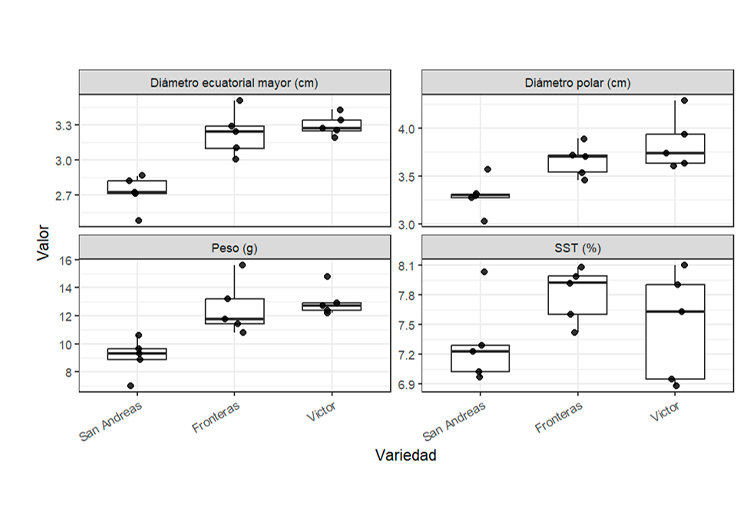
This research evaluated the fruit characteristics of three strawberry (Fragaria × ananassa Duch.) varieties (Fronteras, San Andreas and Víctor) grown under greenhouse conditions and under the same agronomic management. The experiment was established in March 2025 at the Northeast Interdisciplinary Center of the University of Guanajuato, located in the municipality of Tierra Blanca, Guanajuato, under a completely randomized experimental design. The following variables were measured: polar diameter, major equatorial diameter, fresh fruit weight, and total soluble solids content (°Brix). Data were analyzed using a multivariate approach, applying a transformation based on the squared Euclidean norm to integrate the variables into a single index, which was then subjected to analysis of variance (Anova) and comparison of means using Tukey’s test (p≤ 0.05). The analysis of variance showed significant differences between varieties (p= 0.003); Tukey’s test showed that Víctor and Fronteras did not differ from each other and according to the polar and equatorial diameters and the weight of the fruit, they presented the best overall performance, compared with San Andreas, which was significantly lower. It is concluded that, under greenhouse conditions and the climate of northeastern Guanajuato, the Víctor and Fronteras varieties exhibited better overall performance than San Andreas in fruit quality.
Downloads
References
Aguilar-García, R.; Dávalos-González, P. A. and Jofre-Garfías, A. E. 2021. Strawberry iron-manganese chlorosis: a mathematic model to understand the phenomenon. Acta Horticulturae. 1309(IX International Strawberry Symposium):483-486. https://doi.org/10.17660/ActaHortic.2021.1309.69.
Al-Abdullatif, F. A.; Al-Abdullatif, M. A. and Brooks, G. 2019. Manova post hoc techniques used in published articles: a systematic review. General Linear Model Journal. 45(1):4-11.
Alvarado-Chávez, J. A.; Gómez-Gonzáles, A.; Lara-Herrera, A.; Díaz-Pérez, J. C. y García-Herrera, E. J. 2020. Rendimiento y calidad de fruto de fresa cultivada en invernadero en sistema hidropónico piramidal. Revista Mexicana de Ciencias Agrícolas. 11(8):1737-1748. https://doi.org/10.29312/remexca.v11i8.2460.
Ariza, M. T.; Miranda, L.; Gómez-Mora, J. A.; Medina, J. J.; Lozano, D.; Gavilán, P.; Soria, C. and Martínez-Ferri, E. 2021. Yield and fruit quality of strawberry cultivars under different irrigation regimes. Agronomy. 11(2):261. https://doi.org/10.3390/agronomy11020261.
Azodanlou, R.; Darbellay, C.; Luisier, J. L.; Villettaz, J. C. and Amadò, R. 2003. Quality assessment of strawberries (Fragaria species). Journal of Agricultural and Food Chemistry. 51(3):715-721. https://doi.org/10.1021/jf0200467.
Bradford, E.; Hancock, J. F. and Warner, R. M. 2010. Interactions of temperature and photoperiod determine expression of repeat flowering in strawberry. Journal of the American Society for Horticultural Science. 135(2):102-107. https://doi.org/10.21273/JASHS.135.2.102.
Chiomento, J. L. T.; Lima-Júnior, E. P.; D’Agostini, M.; De Nardi, F. S.; Trentin, T. S.; Dornelles, A. G.; Huzar-Novakowiski, J. and Calvete, E. O. 2021. Horticultural potential of nine strawberry cultivars by greenhouse production in Brazil: a view through multivariate analysis. Scientia Horticulturae. 279:109738. https://doi.org/10.1016/j.scienta.2020.109738.
Chitarra, M. I. F. y Chitarra, A. B. 2005. Pós-colheita de frutas e hortaliças fisiologia e manuseio. 2da. Edição. Livraria Funep. 783 p. https://livraria.funep.org.br/product/pos-colheita-de-frutas-e-hortalicas-fisiologia-e-manuseio-2-edic-o/.
Choi, H. G.; Moon, B. Y. and Kang, N. J. 2015. Effects of led light on the production of strawberries during cultivation in a plastic greenhouse and in a growth chamber. Scientia Horticulturae. 189:22-31. https://doi.org/10.1016/j.scienta.2015.03.022.
Corvino, A.; Romaniello, R.; Palumbo, M.; Ricci, I.; Cefola, M.; Pelosi, S. and Pace, B. 2023. Image analysis to predict the maturity index of strawberries. Advances in Horticultural Science. 37(1):83-87. https://doi.org/10.36253/ahsc-13856.
De Mendiburu, F. 2023. Agricolae: Statistical procedures for agricultural research. (Version 1.3-7) [R package]. https://CRAN.R-project.org/package=agricolae.
Hancock, J. F. 2020. Strawberries. James, F. Hancock. CABI.
Heide, O. M.; Stavang, J. A. and Sønsteby, A. 2013. Physiology and genetics of flowering in cultivated and wild strawberries a review. The Journal of Horticultural Science and Biotechnology. 88(1):1-18. https://doi.org/10.1080/14620316.2013.11512930.
Herrera-Reyes, G. S.; Martínez-Reyes, M. Á.; Pérez-Rodríguez, P.; Romero-Padilla, J. M., Luna-Espinoza, I. and Suárez-Espinosa, J. 2024. Analysis for multiple responses in a completely randomized experimental design. Agrociencia. 58(2):151-64. https://doi.org/10.47163/agrociencia.v58i2.3164.
Hoppula, K. B and Karthu, S. 2006. Strawberry fruit quality responses to the production environment. Journal Food Agriculture and Environment. 4(1):166-170.
Knapp, S. J.; Cole, G. S.; Shaw, D. V. and Larson, K. D. 2021. Strawberry plant named ‘UCD Victor’ (US. Patent No. USPP32966P3). United States Patent and Trademark Office.
Kottek, M.; Grieser, J.; Beck, C.; Rudolf, B. and Rubel, F. 2006. World map of the Köppen-Geiger climate classification updated. Meteorologische Zeitschrift. 15(3):259-263. https://doi.org/10.1127/0941-2948/2006/0130.
Krüger, E.; Josuttis, M.; Nestby, R.; Toldam-Andersen, T. B.; Carlen, C. and Mezzetti, B. 2012. Influence of growing conditions at different latitudes of Europe on strawberry growth performance, yield and quality. Journal of Berry Research. 2(3):143-157. https://doi.org/10.3233/JBR-2012-036.
Macías-Gallardo, F.; Barajas-Díaz, C. G. M.; Mireles-Arriaga, A. I. and Ozuna, C. 2023. Strawberry variety influences the effectiveness of postharvest treatment with gaseous ozone: impact on the physicochemical, microbiological, and bioactive properties of the fruit. Processes. 11(2):346. https://doi.org/10.3390/pr11020346.
Minutti-López, S. P.; Gallardo-Velázquez, T.; Osorio-Revilla, G. and Meza-Márquez, O. G. 2019. Chemical composition and antioxidant capacity in strawberry cultivars (Fragaria x ananassa Duch.) by FT-MIR spectroscopy and chemometrics. CyTA-Journal of Food. 17(1):724-732. https://doi.org/10.1080/19476337.2019.1645211.
Miranda, P. S.; Lima, Z. C. M.; Pérez-Maluf, R. and Moreira, A. A. 2024. Pollination of flowers of the San Andreas strawberry cultivar. Pesquisa Agropecuária Brasileira. 59:e03434. https://doi.org/10.1590/s1678-3921.pab2024.v59.03434.
Miranda, P. S.; Lima, Z. C. M.; Pérez-Maluf, R.; Oliveira, E. P.; Monroe, P. H. M. and Moreira, A. A. 2025. Influence of pollination mechanisms on the physical-chemical quality of strawberry (Fragaria x ananassa) cv. San Andreas. Anais da Academia Brasileira de Ciências. 97(3):e20240799. https://doi.org/10.1590/0001-3765202520240799.
Mixquititla-Casbis, G.; Villegas-Torres, O. G.; Andrade-Rodríguez, M.; Sotelo-Nava, H. y Cardoso-Taketa, A. T. 2020. Crecimiento, rendimiento y calidad de fresa por efecto del régimen nutrimental. Revista Mexicana de Ciencias Agrícolas. 11(6):1337-1348. https://doi.org/10.29312/remexca.v11i6.2329.
Palencia, P.; Giné-Bordonaba, J.; Martínez, F. and Terry-León. A. 2016. Investigating the effect of different soilless substrates on strawberry productivity and fruit composition. Scientia Horticulturae. 203:12-19. https://doi.org/10.1016/j.scienta.2016.03.005.
R Core Team. 2024. R: A language and environment for statistical computing. R Foundation for Statistical Computing. Vienna, Austria, http://www.R-project.org.
Shaw, D. and Larson, K. 2014. Strawberry plant named ‘Fronteras’ (US. Patent Application No. US 2015/0230374 A1). United States Patent and Trademark Office.
Simkova, K.; Veberic, R.; Hudina, M.; Grohar, M. C.; Ivancic, T.; Smrke, T.; Pelacci, M. and Jakopic, J. 2023. Berry size and weight as factors influencing the chemical composition of strawberry fruit. Journal of Food Composition and Analysis. 123:105509. https://doi.org/10.1016/j.jfca.2023.105509.
Skrovankova, S.; Sumczynski, D.; Mlcek, J.; Jurikova, T. and Sochor, J. 2015. Bioactive compounds and antioxidant activity in different types of berries. International Journal of Molecular Sciences. 16(10):24673-24706. https://doi.org/10.3390/ijms161024673.
Sønsteby, A. and Heide, O. M. 2009. Temperature limitations for flowering in strawberries and raspberries. Acta Horticulturae. 838:93-98. https://doi.org/10.17660/ActaHortic.2009.838.15.
Steiner, A. A. 1961. A universal method for preparing nutrient solutions of a certain desired composition. Plant and Soil. 15(2):134-154. https://doi.org/10.1007/BF01347224.
Ulrich, D. and Olbricht K. 2013. Diversity of volatile patterns in sixteen Fragaria vesca L. accessions in comparison to cultivars of Fragaria × ananassa. Journal of Applied Botany and Food Quality. 86:37-46. Doi:10.5073/JABFQ.2013.086.006.
Downloads
Published
Issue
Section
License
Copyright (c) 2026 Revista Mexicana de Ciencias Agrícolas

This work is licensed under a Creative Commons Attribution-NonCommercial 4.0 International License.
The authors who publish in Revista Mexicana de Ciencias Agrícolas accept the following conditions:
In accordance with copyright laws, Revista Mexicana de Ciencias Agrícolas recognizes and respects the authors’ moral right and ownership of property rights which will be transferred to the journal for dissemination in open access. Invariably, all the authors have to sign a letter of transfer of property rights and of originality of the article to Instituto Nacional de Investigaciones Forestales, Agrícolas y Pecuarias (INIFAP) [National Institute of Forestry, Agricultural and Livestock Research]. The author(s) must pay a fee for the reception of articles before proceeding to editorial review.
All the texts published by Revista Mexicana de Ciencias Agrícolas —with no exception— are distributed under a Creative Commons License Attribution-NonCommercial 4.0 International (CC BY-NC 4.0), which allows third parties to use the publication as long as the work’s authorship and its first publication in this journal are mentioned.
The author(s) can enter into independent and additional contractual agreements for the nonexclusive distribution of the version of the article published in Revista Mexicana de Ciencias Agrícolas (for example include it into an institutional repository or publish it in a book) as long as it is clearly and explicitly indicated that the work was published for the first time in Revista Mexicana de Ciencias Agrícolas.
For all the above, the authors shall send the Letter-transfer of Property Rights for the first publication duly filled in and signed by the author(s). This form must be sent as a PDF file to: revista_atm@yahoo.com.mx; cienciasagricola@inifap.gob.mx; remexca2017@gmail.
This work is licensed under a Creative Commons Attribution-Noncommercial 4.0 International license.