Economic physiology of mango: the production function for perennial crops in Sinaloa 2000-2023
DOI:
https://doi.org/10.29312/remexca.v17i6.4176Keywords:
agricultural econometrics, economic physiology, mango, perennial crop, production functionAbstract
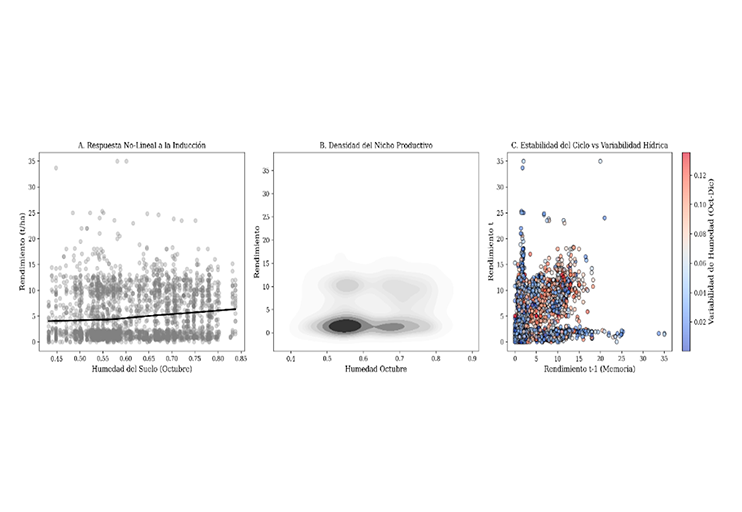
The study of mango production in Sinaloa (2000-2023) demonstrates that yield is not a contemporary stochastic event, but a trajectory-dependent process defined by the orchard’s inherited physiological state. The evidence indicates that the crop arrives at each cycle with an energy ‘memory’ accumulated from its recent production history, which conditions its capacity to respond to climate, management, and inputs. Modeling using ensemble algorithms enabled classification of the production regimes with 77%-79% accuracy, achieving a statistical robustness of R²= 0.84 by identifying that physiological memory dominates the hierarchy of predictors with a relative weight of 53%. This finding allowed us to reinterpret the variability in production. The drop in yield is not explained by structural failures or extreme climatic events but by physiological depletion accumulated after previous cycles of high biomass extraction. Similarly, years with favorable climatic conditions may not translate into high yields if the tree arrives energetically compromised. An induction ‘sweet point’ was identified, where the maximum yield (7.78 t ha-1) is only viable under a water stress index between 0.54 and 0.61; outside this threshold, the tree exhibits an inelastic response regardless of its previous load. Based on this logic, operational bioindicators were developed that allow anticipating the crop’s response and differentiating years to intensify production from |those where physiological recovery should be prioritized, optimizing intertemporal decision-making in perennial agricultural systems.
Downloads
References
Bibliografía
Ahmad, M.; Shabbir, M.; Ali, H.; Hashmi, M. B. F.; Ahmed, M.; Ahmad, S. and Malik, A. 2025. Climate-induced changes in mango production: phenological impacts, pest threats, and mitigation approaches. In: Naqvi, S. A. H.; Ahmad, S. and Ahmed M. (Eds.), climate change and mango production. 773-802 pp. Springer. https://doi.org/10.1007/978-3-031-87035-4-30.
Aigner, D.; Lovell, C. K. and Schmidt, P. 1977. Formulation and estimation of stochastic frontier production function models. Journal of Econometrics. 6(1):21-37. https://doi.org/10.1016/0304-4076(77)90052-5.
Antwi-Boasiako, A.; Amponsah, P.; Opoku, J. A.; Coulibaly, D. and Mintah, P. 2024. Increasing mango production efficiency under the fast-changing climate. In: Hasanuzzaman, M. and Nahar, K. (Eds.), abiotic stress in crop plants: ecophysiological responses and molecular approaches. IntechOpen. https://doi.org/10.5772/intechopen.112951.
Blanchard, O. J. and Summers, L. H. 1986. Hysteresis and the European unemployment problem. NBER Macroeconomics Annual. 1:15-78. https://doi.org/10.1086/654013.
Chambers, R. G. and Quiggin, J. 2000. Uncertainty, production, choice, and agency: the state-contingent approach. Cambridge University Press.
Christensen, L. R.; Jorgenson, D. W. and Lau, L. J. 1973. Transcendental logarithmic production frontiers. The Review of Economics and Statistics. 55(1):28-45. https://doi.org/10.2307/1927992.
Cobb, C. W. and Douglas, P. H. 1928. A theory of production. The American Economic Review. 18(1):139-165. https://doi.org/10.2307/1811556.
Coelli, T. J.; Rao, D. S. P.; O’Donnell, C. J. and Battese, G. E. 2005. An introduction to efficiency and productivity analysis. 2nd. Editition. Springer Science and Business Media. https://doi.org/10.1007/b136381.
FAOSTAT. 2024. Food and Agriculture Organization of the United Nations. Base de datos estadísticos de la FAO. Organización de las Naciones Unidas para la Alimentación y la Agricultura. https://www.fao.org/faostat/es/.
Goldschmidt, E. E. 2013. The evolution of fruit tree productivity: a review. Economic Botany. 67(1):51-62. https://doi.org/10.1007/s12231-012-9219-y.
Infante, F.; Quilantán, J.; Rocha, F.; Esquinca, H.; Castillo, A.; Ibarra-Núñez, G. y Palacio, V. 2011. Mango Ataulfo: orgullo chiapaneco. Biodiversitas. 96:1-5. https://bioteca.biodiversidad.gob.mx/janium/x/bib/7255.
Izzati-Ulinnuha, A. R.; Sakamoto, M.; Masuya, K. and Kawamura, R. 2024. Forecasting mango crop yield in Miyazaki using deep learning. Memoirs of faculty of engineering. University of Miyazaki. 53(1):79-82. https://doi.org/10.34481/0002000820.
Just, R. E. and Pope, R. D. 1978. Stochastic specification of production functions and economic implications. Journal of Econometrics. 7(1):67-86. https://doi.org/10.1016/0304-4076(78)90006-4.
Liu, X.; Xiao, Y.; Zi, J.; Yan, J.; Li, C.; Du, C.; Wan, J.; Wu, H.; Zheng, B.; Wang, S. and Liang, Q. 2023. Differential effects of low and high temperature stress on pollen germination and tube length of mango (Mangifera indica L.) genotypes. Scientific Reports. 13(1):611-614. https://doi.org/10.1038/s41598-023-27917-5.
Masud, G. M. 2016. Pharmacological activities of mango (Mangifera indica): a review. Journal of Pharmacognosy and Phytochemistry. 5(4):183-189.
Monselise, S. P. and Goldschmidt, E. E. 1982. Alternate bearing in fruit trees. Horticultural Reviews. 4(5):128-173. https://doi.org/10.1002/9781118060773.ch5.
Noordam, J. 2024. The impact of climate change on mango cultivation in southern Europe. Tesis de maestría, Utrecht Universit. Utrecht University Repository. https://studenttheses.uu.nl/handle/20.500.12932/47080.
Ocampo, A. 2006. Modelo cinético del secado de la pulpa de mango. Revista EIA. 3(5):119-128. http://www.scielo.org.co/scielo.php?script=sci-arttext&pid=S1794-12372006000100011&lng=en&tlng=es.
Osuna-García, J. A.; Cáceres-Morales, I.; Montalvo-González, E.; Mata-Montes de Oca, M. y Tovar-Gómez, B. 2007. Efecto del 1-metilciclopropeno (1-MCP) y tratamiento hidrotérmico sobre la fisiología y calidad del mango ‘Keitt’. Revista Chapingo Serie Horticultura. 13(2):157-163. https://doi.org/10.5154/r.rchsh.2007.02.014.
Piedragil-Ocampo, B. 2018. Caracterización fisiológica, nutrimental y bioquímica de variedades amarillas de mango (Mangifera indica L.) de reciente introducción a México. Tesis de maestría. Universidad Autónoma de Guerrero (UAG). 71 p. http://ri.uagro.mx/handle/uagro/446.
Romero-Gomezcaña, N. R.; Saucedo-Veloz, C.; Sánchez-García, P.; Rodríguez-Alcázar, J.; González-Hernández, V. M.; Rodríguez-Mendoza, M. N. y Báez-Sañudo, R. 2006. Aplicación foliar de Ca(NO-3)2: fisiología y calidad de frutos de mango `Haden´. Terra Latinoamericana. 24(4):521-527. http://www.redalyc.org/articulo.oa?id=57324410.
SADER, SIAP. 2024. Secretaría de Agricultura y Desarrollo Rural y Servicio de Información Agroalimentaria y Pesquera. Cierre de la producción agrícola: mango en los estados de Sinaloa y Jalisco (2000-2023). Gobierno de México. https://www.gob.mx/siap/acciones-y-programas/produccion-agricola-33119.
Sharma, N.; Vittal, H.; Dubey, A. K.; Sharma, R. M.; Singh, S. K.; Sharma, N.; Singh, N.; Khandelwal, A.; Gupta, D. K.; Mishra, G. P.; Meena, M. C.; Pandey, R. and Singh, N. K. 2025. Physiological and molecular insights into alternate bearing in mango using next-generation sequencing approaches. Journal of Experimental Botany. 76(6):1585-1606. https://doi.org/10.1093/jxb/erae403.
SIAP. 2024a. Servicio de Información Agroalimentaria y Pesquera. Producción Agrícola: Consulta multivariable por municipio, ciclo perenne y modalidad hídrica. https://w6.siap.gob.mx/padrion/.
SIAP. 2024b. Servicio de Información Agroalimentaria y Pesquera. Diccionario de variables y metodología para la generación de estadística de producción agrícola.
Taiz, L. and Zeiger, E. 2010. Plant physiology. 5th. Edition. Sinauer Associates Inc. Sunderland, Massachusetts, USA: 782-798 p.
Vargas-Ortiz, M. A.; De la Cruz-Medina, J.; Oliart-Ros, R. M.; Rebolledo-Martínez, A.; Ramírez, J. A. y García, H. S. 2013. Efecto de las altas presiones hidrostáticas sobre los cambios poscosecha de mango ‘Manila’ en madurez fisiológica. CienciaUAT. 8(1):52-63. https://doi.org/10.29059/cienciauat.v8i1.10.
Vittal, H.; Sharma, N.; Dubey, A. K.; Shivran, M.; Singh, S. K.; Meena, M. C.; Kumar, N.; Sharma, N.; Singh, N.; Pandey, R.; Bollinedi, H.; Singh, B. P. and Sharma, R. M. 2023. Rootstock-mediated carbohydrate metabolism, nutrient contents, and physiological modifications in regular and alternate mango (Mangifera indica L.) scion varieties. Plos One. 18(5):e0284910. https://doi.org/10.1371/journal.pone.0284910.
Wall-Medrano, A.; Olivas-Aguirre, F. J.; Velderrain-Rodríguez, G. R.; González-Aguilar, A.; de la Rosa, L. A.; López-Díaz, J. A. y Álvarez-Parrilla, E. 2015. El mango: aspectos agroindustriales, valor nutricional/funcional y efectos en la salud. Nutrición Hospitalaria. 31(1):67-75. https://doi.org/10.3305/nh.2015.31.1.7701.
Downloads
Published
Issue
Section
License
Copyright (c) 2026 Revista Mexicana de Ciencias Agrícolas

This work is licensed under a Creative Commons Attribution-NonCommercial 4.0 International License.
The authors who publish in Revista Mexicana de Ciencias Agrícolas accept the following conditions:
In accordance with copyright laws, Revista Mexicana de Ciencias Agrícolas recognizes and respects the authors’ moral right and ownership of property rights which will be transferred to the journal for dissemination in open access. Invariably, all the authors have to sign a letter of transfer of property rights and of originality of the article to Instituto Nacional de Investigaciones Forestales, Agrícolas y Pecuarias (INIFAP) [National Institute of Forestry, Agricultural and Livestock Research]. The author(s) must pay a fee for the reception of articles before proceeding to editorial review.
All the texts published by Revista Mexicana de Ciencias Agrícolas —with no exception— are distributed under a Creative Commons License Attribution-NonCommercial 4.0 International (CC BY-NC 4.0), which allows third parties to use the publication as long as the work’s authorship and its first publication in this journal are mentioned.
The author(s) can enter into independent and additional contractual agreements for the nonexclusive distribution of the version of the article published in Revista Mexicana de Ciencias Agrícolas (for example include it into an institutional repository or publish it in a book) as long as it is clearly and explicitly indicated that the work was published for the first time in Revista Mexicana de Ciencias Agrícolas.
For all the above, the authors shall send the Letter-transfer of Property Rights for the first publication duly filled in and signed by the author(s). This form must be sent as a PDF file to: revista_atm@yahoo.com.mx; cienciasagricola@inifap.gob.mx; remexca2017@gmail.
This work is licensed under a Creative Commons Attribution-Noncommercial 4.0 International license.