Biological and botanical treatments as a dual control and biostimulation strategy for corn crops affected by Fusarium verticillioides
DOI:
https://doi.org/10.29312/remexca.v17i5.4136Keywords:
Zea mays L., antagonistas, biocontrol, bioestimulación, incidenciaAbstract
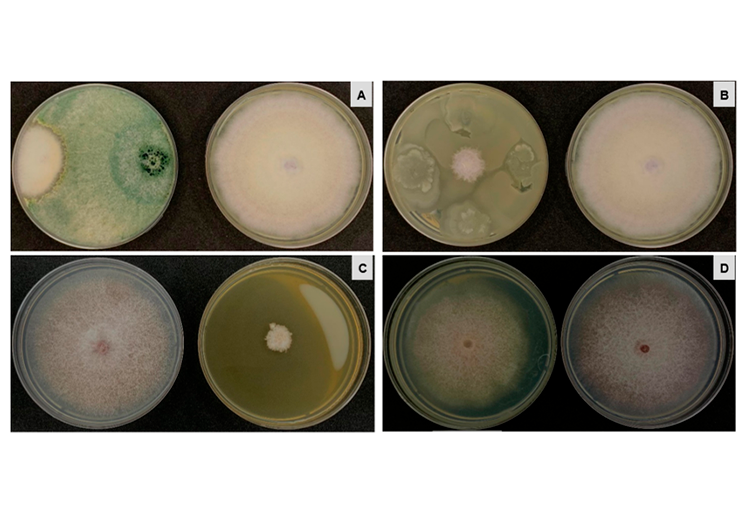
Phytopathogenic fungi in staple cereals can affect not only productivity but also the health of those who consume them. The objective of this research was to determine the antifungal activity of Trichoderma harzianum and Bacillus subtilis, as well as the hydroalcoholic extracts of Larrea tridentata and Argemone mexicana against Fusarium verticillioides under laboratory and field conditions. In vitro inhibition in dual cultures against the phytopathogen ranged from 82 to 86% for T. harzianum, B. subtilis, and L. tridentata; in contrast, for A. mexicana, it was 18%. The treatments reduced the incidence in the harvested grain by more than 70% in treated plants compared to the control. The application of treatments with T. harzianum, B. subtilis, A. mexicana, L. tridentata and a combination of T. harzianum and B. subtilis achieved a significant increase in plant height, which is directly related to the leaf area index; this resulted in optimal grain filling compared to the control; as a result, the yield potential of the Hernán Cortés hybrid was significantly expressed, with the botanical extracts outperforming the control and the microorganisms themselves, resulting in greater ear weight. Molecular corroboration of the phytopathogenic strain indicated 99% identity with F. verticillioides contained in the GenBank database.
Downloads
References
Arteaga, S.; Andrade, C. and Cárdenas, R. 2005. Larrea tridentata (Creosote bush), an abundant plant of Mexican and US-American deserts and its metabolite nordihydroguaiaretic acid. Journal of Ethnopharmacology. 98(3):231-239. Doi: 10.1016/j.jep.2005.01.002.
Asiya, I. U.; Anas, Y.; Yazid, M. B.; Muhammad, B. T.; Hafsat, M. D.; Balkisu, M. M. and Hassan, S. 2026. Fumonisin toxicosis and its effects on human health: Sources, Detection, and Risk Mitigation. 13(15):1311-1324. Doi: 10.51244/IJRSI.2026.1315PH00014.
Bell, D. K.; Wells, H. D. and Markham, C. R. 1982. In vitro antagonism of Trichoderma species against six fungal plant pathogens. Phytopathology. 72(4):379-382.
Ben Mrid, R.; Benmrid, B.; Hafsa, J.; Boukcim, H.; Sobeh, M. y Yasri, A. 2021. Metabolitos secundarios como agentes bioestimulantes y bioprotectores: una revisión. Science of the Total Environmental. 777(1):146204. Doi: 10.1016/j.scitotenv.2021.146204.
Bhandari, S.; Yadav, P. K. and Sarhan, A. T. 2021. Botanical fungicides; current status, fungicidal properties and challenges for wide scale adoption: a review. Reviews in Food and Agriculture. 2(2):63-68. Doi: 10.26480/rfna.02.2021.63.68.
Cao, Y.; Pi, H.; Chandrangsu, P.; Li, Y.; Wang, Y.; Zhou, H.; Xiong, H.; Helmann, J. D. and Cai, Y. 2018. Antagonism of two plant‑growth promoting Bacillus velezensis isolates against Ralstonia solanacearum and Fusarium oxysporum. Scientific Reports. 8(1):4360. Doi: 10.1038/s41598-018-22782-z.
Castro-del Ángel, E.; Sánchez-Arizpe, A.; Galindo-Cepeda, M. E. y Vázquez-Badillo, M. E. 2020. Control biológico de la pudrición de mazorca en genotipos de maíz con especies de Trichoderma. Revista BioCiencias. 7(1):e965. Doi: 10.15741/revbio.07.e965.
Chávez-Ambriz, L. A.; Hernández-Morales, A.; Cabrera-Luna, J. A.; Luna-Martínez, L. y Pacheco-Aguilar, J. R. 2016. Aislados de Bacillus provenientes de la rizósfera de cactus incrementan la germinación y la floración en Mammillaria spp. (Cactaceae). Revista Argentina de Microbiología. 48(4):333-341. Doi: 10.1016/j.ram.2016.09.001.
Contreras-Cornejo, H. A.; Schmoll, M.; Esquivel-Ayala, B. A.; González-Esquivel, C. E.; Rocha-Ramírez, V. and Larsen, J. 2024. Mechanisms for plant growth promotion activated by Trichoderma in natural and managed terrestrial ecosystems. Microbiological Research. 281(1):127621. Doi: 10.1016/j.micres.2024.127621.
Czembor, E.; Waśkiewicz, A.; Piechota, U.; Puchta, M.; Czembor, J. H. and Stȩpień, L. 2019. Differences in ear rot resistance and Fusarium verticillioides-produced fumonisin contamination between Polish currently and historically used maize inbred lines. Frontiers in Microbiology. 10(1):449. Doi: 10.3389/fmicb.2019.00449.
Ei, E.; Park, H. H. and Kuk, Y. I. 2024. Effects of plant extracts on growth promotion, antioxidant enzymes and secondary metabolites in rice (Oryza sativa) plants. Plants. 13(19):2727. Doi: 10.3390/plants13192727.
Einloft, T. C.; Hartke, S.; de Oliveira, P. B.; Silveira, S. P. and Gomes, D. R. 2021. Selection of rhizobacteria for biocontrol of Fusarium verticillioides on non-rhizospheric soil and maize seedlings roots. European Journal of Plant Pathology. 160(3):503-518. Doi: 10.1007/s10658-021-02260-2.
Elamathi, E.; Malathi, P.; Viswanathan, R. and Sundar, A. R. 2018. Expression analysis on mycoparasitism related genes during antagonism of Trichoderma with Colletotrichum falcatum causing red rot in sugarcane. Journal of Plant Biochemistry and Biotechnology. 27(3):351-361. Doi: 10.1007/s13562-018-0444-y.
Ferrigo, D.; Causin, R. and Dalla Costa, L. 2023. Pathogenic and genetic characterization of Fusarium verticillioides strains collected from maize and sorghum kernels. Agriculture. 13(1):105. Doi: 10.3390/agriculture13010105.
Figueroa-López, A. M.; Cordero-Ramírez, J. D.; Martínez-Álvarez, J. C.; López-Meyer, M.; Lizárraga-Sánchez, G. J.; Félix-Gastélum, R.; Castro-Martínez, C. and Maldonado-Mendoza, I. E. 2016. Rhizospheric bacteria of maizewith potential for biocontrol of Fusarium verticillioides. SpringerPlus. 5(1):124. Doi: 10.1186/s40064-016-1780-x.
FIRA. 2024. Panorama Agroalimentario del maíz. Fideicomisos Instituidos en Relación con la Agricultura. https://www.fira.gob.mx/.
Gai, X.; Dong, H.; Wang, S.; Liu, B.; Zhang, Z.; Li, X. and Gao, Z. 2018. Infection cycle of maize stalk rot and ear rot caused by Fusarium verticillioides. PLoS ONE. 13(7):e0201588. Doi: 10.1371/journal.pone.0201588.
Gong, Y.; Zhang, L.; Wang, J. and Liu, R. 2024. Antagonistic activity of beneficial microorganisms against Fusarium verticillioides and their impact on Fumonisin B1 reduction in maize. Toxins. 16(2):85. DOI: 10.3390/toxins16020085.
González, A. y Ávila, J. F. 2014. El maíz en Estados Unidos y en México. Hegemonía en la producción de maíz transgénico y su influencia en México. Argumentos. Estudios Críticos de la Sociedad. 27(75):147-162.
González-Santos, R.; Hernández-Sandoval, L.; Hernández-Puente, K. N. y Ortega-Paczka, R. 2023. Distribución y caracterización ecogeográfica de maíces nativos de Querétaro, México. Revista Fitotecnia Mexicana. 46(4):379-389.
Hassan, H. S.; Mohamed, A. A.; Feleafel, M. N.; Salem, M. Z. M.; Ali, H. M.; Akrami, M. and Abd-Elkader, D. Y. 2021. Natural plant extracts and microbial antagonists to control fungal pathogens and improve the productivity of zucchini (Cucurbita pepo L.) in vitro and in greenhouse. Horticulturae. 7(11):470. Doi: 10.3390/horticulturae7110470.
Hernández, L. A.; Bautista, B. S. y Velázquez, V. M. 2007. Prospectiva de extractos vegetales para controlar enfermedades postcosecha hortofrutículas. Revista Fitotecnia Mexicana. 30(2):119-123.
Hernández-Castillo, F. D.; Lira-Méndez, K.; Gallegos-Morales, G.; Cepeda-Siller, M. y Rodríguez-Herrera, R. 2008. Uso de extractos vegetales y fungicidas biológicos para el control de Fusarium oxysporum f. sp. lycopersici en tomate. Revista Mexicana de Fitopatología. 26(2):95-100.
Hofstetter, U. 2025. Dsm-firmenich mycotoxin survey January to December 2024. Aqua Culture Asia Pacific. 21(2):42-46.
Jhariya, M. K.; Banerjee, A.; Meena, R. S. and Yadav, D. K. 2019. Sustainable agriculture, forest and environmental management. Springer Nature. 1-14 pp. Doi: 10.1007/978-981-13-2772-8.
Ji, C.; Chen, Z.; Kong, X.; Xin, Z.; Sun, F.; Xing, J.; Li, C.; Li, K.; Liang, Z. and Cao, H. 2022. Biocontrol and plant growth promotion by combined Bacillus spp. inoculation affecting pathogen and AMF communities in the wheat rhizosphere at low salt stress conditions. Frontiers in Plant Science. 13(1):104317. Doi: 10.3389/fpls.2022.1043171.
Leslie, J. F. and Summerell, B. A. 2006. The Fusarium Laboratory Manual. Blackwell Publishing. Ames, Iowa, USA. 388 p. Doi: 10.1002/9780470278376.
López-Nicora, H. D.; Stewart, S. and Mitchell, T. K. 2025. Integrated management strategies to mitigate Fusarium ear rot and associated mycotoxins in corn. Plant Disease. 109(1):45-58.
Madariaga-Mazón, A.; Hernández-Alvarado, R. B.; Noriega-Colima, K. O.; Osnaya-Hernández, A. and Martínez-Mayorga, K. 2019. Toxicidad de metabolitos secundarios. Física y Ciencia Popular: Revista de Divulgación. 4(1):1-11.
Mendoza-Pérez, C.; Ramírez-Ayala, C.; Ojeda-Bustamante, W. y Flores-Magdaleno, H. 2017. Estimación de índice de área foliar y rendimiento de chile poblano cultivado en invernadero. Ingeniería Agrícola y Biosistemas. 9(1):37-50. Doi: 10.5154/r.inagbi.2016.11.012.
Pedraza, L. A.; López, C. A. y Uribe-Vélez, D. 2020. Mecanismos de acción de Bacillus spp. (Bacillaceae) contra microorganismos fitopatógenos durante su interacción con plantas. Acta Biológica Colombiana. 25(1):112-125. Doi: 10.15446/abc.v25n1.75138.
Peña, B. S. D. 2017. Hongos patógenos y micotoxinas en genotipos de maíz (Zea mays L.) en la región central de México. Sociedades Rurales y Producción Agropecuaria. 3(1):1-12.
Peñuelas, O.; Arellano, M.; Vargas, I.; Lares, F.; Cantú, E. U.; Hernández‑Rodríguez, S. E.; Gutiérrez, M. A. y Mungarro, C. 2017. Bioactividad in vitro de extractos de gobernadora (Larrea tridentata) sobre la inhibición de hongos poscosecha: Alternaria tenuissima, Aspergillus niger, Penicillium polonicum y Rhizopus oryzae. Polibotánica. 40(1):183‑198. Doi: 10.18387/polibotanica.40.13.
Poveda, J. 2022. Combined use of Trichoderma and beneficial bacteria in biocontrol. Biological Control. 170(1):105800. Doi: 10.1016/j.biocontrol.2022.105800.
Rivas-Valencia, P.; Virgen-Vargas, J.; Rojas-Martínez, I.; Cano-Salgado, A. y Ayala-Escobar, V. 2006. Evaluación de pudrición de mazorca de híbridos de maíz en valles altos. Revista Mexicana de Ciencias Agrícolas. 2(6):1477-1484.
Robledo-Gutiérrez, R. G.; Zambrano-Soria, M.; Bueno-Duran, A.; Navidad-Murrieta, M. S.; Ventura-Ramón, G. H. y Toledo-Ibarra, G. A. 2017. Determinación de fumonisinas en maíz de consumo humano y forrajero expedido en la ciudad de Tepic. Revista Bio Ciencias. 4(5):13.
Singh, P.; Kaur, J. and Kumar, R. 2025. Unveiling toxigenic Fusarium species causing maize ear rot: insights into fumonisin production potential. Frontiers in Plant Science. 16(1):1516644. Doi: 10.3389/fpls.2025.1516644.
Soto, I. H.; Maldonado, A. J.; Montiel, R. G. C.; Álvarez, G. A. y Hernández-Fuentes, A. D. 2022. Argemone mexicana contiene metabolitos secundarios que controlan hongos fitopatógenos. Boletín Científico Agropecuario del ICAP. 8(16):6-10. Doi: 10.29057/icap.v8i16.8398.
Suriani, S.; Sebayang, A.; Mirsam, H.; Pakki, S.; Azrai, M. and Muis, A. 2021. Control of Fusarium verticillioides on corn with a combination of Bacillus subtilis TM3 formulation and botanical pesticides. Saudi Journal of Biological Sciences. 28(12):7000-7005. Doi: 10.1016/j.sjbs.2021.07.085.
Wang, X.; Zhao, L.; Li, Y. and Chen, Q. 2024. Botanical extracts as an eco-Friendly strategy for controlling Fusarium verticillioides and mycotoxin contamination in maize. Plants. 13(4):512. Doi: 10.3390/plants13040512.
Zin, N. A. and Badaluddin, N. A. 2020. Biological functions of Trichoderma spp. for agriculture applications. Annals of Agricultural Sciences. 65(2):168-178. Doi: 10.1016/j.aoas.2020.09.003.
Downloads
Published
Issue
Section
License
Copyright (c) 2026 Revista Mexicana de Ciencias Agrícolas

This work is licensed under a Creative Commons Attribution-NonCommercial 4.0 International License.
The authors who publish in Revista Mexicana de Ciencias Agrícolas accept the following conditions:
In accordance with copyright laws, Revista Mexicana de Ciencias Agrícolas recognizes and respects the authors’ moral right and ownership of property rights which will be transferred to the journal for dissemination in open access. Invariably, all the authors have to sign a letter of transfer of property rights and of originality of the article to Instituto Nacional de Investigaciones Forestales, Agrícolas y Pecuarias (INIFAP) [National Institute of Forestry, Agricultural and Livestock Research]. The author(s) must pay a fee for the reception of articles before proceeding to editorial review.
All the texts published by Revista Mexicana de Ciencias Agrícolas —with no exception— are distributed under a Creative Commons License Attribution-NonCommercial 4.0 International (CC BY-NC 4.0), which allows third parties to use the publication as long as the work’s authorship and its first publication in this journal are mentioned.
The author(s) can enter into independent and additional contractual agreements for the nonexclusive distribution of the version of the article published in Revista Mexicana de Ciencias Agrícolas (for example include it into an institutional repository or publish it in a book) as long as it is clearly and explicitly indicated that the work was published for the first time in Revista Mexicana de Ciencias Agrícolas.
For all the above, the authors shall send the Letter-transfer of Property Rights for the first publication duly filled in and signed by the author(s). This form must be sent as a PDF file to: revista_atm@yahoo.com.mx; cienciasagricola@inifap.gob.mx; remexca2017@gmail.
This work is licensed under a Creative Commons Attribution-Noncommercial 4.0 International license.