Selenium nanoparticles and selenite in lettuce seedling production
DOI:
https://doi.org/10.29312/remexca.v17i2.4068Keywords:
beneficial elements, nanotechnology, plant stimulation, vegetablesAbstract
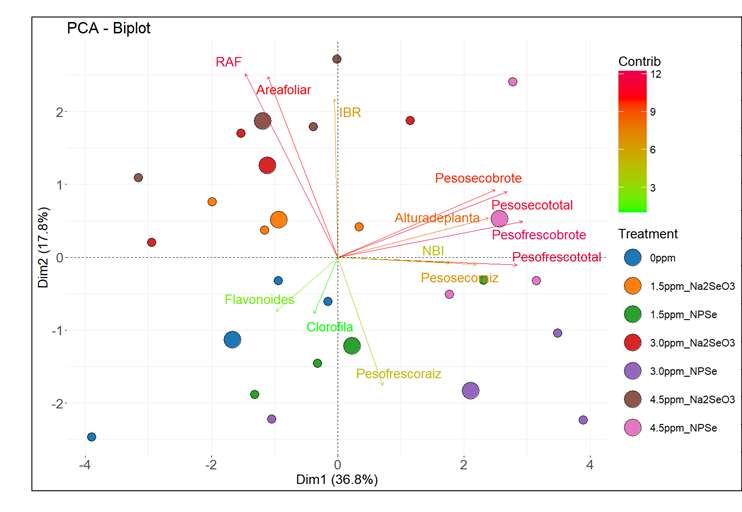
The production of quality seedlings in horticultural crops is a fundamental step for their success; to this end, fertilization plays a crucial role. Selenium (Se) has been evaluated for its beneficial effects on plant physiology. Nevertheless, studies at the seedling stage are scarce. Therefore, the present study was conducted at the Autonomous University of San Luis Potosí, Mexico, in 2025 with the aim of evaluating the foliar application of two selenium sources: sodium selenite (Na2SeO3) and Se nanoparticles (SeNPs), for the production of lettuce (Lactuca sativa L.) seedlings. The treatments were: 1) absolute control, 0 ppm Se (water spraying); 2) 1.5 ppm SeNPs; 3) 3 ppm SeNPs; 4) 4.5 ppm SeNPs; 5) 1.5 ppm Na2SeO3; 6) 3 ppm Na2SeO3; and 7) 4.5 ppm Na2SeO3. After 30 days of germination, dry weight, fresh weight, height, leaf area, shoot/root index, leaf area ratio, chlorophyll index, nitrogen balance index and flavonoid index were determined. The results indicated that foliar application of 3 and 4.5 ppm SeNPs improved the quality of lettuce seedlings, as they generated a better shoot/root balance, higher root dry weight, and a good nitrogen balance. These indicators suggest that seedlings may have more prolonged post-transplant survival and continuous growth, as they can have a greater capacity to absorb water and nutrients. No phytotoxic effects were found on seedling growth.
Downloads
References
Bano, I.; Skalickova, S.; Sajjad, H.; Skladanka, J. and Horky, P. 2021. Uses of selenium nanoparticles in the plant production. Agronomy. 11(11):1-12. https://doi.org/10.3390/agronomy11112229.
Campos-García, T.; Hernández-Soltero, M. F.; Hernández-Fernández, O. B.; Vázquez-Martínez, J. and García-Morales, S. 2025. Selenium nanoparticles induce differential shoot/root response of Capsicum annuum seedlings revealed by non-targeted metabolomic analysis. Plant Nano Biology. 11:100139. https://doi.org/10.1016/j.plana.2025.100139.
El-Ramady, H. R.; Domokos-Szabolcsy, E.; Abdalla, N. A.; Alshaal, T. A.; Shalaby, T. A.; Sztrik, A.; Prokisch, J. and Fari, M. G. 2014. Selenium and nano-selenium in agroecosystems. Environmental Chemistry Letters. 12(4):495-510. 10.1007/s10311-014-0476-0.
Garza-García, J. J. O.; Hernández-Díaz, J. A.; Zamudio-Ojeda, A.; León-Morales, J. M.; Guerrero-Guzmán, A.; Sánchez-Chiprés, D. R.; López-Velázquez, J. C. and García-Morales, S. 2022. The role of selenium nanoparticles in agriculture and food technology. Biological Trace Element Research. 200(5):2528-2548. https://doi.org/10.1007/s12011-021-02847-3.
Gaucin-Delgado, J. M.; Hernández-Montiel, L. G.; Ramírez-Rodríguez, S. C.; López-Salazar, R.; Ramirez-Aragón, M. G.; Hermosillo-Alba, M. C. and Preciado-Rangel, P. 2024. Foliar fertilization of nano-selenium and its effects on bioactive compounds and enzymatic activity in lettuce. Revista Terra Latinoamericana. 42:1-12. https://doi.org/10.28940/terra.v42i0.1939.
Golubkina, N.; Kharchenko, V.; Moldovan, A.; Antoshkina, M.; Ushakova, O. V Sękara, A.; Stoleru, V.; Murariu, O. C.; Vincenzo-Tallarita, A.; Sannino, M. and Caruso, G. 2024. Effect of selenium and garlic extract treatments of seed-addressed lettuce plants on biofortification level, seed productivity and mature plant yield and quality. Plants. 13(9):1-15. https://doi.org/10.3390/ plants13091190.
Hernández-Díaz, J. A.; Garza-García, J. J.; León-Morales, J. M.; Zamudio-Ojeda, A.; Arratia-Quijada, J.; Velázquez-Juárez, G.; Zamudio-Ojeda, A.; López-Velázquez, J. C. and García-Morales, S. 2021. Antibacterial activity of biosynthesized selenium nanoparticles using extracts of Calendula officinalis against potentially clinical bacterial strains. Molecules. 26(19):5929. https://doi.org/10.3390/molecules26195929.
Huang, S.; Ying, Z.; Chen, J.; Yang, Y.; Zhang, J.; Yang, L. and Liu, M. 2023. Effect of selenium application on growth, antioxidative capacity and nutritional quality in purple lettuce seedlings. Agronomy. 13(7):1664. https://doi.org/10.3390/agronomy13071664.
Khai, H. D.; Hiep, P. P. M.; Tung, H. T.; Phong, T. H.; Mai, N. T. N.; Luan, V. Q.; Cuong, D. M.; Vinh, B. V. T. and Nhut, D. T. 2024. Selenium nanoparticles promote adventitious rooting without callus formation at the base of passion fruit cuttings via hormonal homeostasis changes. Scientia Horticulturae. 323:112485. https://doi.org/10.1016/j.scienta.2023.112485.
Malagoli, M.; Schiavon, M.; Dall’Acqua, S. and Pilon-Smits, E. A. 2015. Effects of selenium biofortification on crop nutritional quality. Frontiers in Plant Science. 6:280. http://dx.doi.org/10.3389/fpls.2015.00280.
Mozafariyan, M.; Shekari, L.; Hawrylak-Nowak, B. and Kamelmanesh, M. M. 2014. Protective role of selenium on pepper exposed to cadmium stress during reproductive stage. Biological Trace Element Research. 160(1):97-107. DOI 10.1007/s12011-014-0028-2.
Tarrahi, R.; Mahjouri, S. and Khataee, A. 2021. A review on in vivo and in vitro nanotoxicological studies in plants: a headlight for future targets. Ecotoxicology and Environmental Safety. 208:111697. https://doi.org/10.1016/j.ecoenv.2020.111697.
Downloads
Published
Issue
Section
License
Copyright (c) 2026 Revista Mexicana de Ciencias Agrícolas

This work is licensed under a Creative Commons Attribution-NonCommercial 4.0 International License.
The authors who publish in Revista Mexicana de Ciencias Agrícolas accept the following conditions:
In accordance with copyright laws, Revista Mexicana de Ciencias Agrícolas recognizes and respects the authors’ moral right and ownership of property rights which will be transferred to the journal for dissemination in open access. Invariably, all the authors have to sign a letter of transfer of property rights and of originality of the article to Instituto Nacional de Investigaciones Forestales, Agrícolas y Pecuarias (INIFAP) [National Institute of Forestry, Agricultural and Livestock Research]. The author(s) must pay a fee for the reception of articles before proceeding to editorial review.
All the texts published by Revista Mexicana de Ciencias Agrícolas —with no exception— are distributed under a Creative Commons License Attribution-NonCommercial 4.0 International (CC BY-NC 4.0), which allows third parties to use the publication as long as the work’s authorship and its first publication in this journal are mentioned.
The author(s) can enter into independent and additional contractual agreements for the nonexclusive distribution of the version of the article published in Revista Mexicana de Ciencias Agrícolas (for example include it into an institutional repository or publish it in a book) as long as it is clearly and explicitly indicated that the work was published for the first time in Revista Mexicana de Ciencias Agrícolas.
For all the above, the authors shall send the Letter-transfer of Property Rights for the first publication duly filled in and signed by the author(s). This form must be sent as a PDF file to: revista_atm@yahoo.com.mx; cienciasagricola@inifap.gob.mx; remexca2017@gmail.
This work is licensed under a Creative Commons Attribution-Noncommercial 4.0 International license.