Rootstock influence on the characteristics of Persian lime fruits
DOI:
https://doi.org/10.29312/remexca.v17i2.3959Keywords:
fresh weight, fruit color, total soluble solidsAbstract
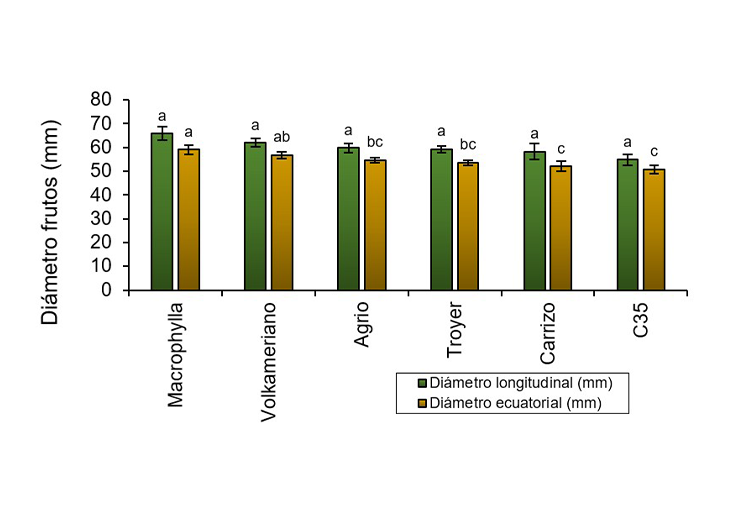
The use of rootstocks in citrus has been shown to improve agronomic and physicochemical characteristics of the fruit. In Mexico, the ‘Agrio’ orange tree (Citrus aurantium L.) remains the most widely used rootstock despite its phytosanitary limitations. In Quintana Roo, the production and the area planted with citrus increased by 6.3% and 12.1%, respectively, in the last decade. In contrast, the average annual yield decreased by 5%. This research was conducted in 2024 at the Chetumal Experimental Field of the National Institute of Forestry, Agricultural and Livestock Research, with the aim of evaluating the effect of six rootstocks on the physicochemical characteristics of the Persian lime (Citrus latifolia T.) fruit. The weight and equatorial and longitudinal diameters of the fruit, peel color, number of carpels, juice volume, total soluble solids and pH of the juice of Persian lime grafted onto six rootstocks were recorded. To determine the color and total soluble solids, the methodology proposed by the CIE and AOAC was used. The statistical analysis consisted of an analysis of variance (Anova) using a univariate general linear model, under a completely randomized experimental design and Tukey’s test for mean comparison (p≤ 0.05). The results indicate that the ‘Macrophylla’ and ‘Volkameriano’ rootstocks have a higher weight and equatorial diameter of the fruit; in contrast, the ‘Troyer’, ‘Carrizo’, and ‘C-35’ rootstocks are distinguished by inducing a higher content of total soluble solids and higher pH values in the juice.
Downloads
References
Aguilar-Hernández, M. G.; Núñez-Gómez, D.; Forner-Giner, M. Á.; Hernández, F.; Pastor-Pérez, J. J. and Legua, P. 2021. Quality parameters of Spanish lemons with commercial interest. Foods. 10(1):1-13. https://doi.org/10.3390/foods10010062.
AOAC. 2023. AOAC official method 983.17 solids (soluble) in citrus fruit juices: refractometer method, en official methods of analysis of aoac international. 22nd Ed. Oxford University Press. 37:7. https://doi.org/10.1093/9780197610145.003.3370.
Barry, G. H.; Castle, W. S. and Davies, F. S. 2004. Soluble solids accumulation in ‘Valencia’ sweet orange as related to rootstock selection and fruit size. Journal of the American Society for Horticultural Science. 129(4):594-598.
Berdeja-Arbeu, R.; Aguilar-Méndez, L.; Moreno-Velázquez, D.; Vázquez-Huerta, G.; Ontiveros-Capurata, R. and Ibáñez-Martínez, A. 2016. Calidad de fruta de lima ‘Persa’ en diferentes portainjertos en Veracruz, México. Acta Agrícola y Pecuaria. 2(1):17-22.
Cantuarias-Avilés, T.; Mourão-Filho, F. A. A.; Stuchi, E. S.; Silva, S. R. and Espinoza-Nuñez, E. 2011. Horticultural performance of ‘folha murcha’ sweet orange onto twelve rootstocks. Scientia Horticulturae. 129(2):259-265. https://doi.org/10.1016/j.scienta.2011.03.039.
FAOSTAT. 2025. Food and Agriculture Organization of the United Nations. https://www.fao.org/faostat/en/#data/QCL.
Hayat, F.; Li, J.; Iqbal, S.; Peng, Y.; Hong, L.; Balal, R. M.; Khan, M. N.; Nawaz, M. A.; Khan, U.; Farhan, M. A.; Li, C. ; Song, W.; Tu, P. and Chen, J. 2022. A mini review of citrus rootstocks and their role in high-density orchards. Plants. 11(21):1-14. https://doi.org/10.3390/plants11212876.
INIFAP. 2017. Instituto Nacional de Investigaciones Forestales, Agrícolas y Pecuarias. Agenda técnica agrícola de Veracruz. 52-56 pp. https://vun.inifap.gob.mx/vun-media/bibliotecaweb/-media/-agendas/4147-4844-agenda-técnica-veracruz-2017.pdf.
Lado, J.; Rodrigo, M. J. and Zacarías, L. 2014. Maturity indicators and citrus fruit quality. Stewart Postharvest, Review. 2(2):1-6.
Liu, X.; Gmitter, F. G.; Grosser, J. W. and Wang, Y. 2023. Effects of rootstocks on the flavor quality of huanglongbing-affected sweet orange juices using targeted flavoromics strategy. RSC Advances. 13(8):5590-5599. https://doi.org/10.1039/d2ra08182b.
Liu, X.; Li, J.; Huang, M. and Chen, J. 2015. Mechanisms for the Influence of citrus rootstocks on fruit size. Journal of Agricultural and Food Chemistry. 63(10):2618-2627. https://doi.org/10.1021/jf505843n.
López-Fortoso, F.; González-Arnao, M. T.; Bulbarela-Marini, J. E.; Pastelín-Solano, M. C.; Guevara-Valencia, M.; Rascón-Díaz, P.; Cruz-Cruz, C. A. and Castañeda-Castro, O. 2021. Characterization in clonal selections of Citrus x latifolia Tanaka ex Q. Jiménez. Agro Productividad. 14(3):11-16. https://doi.org/10.32854/agrop.v14i3.1798.
Martínez-Nicolas, J. J.; Núñez-Gómez, D.; Lidón, V.; Martínez-Font, R.; Melgarejo, P.; Hernández, F. and Legua, P. 2022. Physico chemical attributes of lemon fruits as affected by growing substrate and rootstock. Foods. 11(16):1-16. https://doi.org/10.3390/foods11162487.
Pauli, H. 1976. Proposed extension of the CIE recommendation on uniform color spaces, color difference equations, and metric color terms. Journal of the Optical Society of America. 66(8):866-867. https://doi.org/10.1364/josa.66.000866.
Raddatz-Mota, D.; Franco-Mora, O.; Mendoza-Espinoza, J. A.; Rodríguez-Verástegui, L. L.; León-Sánchez, F. and Rivera-Cabrera, F. 2019. Effect of different rootstocks on Persian lime (Citrus latifolia T.) postharvest quality. Scientia Horticulturae. 257:1-10. https://doi.org/10.1016/j.scienta.2019.108716.
Rivas-Valencia, P.; Loeza-Kuk, E.; Domínguez-Monge, S. and Lomas-Barrié, C. T. 2017. Chronic infection of the citrus tristeza virus in Citrus sinensis, C. aurantium trees in a restrictive thermal regime in Yucatán. Revista Chapingo Serie Horticultura. 23(3):187-202. https://doi.org/10.5154/r.rchsh.2016.11.028.
Robertson, A. R. 1977. The CIE 1976 color difference formulae. Color research and application. 2(1):7-11. https://doi.org/10.1002/j.1520-6378.1977.tb00104.x.
SEECO. 1996. NMX-FF-077-1996-SCFI Productos alimenticios no industrializados para consumo humano-fruta fresca-limón persa (Citrus Latifolia L.) especificaciones. Dirección General de Nomas.
SEMARNAT. 2002. Norma Oficial Mexicana NOM-021-SEMARNAT-2000 antes NOM-021-RECNAT-2000. Diario Oficial de la Federación. 73 p. http://www.ordenjuridico.gob.mx/Documentos/Federal/wo69255.pdf.
SIAP. 2025. Servicio de Información Agroalimentaria y Pesquera. https://www.gob.mx/siap/acciones-y-programas/produccion-agricola-33119.
Downloads
Published
Issue
Section
License
Copyright (c) 2026 Revista Mexicana de Ciencias Agrícolas

This work is licensed under a Creative Commons Attribution-NonCommercial 4.0 International License.
The authors who publish in Revista Mexicana de Ciencias Agrícolas accept the following conditions:
In accordance with copyright laws, Revista Mexicana de Ciencias Agrícolas recognizes and respects the authors’ moral right and ownership of property rights which will be transferred to the journal for dissemination in open access. Invariably, all the authors have to sign a letter of transfer of property rights and of originality of the article to Instituto Nacional de Investigaciones Forestales, Agrícolas y Pecuarias (INIFAP) [National Institute of Forestry, Agricultural and Livestock Research]. The author(s) must pay a fee for the reception of articles before proceeding to editorial review.
All the texts published by Revista Mexicana de Ciencias Agrícolas —with no exception— are distributed under a Creative Commons License Attribution-NonCommercial 4.0 International (CC BY-NC 4.0), which allows third parties to use the publication as long as the work’s authorship and its first publication in this journal are mentioned.
The author(s) can enter into independent and additional contractual agreements for the nonexclusive distribution of the version of the article published in Revista Mexicana de Ciencias Agrícolas (for example include it into an institutional repository or publish it in a book) as long as it is clearly and explicitly indicated that the work was published for the first time in Revista Mexicana de Ciencias Agrícolas.
For all the above, the authors shall send the Letter-transfer of Property Rights for the first publication duly filled in and signed by the author(s). This form must be sent as a PDF file to: revista_atm@yahoo.com.mx; cienciasagricola@inifap.gob.mx; remexca2017@gmail.
This work is licensed under a Creative Commons Attribution-Noncommercial 4.0 International license.