Evaluation of Passiflora alata as a potential rootstock tolerant to Fusarium in granadilla
DOI:
https://doi.org/10.29312/remexca.v17i2.3930Keywords:
disease tolerance, fusarium wilt, graft compatibility, passifloraceae, rootstockAbstract
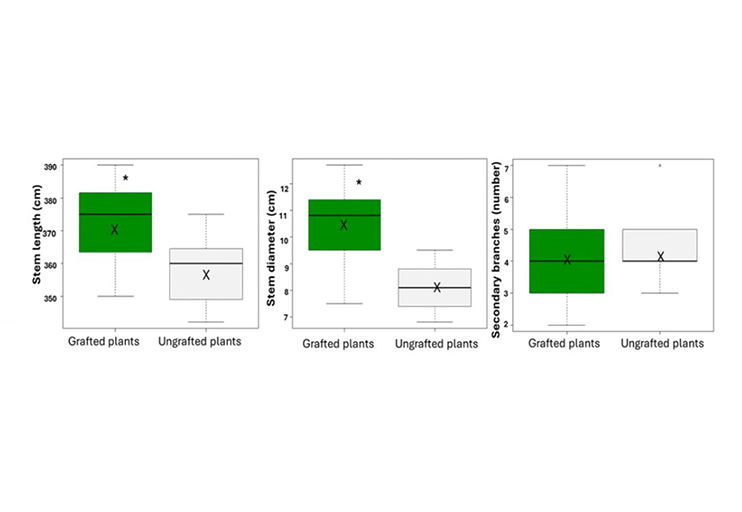
Granadilla (Passiflora ligularis Juss.) production in Colombia faces severe limitations due to “wilting disease” caused by Fusarium solani f. sp. passiflorae, leading to losses of over 90%. Given the limited genetic resistance of commercial cultivars, this study evaluated Passiflora alata Curtis as a tolerant rootstock through grafting. The objective was to determine the tolerance of P. alata to F. solani, its graft compatibility with P. ligularis, and agronomic performance under field conditions. The research was conducted between 2022 and 2024 in the municipalities of Rionegro and San Vicente Ferrer, Antioquia, Colombia. Seed-derived seedlings were used for inoculation trials in a greenhouse, compatibility testing with two grafting techniques (splice and cleft) and field evaluations of grafted and non-grafted plants over 15 months. Results showed P. alata exhibited high tolerance to F. solani infection with only 8% incidence, compared to 96% in P. ligularis. The cleft grafting technique had a higher success rate (92%) compared to splice (84%). In the field, grafted plants had higher survival (95% vs 78%), more vigorous vegetative growth, and earlier flowering (210 vs 375 days). These findings suggest that using P. alata as a rootstock is a potential strategy for managing F. solani and improving granadilla crop establishment and performance in affected areas.
Downloads
References
Adıgüzel, P.; Nyirahabimana, F. and Solmaz, I. 2022. Recent developments of grafting in Cucurbitaceae. Agricultural practices and sustainable management in Türkiye. In agricultural practices and sustainable management in Türkiye; Iksad Publishing House. Ankara, Türkiye. 207 p.
Adıgüzel, P.; Namlı, M.; Nyirahabimana, F.; Solmaz, I. and Sarı, N. 2023. The effects of grafting on plant, fruit and seed quality in cantaloupe (Cucumis melo L. var. Cantalupensis) Melons. Seeds. 2(1):1-14. https://doi.org/10.3390/seeds2010001.
Barbosa Santos, T.; Araujo, F. P.; Neto, A. F.; Freitas, S. T.; Souza- Araújo, J.; Oliveira, V. and Lima, M. S. 2021. Phytochemical compounds and antioxidant activity of the pulp of two brazilian passion fruit species: Passiflora cincinnata Mast. and Passiflora edulis Sims. International Journal of Fruit Science. 21(1):255-269.
CABI. 2024. Passiflora ligularis (sweet granadilla) [Factsheet]. CABI Digital Library. https://www.cabidigitallibrary.org/doi/full/10.1079/cabicompendium.116173.
Castaño-Zapata, J. 2015. Principios básicos de hongos fitopatógenos. Centro Ed. Universidad de Caldas (Colombia). 362 p.
CORNARE. 2012. Corporación Autónoma Regional de las Cuencas de los ríos Negro- Nare. Gobernación de Antioquia-Ministerio de Ambiente y Desarrollo Sostenible. Evaluación y zonificación de riesgos por avenida torrencial, inundación y movimiento en masa y dimensionamiento de procesos erosivos en el municipio de San Vicente Ferrer. Videográficas LTDA, Colombia. http://www.cornare.gov.co/GestionRiesgo/SAN-VICENTE/Documento-San-Vicente.pdf.
Cuya, E. y Escobedo, J. 2018. Injerto de granadilla (Passiflora ligularis Juss.) sobre maracuyá (Passiflora edulis f. flavicarpa) utilizando dos secciones de brotes de plantas adultas, dos tipos de injerto y dos cámaras húmedas individuales. Anales Científicos. 79(2):431-435.
Data Bridge Market Research. 2024. Global passion fruit market size, share, and trends industry trends and forecast to 2032. https://www.databridgemarketresearch.com/reports/global-passion-fruit-marke.
Dhurve, L.; Mathew, D.; Kumar, A., Joseph, A. and Mehara, H. 2024. Rootstock system for fruit crop improvement. Ed. Mohamed Abdel-Raheem. In: Research Advances and Challenges in Agricultural Sciences. 7 p.
Espinal, F. A.; Ocampo, J. A.; Morillo, Y. C. and Hurtado, A. S. 2023. Development of yellow passion fruit seedlings grafted onto four rootstocks of Passiflora species. Acta Agronômica. 72(3):1-26. https://doi.org/10.15446/acag.v72n3.112525.
Faleiro, F. G.; Junqueira, N. T. y Braga, M. F. 2008. Caracterização de germoplasma e melhoramento genético do maracujazeiro assistidos por marcadores moleculares. Planaltina, DF. Embrapa Cerrados. Pesquisa e Desenvolvimento (BPD) núm. 207, 58 p.
Fischer, I. H.; Bueno, C. J.; Garcia, M. J. M. and Almeida, A. M. 2010. Reação de sweet passion fruit zeiro-amarelo ao complexo fusariose-nematoide de galha. Acta Scientiarum. 32(2):223- 227.
Fischer, G. and Miranda, D. 2021. Review on the ecophysiology of important Andean fruits: Passiflora L. Revista Facultad Nacional de Agronomía Medellín. 74(2):9471-9481. Doi: https://doi.org/10.15446/rfnam.v74n2.91828.
Forero, R.; Ortiz, E.; León, W.; Gómez, J. y Hoyos-Carvajal, L. 2015. Análisis de la resistencia a Fusarium oxysporum en plantas de Passiflora maliformis L. Revista Colombiana de Ciencias Hortícolas. 9(2):197-208.
Hayat, F.; Li, J.; Iqbal, S.; Khan, U.; Ali, N. A.; Peng, Y.; Hong, L.; Asghar, S.; Javed, H. U. and Li, C. 2023. Hormonal Interactions underlying rootstock-induced vigor control in horticultural crops. Appl. 13(3):1237. https://doi.org/10.3390/app13031237.
Hurtado, A.; Ceballos, N. and Ocampo, J. 2021. Chapter 3. Ecophysiology and grafted fruit quality in Passiflora species. In: Passiflora: genetic, grafting and biotechnology approaches. Ed. Nova Science Publisher. New York. 101-136 pp.
Lima, L. K. S.; Soares, T. L.; Souza, E. H.; Jesus, O. N. and Girardi, E. A. 2017. Initial vegetative growth and graft region anatomy of yellow passion fruit on Passiflora spp. rootstocks. Sci. Hortic. 215(2):134-141. https://doi.org/10.1016/j.scienta.2016.12.001.
Lima, L. K. S.; Jesus, O. N.; Teixeira, J. H. S.; Guimarães, M. A. S.; Cardoso, C. S.; Brito-Castro, R.; Rosa, C. C. and Girardi, E. A. 2021. Performance of graft combinations of Passiflora spp., under tropical semi-arid conditions in Brazil. Fruits. 76(2):80-92.
Lu, X.; Liu, W.; Wang, T.; Zhang, J.; Li, X. and Zhang, W. 2020. Systemic long-distance signaling and communication between rootstock and scion in grafted vegetables. Front. Plant Sci. 11:5-15.
Ocampo, J.; Hurtado, A. S. and López, W. 2021. Chapter 1. Genetic resources and breeding prospects in Passiflora species. In: Passiflora: genetic, grafting and biotechnology approaches. Ed. Nova Science Publisher. New York. 76 p.
Osorio, J. A. C.; Martínez, E. P. L.; Hio, J. C.; Aguirre, J. E. R.; Vergara, J. A. A.; Luque, N. Y. S.; Rojas, E. D. Z. y Cruz, G. N. 2020. Caracterización sanitaria de los cultivos de granadilla, gulupa y maracuyá en Colombia, con especial referencia a la secadera causada por Fusarium solani f. sp. Passiflorae. Primera Ed. Vol. 1. Mosquera, Colombia: Agrosavia. Hilos Tensados. 41-66 pp. Doi: https://doi.org/10.21930/agrosavia.investigation.7403381.
Pardo-Solórzano, M. V.; Costa, G. M. y Castellanos, L. 2024. Passiflora by-products: chemical profile and potential use as cosmetic ingredients. Sci. Pharm. 92-57 pp.
Patiño-Pacheco, M. J. y Pérez-Cardona, O. Y. 2021. Evaluación de la resistencia de genotipos de Passiflora a Fusarium solani f. sp. passiflorae en granadilla. Entramado. 17(2):256-267.
Salazar-González, C.; Yela-Caicedo, O. and Gómez-Espinoza, B. 2022. Molecular characterization of Fusarium spp. associated vascular wilt in passion fruit (Passiflora ligularis Juss). Revista de Ciencias Agrícolas. 39(2):33-46 Doi: https://doi.org/10.22267/rcia.223902.180.
Schmildt, E. R.; Oliari, L. S.; Alexandre, R. S.; Silva, F. O. and Schmildt, O. 2017. Histological aspects of mini-grafting of Passiflora edulis sims and Passiflora mucronata Lam. Rev. Bras. Frutic. Jaboticabal. 2(40):e174.
Tamayo, M. P.; Gıraldo, G. B. y Morales, O. J. 1999. Enfermedades en semilleros y almácigos de granadilla. Revista Facultad Nacional Agropecuaria Medellín. 52(2):773-779.
Torres, C. M.; Sánchez, M.; Bravo, N. O.; Marmolejo, F. T. and Gómez, E. D. L. 2000. Enfermedades fungosas y bacterianas en el cultivo de maracuyá Passflora edulis var. flavicarpa Degener en dos agroecosistemas. Fitopatología Colombiana. 26(2):47-54.
Downloads
Published
Issue
Section
License
Copyright (c) 2026 Revista Mexicana de Ciencias Agrícolas

This work is licensed under a Creative Commons Attribution-NonCommercial 4.0 International License.
The authors who publish in Revista Mexicana de Ciencias Agrícolas accept the following conditions:
In accordance with copyright laws, Revista Mexicana de Ciencias Agrícolas recognizes and respects the authors’ moral right and ownership of property rights which will be transferred to the journal for dissemination in open access. Invariably, all the authors have to sign a letter of transfer of property rights and of originality of the article to Instituto Nacional de Investigaciones Forestales, Agrícolas y Pecuarias (INIFAP) [National Institute of Forestry, Agricultural and Livestock Research]. The author(s) must pay a fee for the reception of articles before proceeding to editorial review.
All the texts published by Revista Mexicana de Ciencias Agrícolas —with no exception— are distributed under a Creative Commons License Attribution-NonCommercial 4.0 International (CC BY-NC 4.0), which allows third parties to use the publication as long as the work’s authorship and its first publication in this journal are mentioned.
The author(s) can enter into independent and additional contractual agreements for the nonexclusive distribution of the version of the article published in Revista Mexicana de Ciencias Agrícolas (for example include it into an institutional repository or publish it in a book) as long as it is clearly and explicitly indicated that the work was published for the first time in Revista Mexicana de Ciencias Agrícolas.
For all the above, the authors shall send the Letter-transfer of Property Rights for the first publication duly filled in and signed by the author(s). This form must be sent as a PDF file to: revista_atm@yahoo.com.mx; cienciasagricola@inifap.gob.mx; remexca2017@gmail.
This work is licensed under a Creative Commons Attribution-Noncommercial 4.0 International license.