Pollination of Apis mellifera L. on the quality and quantity of Mexican lime
DOI:
https://doi.org/10.29312/remexca.v17i2.3903Keywords:
Apis mellifera, Citrus aurantifolia, fruit setAbstract
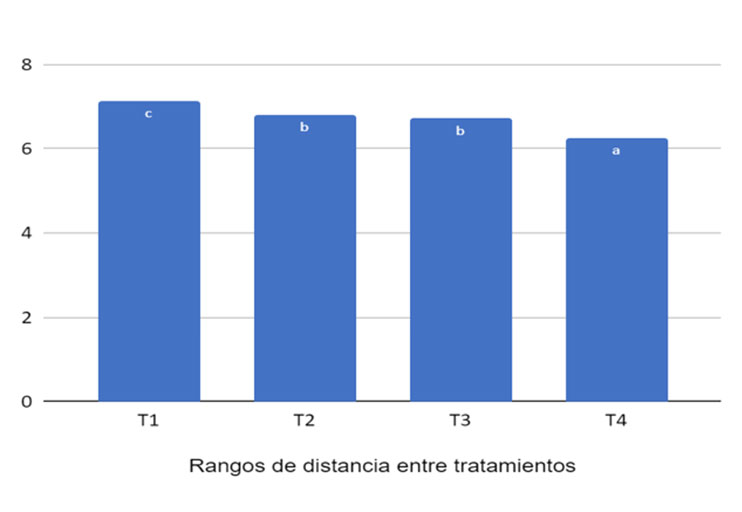
Honeybees (Apis mellifera L.) are the most efficient pollinators in cultivated and wild plants, playing an essential role in agricultural production and ecosystem conservation. This research aimed to evaluate the effect of the distance of Apis mellifera L. hives in pollination with honeybees on the quantity and quality of the fruits of the Mexican lime [Citrus aurantifolia (Christm.) Swingle] from March to July 2022, at the Villa Chica farm of the SiCar Farms company, located in the municipality of Tecomán, Colima, Mexico, with an area of 3.75 ha, where eight honeybee colonies were installed; 36 trees were selected and divided into four treatments that consisted of different ranges of distance from the location of the bee colonies and a control group that was isolated: T1 (0-100 m), T2 (101-200 m), T3 (201-300 m), T4 (randomly selected trees excluding pollinators). Treatments T1 and T2 presented a positive effect on the variables of fruit set percentage, fruit weight, polar diameter, juice weight, and number of seeds, compared to the other treatments, so it is recommended to place hives uniformly in the Mexican lime crops at distances not greater than 200 m between them in order to improve pollination activity and obtain fruits in greater quantity and better quality.
Downloads
References
Bibliografía
Baena-Diaz, F. Chévez, M. E.; Ruiz-Merced, F. y Porter-Bolland, L. 2022. Apis mellifera en México: producción de miel, floral melífera y aspectos de polinización. Revista Mexicana de Ciencias Pecuarias. 13(2):525-548.
Ballesteros, H. H.; Tello, J. E.; Castañeda, S. J.; Calvo, N. E.; Ortega, N. C.; Riveros, L. E. y Vásquez, R. E. 2011. Polinización dirigida con abejas Apis mellifera: tecnología para el mejoramiento de la producción de cultivos con potencial exportador. Agrosavia. Bogotá, Colombia. 88 p.
Carrera, A. A.; Mark, D. y Gil, R. 2008. Algunas características físicas y químicas de frutos de cinco variedades de mango en condiciones de sabana del estado Monagas. Agronomía Tropical. 58(1):27-30.
Castañeda, C. S.; Vásquez, R. R. y Ballesteros, CH. H. 2012. Efecto de la polinización dirigida con abejas Apis mellifera sobre la cantidad y calidad del fruto en cultivo de naranja Citrus sinensis. Vitae. 19(1):S66-S68.
Citrojugo. 2022. Ing. Miguel Ángel Alfaro. Sicar Farms. Com. Pers.
Dos-Santos, S. A.; Roselino, A. C.; Hrncir, M. and Bego, L. R. 2009. Pollination of tomatoes by the stingless bee Melipona quadrifasciata and the honeybee Apis mellifera (Hymenoptera, Apidae). Genética e Investigación Molecular. 8(2):751-757.
Fonseca, M. R.; Chiriví, J. S.; Guzmán, A. R.; Prada, Y. M.; Morales, J. B. y Barrera, S. E. 2019. Capítulo 10. Polinización. Libros Universidad Nacional Abierta y a Distancia. 188-200 pp.
Interiano, I. Z.; Bucio, C. M. Salas, M. D. Salazar, E. S.; Martínez, J. O. and Wallace, R. 2015. Effect of pollination of strawberries by Apis mellifera L. and Chrysoperla carnea S. on quality of the fruits. Nova Scientia. 7(13):85-100.
Khan, K. A.; Ahmad, K. J.; Razzaq, A.; Shafiqe, M.; Abbasi, K. H.; Saleem, M. and Arshad-Ullah, M. 2012. Pollination effect of honeybees, Apis mellifera L. (Hymenoptera: Apidae) on apple fruit development and its weight. Persian Gulf Crop Protection. 1(2):1-5.
Klein, A. M.; Vaissiere, B. E.; Cane, J. H.; Steffan-Dewenter, I.; Cunningham, S. A.; Kremen, C. and Tscharntke, T. 2007. Importance of pollinators in changing landscapes for world crops. Biological Sciences. 274(1608):303-313. https://doi.org/10.1098/rspb.2006.3721.
Malerbo-Souza, D. T.; Nogueira-Couto, R. H. and Couto, L. A. 2004. Honeybee attractants and pollination in sweet orange, Citrus sinensis (L.) Osbeck, var. Pera-Rio. Brasil. Journal of Venomous Animals and Toxins including Tropical Diseases. 10(2):144-153.
Narang, N. and Jiraungkoorskul, W. 2016. Anticancer activity of key lime, Citrus aurantifolia. Pharmacogn. 10(20):118-122. Doi: 10.4103/0973-7847.194043.
Pesante, G. D. 2010. Información sobre polinización de algunos arbustos y árboles de importancia agrícola y apícola. Universidad de Puerto Rico. San Juan, Puerto Rico. https://www.herbogeminis.com/revista/IMG/pdf/informacion-sobre-polinizacion.pdf.
Petersen, J. D.; Reiners, S. and Nault, B. A. 2013. Pollination services provided by bees in pumpkin fields supplemented with either Apis mellifera or Bombus impatiens or not supplemented. Reino Unido. PLoS On. 8(7):e69819. https://doi.org/10.1371/journal.pone.0069819.
Sagwe, R. N.; Peters, M. K.; Dubois, T.; Steffa-Dewenter, I. and Lattorf, M. G. 2023. Insect pollination and pollinator supplementation enhances fruit weight, quality, and marketability of avocado (Persea americana). USA. Arthropod-Plant Interactions. 17(1):1-11.
Sajjad, A.; Maqsood, S.; Abbasi, A.; Awais, M.; Rafiq, S.; Rafique, M. K.; Riaz, I. and Haq, I. U. 2023.Comparison of wild honeybees in the pollination of strawberries in Bahawalpur, Pakistan. Revista de la Sociedad Entomológica Argentina. 82(3):1-8.
Sanford, M. T. 1992. Pollination of citrus by honeybees. University of Florida Cooperative Extension Service. Institute of Food and Agriculture Sciences. USA. 6 p.
Santos, E.; Mendoza, Y.; Vera, M.; Carrasco-Letelier, L. Díaz, S. y Invernizzi, C. 2013. Aumento en la producción de semillas de soja (Glycine max) empleando abejas melíferas (Apis mellifera). Agrociencia. 17(1):81-90.
SAS. 2002. Statistical Analysis System. Software académico SAS.
SIAP. 2024. Servicio de Información Agroalimentaria y Pesquera. Panorama Agroalimentario 2024. http://www.siap.gob.mx.
Siopa, C.; Carvalheiro, L. G.; Castro, H.; Loureiro, J. y Castro, S. 2024. Animal-pollinated crops and cultivars a quantitative assessment of pollinator dependence values and evaluation of methodological approaches. Journal of Applied Ecology. 61(6):1279-1288. https://doi.org/10.1111/1365-2664.14634.
Vásquez, R. E.; Ballesteros, H. H.; Muñoz, C. A. y Cuellar, M. E. 2006. Utilización de la abeja Apis mellifera como agente polinizador en cultivos comerciales de fresa (Fragaria chiloensis) y mora (Rubus glaucus) y su efecto en la producción. Produmedios. Bogotá, Colombia. 78 p.
Vásquez, R. E.; Martínez, R. A.; Ortega, N. C. y Maldonado, W. D. 2021. Conceptos fundamentales de producción apícola. Corporación Colombiana de Investigación Agropecuaria (Agrosavia). Segunda edición. Mosquera, Colombia. 184 p.
Downloads
Published
Issue
Section
License
Copyright (c) 2026 Revista Mexicana de Ciencias Agrícolas

This work is licensed under a Creative Commons Attribution-NonCommercial 4.0 International License.
The authors who publish in Revista Mexicana de Ciencias Agrícolas accept the following conditions:
In accordance with copyright laws, Revista Mexicana de Ciencias Agrícolas recognizes and respects the authors’ moral right and ownership of property rights which will be transferred to the journal for dissemination in open access. Invariably, all the authors have to sign a letter of transfer of property rights and of originality of the article to Instituto Nacional de Investigaciones Forestales, Agrícolas y Pecuarias (INIFAP) [National Institute of Forestry, Agricultural and Livestock Research]. The author(s) must pay a fee for the reception of articles before proceeding to editorial review.
All the texts published by Revista Mexicana de Ciencias Agrícolas —with no exception— are distributed under a Creative Commons License Attribution-NonCommercial 4.0 International (CC BY-NC 4.0), which allows third parties to use the publication as long as the work’s authorship and its first publication in this journal are mentioned.
The author(s) can enter into independent and additional contractual agreements for the nonexclusive distribution of the version of the article published in Revista Mexicana de Ciencias Agrícolas (for example include it into an institutional repository or publish it in a book) as long as it is clearly and explicitly indicated that the work was published for the first time in Revista Mexicana de Ciencias Agrícolas.
For all the above, the authors shall send the Letter-transfer of Property Rights for the first publication duly filled in and signed by the author(s). This form must be sent as a PDF file to: revista_atm@yahoo.com.mx; cienciasagricola@inifap.gob.mx; remexca2017@gmail.
This work is licensed under a Creative Commons Attribution-Noncommercial 4.0 International license.