Crop alternaves for forage producon in southern Sonora
DOI:
https://doi.org/10.29312/remexca.v16i8.3886Keywords:
corn, oats, triticaleAbstract
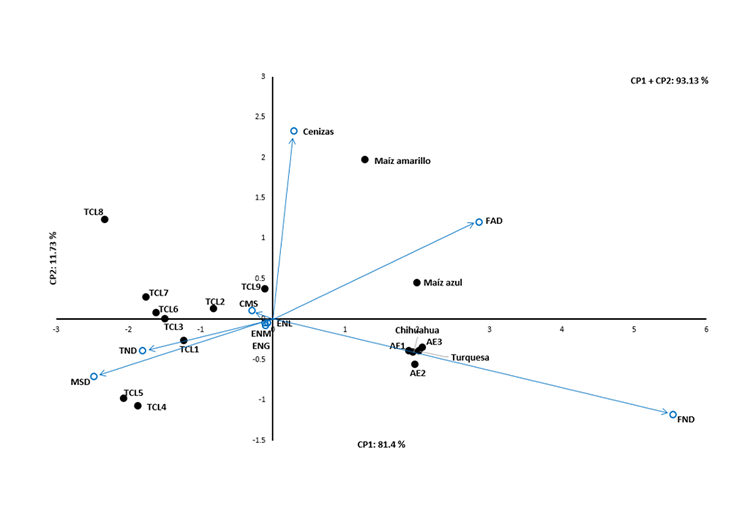
In southern Sonora, Mexico, the nutritional value of forage for herbivores has not been established for a long time, whereas technological options have diversified; therefore, there is a need to evaluate annual crops as an option for forage production in order to integrate them into the agrifood chain. This research aimed to evaluate the forage production and chemical properties of different annual species in the semiarid conditions of southern Sonora. Nine elite spring-habit triticale lines, five varieties of oats, and two varieties of colored corn -yellow and purple- were evaluated in the field and laboratory in the autumn-winter cycle of 2023-2024. The agronomic variables were green forage (GF), dry forage (DF), and plant height (PH), as well as their chemical properties. The results showed statistical differences between species for forage variables, where corn showed higher production of green (GF) and dry (DF) forage, whereas the triticale lines TCL3, TCL7, and TCL9 clustered as a second option in GF and DF production; for their part, the TCL5, TCL2 and TCL4 lines provided better chemical properties, followed by the corn varieties, experimental oats 3, and the Turquesa oat variety.
Downloads
References
Billman, E. D.; Souza, I. A.; Smith, R. G.; Soder, K. J.; Warren, N.; Teixeira F. A. and Brito A. F. 2021. Winter annual forage mass-nutritive value trade-offs are affected by harvest timing. Crop, Forage and Turfgrass Management. 7(e20113):1-9. https://doi.org/10.1002/cft2.20113.
Fraś, A.; Gołębiewska, K.; Gołębiewski, D.; Mańkowski, D. R.; Boros, D. and Szecówka, P. 2016. Variability in the chemical composition of triticale grain, flour and bread. Journal of Cereal Sience. 71:66-72.
French, K. E. 2017. Species composition determines forage quality and medicinal value of high diversity grasslands in lowland England. Agriculture Ecosystems and Environment. 241:193-204. https ://doi.org/10.1016/j.agee.2017.03.012.
García, E. 2004. Modificaciones al sistema de clasificación climática de Köppen. Universidad Nacional Autónoma de México (UNAM). 97 p.
Hanoglu, O. H. 2024. Forage yields and nutritive values of oat and triticale pastures for grazing sheep in early spring. Peer Journal. 12:e17840. https://doi.org/10.7717/peerj.17840.
Lauzon, J.; Tremblay, G. F.; Bélanger, G.; Seguin, P.; Lajeunesse, J. and Gervais, R. 2019. Alfalfa and timothy nutritive value in contrasting agroclimatic regions. Agronomy Journal. 111(3):1371-1380.
Lee, M. A.; Davis, A. P.; Chagunda, M. G. G. and Manning, P. 2017. Forage quality declines with rising temperatures, with implications for livestock production and methane emissions. Biogeosciences. 14:1403-1417. https://doi.org/10.5194/bg-14-1403-2017.
Lemaire, G.; Sinclair, T.; Sadras, V. and Bélanger, G. 2019. Allometric approach to crop nutrition and implications for crop diagnosis and phenotyping. A review. Agronomy for Sustainable Development. 39:27-43.
López-Jara, A. G.; Reta-Sánchez, D. G.; Santana, O. I.; Reyes-González, A.; Rodríguez-Hernández, K.; Granados-Niño, J. A.; López-Calderón, M. J. y Sánchez-Duarte, J. I. 2025. Rendimiento de forraje y valor nutritivo del ensilado de forrajes alternativos y tradicionales de otoño-invierno. Revista Mexicana de Ciencias Pecuarias. 16(1):208-223.
Mancipe, M. E. A.; Vásquez, V. J. E.; Castillo, S. J.; Ortiz, C. R. E.; Avellaneda, A. Y. y Vargas, M. J. D. J. 2021. Productividad y valor nutricional de forraje de cebada y trigo del trópico alto colombiano. Agronomía Mesoamericana. 32(1):271-292.
Reta, S. D. G.; Sánchez, D. J. I.; Ochoa, M. E.; González, C. A. I.; Reyes, A. G. y Rodríguez, H. K. 2023. Rendimiento y valor nutritivo de brásicas forrajeras en comparación con forrajes tradicionales. Revista Mexicana de Ciencias Pecuarias. 14(1):237-247.
Riasat, M.; Kiaani, S.; Saed-Mouchehsi, A. and Pessarakli, M. 2019. Oxidant related biochemical traits are significant indices in triticale grain yield under drought stress condition. Journal of Plant Nutrition. 42(2):111-126. https://doi.org/10.1080/01904167.2018.1549675.
SAS Institute. 2016. User’s Guide of SAS. SAS Institute Inc. Cary, North Carolina, USA. 550 p.
Shenk, J. S. and Westerhaus, M. O. 1995. The application of near Infrared reflectance spectroscopy (NIRS) to forage analysis. In: forage quality, evaluation, and utilization. Ed. Fahey, G. C. Madison, USA. 406-449 pp.
SIAP. 2023. Servicio de Información Agroalimentaria y Pesquera. Anuario estadístico de la producción agrícola. Secretaría de Agricultura y Desarrollo Rural. Ciudad de México. https://nube.siap.gob.mx/cierreagricola/.
Soest, V. P. J. 1970. The chemical basis for nutritive evaluation of forages. Proc. Nat. Conf. On forage quality evaluation and utilization. Lincoln, Nebraska, USA. 78 p.
Thapa, R.; Poffenbarger, H.; Tully, K. L.; Ackroyd, V. J.; Kramer, M. and Mirsky, S. B. 2018. Biomass production and nitrogen accumulation by hairy vetch cereal rye mixtures: a meta-analysis. Agronomy Journal. 110(4):1197-1208. https://doi.org/10.2134/agronj2017.09.0544.
Velasco, L. J. L.; Soto, O. R.; Ail, C. C. E.; Grimaldo, J. O.; Avilés, M. S. M. y Lozano-Río, A. J. 2020. Rendimiento de biomasa y grano en variedades de triticale en el Valle de Mexicali. Revista Mexicana de Ciencias Agrícolas. 11(5):1097-1109.
Wood, S.; Seguin, P.; Tremblay, G. F.; Bélanger, G.; Lajeunesse, J.; Martel, H.; Berthiaume, R. and Claessens, A. 2018. Validation of predictive equations of pre-harvest forage nutritive value for alfalfa grass mixtures. Agronomy Journal. 110(3):950-960.
Zhu, F. 2018. Triticale: nutritional composition and food uses. Food Chemistry. 241:468-479.
Published
How to Cite
Issue
Section
License
Copyright (c) 2025 Revista Mexicana de Ciencias Agrícolas

This work is licensed under a Creative Commons Attribution-NonCommercial 4.0 International License.
The authors who publish in Revista Mexicana de Ciencias Agrícolas accept the following conditions:
In accordance with copyright laws, Revista Mexicana de Ciencias Agrícolas recognizes and respects the authors’ moral right and ownership of property rights which will be transferred to the journal for dissemination in open access. Invariably, all the authors have to sign a letter of transfer of property rights and of originality of the article to Instituto Nacional de Investigaciones Forestales, Agrícolas y Pecuarias (INIFAP) [National Institute of Forestry, Agricultural and Livestock Research]. The author(s) must pay a fee for the reception of articles before proceeding to editorial review.
All the texts published by Revista Mexicana de Ciencias Agrícolas —with no exception— are distributed under a Creative Commons License Attribution-NonCommercial 4.0 International (CC BY-NC 4.0), which allows third parties to use the publication as long as the work’s authorship and its first publication in this journal are mentioned.
The author(s) can enter into independent and additional contractual agreements for the nonexclusive distribution of the version of the article published in Revista Mexicana de Ciencias Agrícolas (for example include it into an institutional repository or publish it in a book) as long as it is clearly and explicitly indicated that the work was published for the first time in Revista Mexicana de Ciencias Agrícolas.
For all the above, the authors shall send the Letter-transfer of Property Rights for the first publication duly filled in and signed by the author(s). This form must be sent as a PDF file to: revista_atm@yahoo.com.mx; cienciasagricola@inifap.gob.mx; remexca2017@gmail.
This work is licensed under a Creative Commons Attribution-Noncommercial 4.0 International license.