A protocol for the in vitro establishment of Psidium guajava L. using seeds, for the conservation of native germplasm
DOI:
https://doi.org/10.29312/remexca.v16i6.3819Keywords:
Asepsis, guava, in vitro culture, conservationAbstract
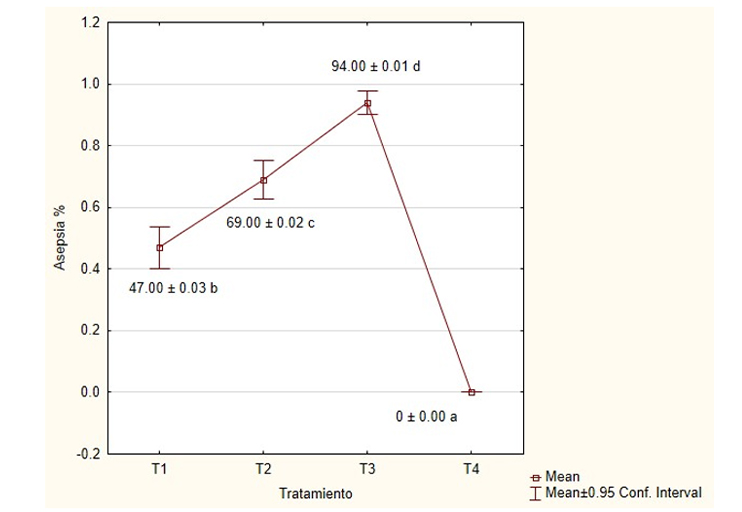
The guava Psidium guajava L. is a very important fruit tree for Aguascalientes. In the municipality of Calvillo, guava orchards were established with an area of more than 6 000 ha. The current problem is that it is being replaced with other crops, such as avocados, lemons, and vegetables. One solution for the conservation of these important genetic resources is germplasm banks, linked to in vitro propagation, which is a biotechnological tool that allows healthy guava plants to be reproduced in small spaces and controlled conditions. In view of this, a methodology for the in vitro establishment of guava seeds was standardized. Four treatments were evaluated in a first experiment to improve aseptic conditions, then a second experiment was conducted to determine the best in vitro culture proposal, including scarified and non-scarified seeds to define the complete protocol. In the first experiment, T3 with 0.1% Tween® 20 (polysorbate), 6 ml L-1 Fractal® (citrus seed extract), 5% chlorine, and 70% ethanol showed 95% asepsis. In the second experiment, from the in vitro establishment stage, T4, with seed scarified with activated charcoal, obtained 90% germination with a length of 4.05 cm. Finally, it was found that, using scarified seed, the MS culture medium supplemented with 2 g L-1 of activated charcoal, 0.5 mg L-1 of BAP and 7.5 g L-1 of agar-agar was the best to establish the in vitro reproduction protocol.
Downloads
References
Berni, L. S. R. L. 2025. Fractal®. Poder orgánico 100% natural. https://www.bernilabs.com/fichas/ficha-fractal.pdf. 1-2 pp.
Cabral-Miramontes, J. P.; Chávez-Simental, J. A.; Pulido-Díaz, C.; González-Portillo, M.; Goche-Télles, J. R. y Barragán-Hernández, V. M. 2022. In vitro propagation of apple trees from mature zygotic embryos. Revista Mexicana Ciencias Agrícolas. 13(4):603-616. https://doi.org/10.29312/remexca.v13i4.2164.
Casanova, P. N. M.; Bertolini, V. e Iracheta, D. L. 2019. Conservación in vitro de Monstera acuminata Koch. y Monstera deliciosa Liebm. Acta Agronómica. 68(3):196-204. https://doi.org/10.15446/acag.v68n3.75891.
Concepción, L. O.; Nápoles, B. L.; Pérez, M. A.; Peralta, B. N. y Trujillo S. R. 2004. Regeneración de brotes adventicios en hojas de guayaba (Psidium guajava L.) cultivadas in vitro. Revista Colombiana de Biotecnología. 6(2):56-61. https://www.redalyc.org/pdf/776/77660208.pdf.
Domínguez-Perales, L. A.; Domínguez-Álvarez, J. L.; Cruz-Izquierdo, S. C.; Santacruz-Valera, A.; Barrientos-Priego, A.; Padilla-Ramírez, J. S. y Gutiérrez-Espinosa, M. A. 2016. Propagación in vitro de selecciones de guayaba (Psidium guajava L.). Revista Fitotecnia Mexicana. 39(3):285-295. https://www.scielo.org.mx/pdf/rfm/v39n3/0187-7380-rfm-39-03-00285.pdf.
Flores, C. O.; Cuéllar, J. F.; Montes, M. E.; Gámez, P. M. R.; González, M. T.; Guevara, V. M. y Aguilar, R. N. 2017. Germinación in vitro de semillas de Vanilla planifolia Jacks y comparación de métodos de micropropagación. 21(2):69-83. http://ww.ucol.mx/revaia/portal/pdf/2017/mayo/5.pd.
Google Earth. 2025. Mapa de el llano Aguascalientes, México. Google Maps https://earth.google.com/web/@21.8189517,102.10082039,48322.93570666a,51353.28893043d,35y,-0h,0t,0r/data=cgrcaggbogmkata.
Martín, D. 2017. Embriogénesis somática: una herramienta biotecnológica para la propagación in vitro de guayaba. Biotecnología Vegetal. 17(4):209-220. https://revista.ibp.co.cu/index.php/BV/article/view/563/pdf.
Martínez, E. M. 2021. Conservación in vitro de germoplasma, un método para salvar el acervo genético en plantas. Centro de Investigación Científica de Yucatán, AC. 13:83-86. https://www.cicy.mx/documentos/cicy/desde-herbario/2021/2021-04-29-mmartinez-esteves-conservacion-in-vitro-de-germoplasma.pdf.
Murashige, T. and Skoog, F. 1962. A revised medium for growth and bioassays with tobacco tissue cultures. Physiol. Plant. 15(3):473-497.
Ocampo, F. y Núñez, V. M. 2007. Propagación in vitro de Psidium guajava mediante organogénesis directa a partir de segmentos nodales. Revista Corpoica-Ciencia y Tecnología Agropecuaria. 8(1):22-27. https://www.redalyc.org/pdf/4499/449945022003.pdf.
Pérez, M. B. E.; Esparza, A. M. J. y Pérez, R. M. E. 2012. Conservación in vitro de germoplasma de Agave spp. bajo condiciones de crecimiento retardado. Revista Fitotecnia Mexicana. 35(4):279-287. https://www.scielo.org.mx/pdf/rfm/v35n4/v35n4a4.pdf.
Pérez, A. T.; Nápoles, L.; Concepción, O. y Trujillo, R. 2002. Multiplicación in vitro de brotes de guayaba (Psidium guajava L.) var. Enana roja cubana EEA 18-40 obtenidos a partir de semillas. Cultivos Tropicales. 23(3):57-61. https://www.redalyc.org/pdf/1932/193218120008.pdf.
Ramírez, M. y Salazar, E. 1997. Establecimiento in vitro de segmentos nodales de guayabo (Psidium guajava L.). Revista Facultad de Agronomía. 14:497-506. https://produccioncientificaluz.org/index.php/agronomia/article/view/26150/26776.
Ramírez, A. O.; Hernández, M. J. y González, E. J. M. 2022. Análisis económico de la guayaba en Calvillo, Aguascalientes, México. Revista Mexicana de Agronegocios. 51:267-276. http://ri.uaemex.mx/handle/20.500.11799/137784.
Ramos-Sandoval, I. N.; García-Salazar, J. A.; Borja-Bravo, M.; Guajardo-Hernández, L. G.; Almeraya-Quintero, S. X. y Arana-Coronado, Óscar. A. 2017. El mercado de la guayaba en Aguascalientes: un análisis para reducir la volatilidad de los precios. Revista Mexicana de Ciencias Agrícolas. 8(18):3755-3767.https://www.redalyc.org/journal/2631/263152571008/html/.
Ruíz-Rivas, M.; Téllez-Valerio, C. E.; Martínez-Núñez, M.; Vera-Hernández, P.; Martínez-Romero, E. y Rosas-Cárdenas, F. de F. 2022. Influencia de la luz en la generación de callos y el cultivo in vitro de plantas. Revista Mexicana de Ciencias Agrícolas. 27(esp):11-21. https://doi.org/10.29312/remexca.v13i27.3156.
Sánchez-Chiang, N. y Jiménez, V. M. 2010. Técnicas de conservación in vitro para el establecimiento de bancos de germoplasma en cultivos tropicales. Agronomía Mesoamericana. 21(1):193-205. https://www.scielo.sa.cr/pdf/am/v21n1/a20v21n1.pdf.
Sánchez-Soto, B. H.; Pacheco-Aispuro, E.; Lugo-García, G. A.; Reyes-Olivas, A. y García-Moya, E. 2017. Métodos de escarificación en semillas de Guaiacum coulteri, especie amenazada de bosque tropical caducifolio del norte de Sinaloa, México. Gayana Botánica. 74(2):262-268. http://dx.doi.org/10.4067/S0717-66432017000200262.
SIAP. 2025. Sistema de Información Agroalimentaria y Pesquera. Anuario estadístico de la producción agrícola. https://nube.siap.gob.mx/cierreagricola/.
TIBCO Inc. 2017. Statistica data analysis software system. Version 13.3 for Windows, TIBCO Inc, Tulsa, OK, USA. https://www.tibco.com/products/data-science.
Torres, J. R.; Lecona, C. A.; Silverio, M. C.; Gutiérrez, F. A.; Ruiz, N. y Santana, N. 2023. Organogénesis directa en piña criolla inducida por 6-bencilaminopurina. Revista Mexicana de Ciencias Agrícolas. 14(6):1-12. https://doi.org/10.29312/remexca.v14i6.3159.
Valdés-Infante, J.; Rodríguez-Medina, N. N.; González, L.; Velázquez, J. B.; Rivero- Rodríguez, D.; Sourd-Martínez, D. G., Martínez-González, F. y Rodríguez, J. A. 2012. La biotecnología como herramienta para la propagación, conservación y el mejoramiento genético del guayabo. Revista Colombiana de Biotecnología. 14(2):7-19. http://www.scielo.org.co/pdf/biote/v14n2/v14n2a02.pd.
Zurita-Valencia, W.; Gómez-Cruz, E.; Atrián-Mendoza, E.; Hernández, A.; Granado-García, M. E.; García-Magaña, J.; Salgado-Garciglia, R. y Sánchez-Vargas, N. M. 2014. Establecimiento de un método eficiente de germinación in vitro y micropropagación del cirimo (Tilia Mexicana Schlecht.) (Tiliaceae). 38(19):129-144. https://www.scielo.org.mx/scielo.php?script=sci-arttext&pid=S140527682014000200007.
Published
How to Cite
Issue
Section
License
Copyright (c) 2025 Revista Mexicana de Ciencias Agrícolas

This work is licensed under a Creative Commons Attribution-NonCommercial 4.0 International License.
The authors who publish in Revista Mexicana de Ciencias Agrícolas accept the following conditions:
In accordance with copyright laws, Revista Mexicana de Ciencias Agrícolas recognizes and respects the authors’ moral right and ownership of property rights which will be transferred to the journal for dissemination in open access. Invariably, all the authors have to sign a letter of transfer of property rights and of originality of the article to Instituto Nacional de Investigaciones Forestales, Agrícolas y Pecuarias (INIFAP) [National Institute of Forestry, Agricultural and Livestock Research]. The author(s) must pay a fee for the reception of articles before proceeding to editorial review.
All the texts published by Revista Mexicana de Ciencias Agrícolas —with no exception— are distributed under a Creative Commons License Attribution-NonCommercial 4.0 International (CC BY-NC 4.0), which allows third parties to use the publication as long as the work’s authorship and its first publication in this journal are mentioned.
The author(s) can enter into independent and additional contractual agreements for the nonexclusive distribution of the version of the article published in Revista Mexicana de Ciencias Agrícolas (for example include it into an institutional repository or publish it in a book) as long as it is clearly and explicitly indicated that the work was published for the first time in Revista Mexicana de Ciencias Agrícolas.
For all the above, the authors shall send the Letter-transfer of Property Rights for the first publication duly filled in and signed by the author(s). This form must be sent as a PDF file to: revista_atm@yahoo.com.mx; cienciasagricola@inifap.gob.mx; remexca2017@gmail.
This work is licensed under a Creative Commons Attribution-Noncommercial 4.0 International license.