Monserrat (D): an irrigated barley variety for El Bajío
DOI:
https://doi.org/10.29312/remexca.v16i8.3777Keywords:
barley, feed, genotypeAbstract
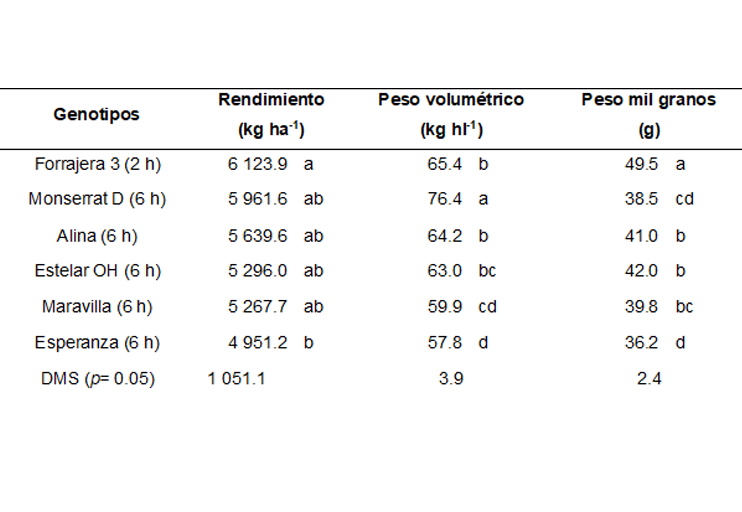
The Montserrat (D) variety has a high nutritional value due to its content of β-glucans (5.5%), protein (12.2%), and starch (67.2%) in grains, presents a potential yield of up to 7.5 t ha-1 for sowing dates from November 15 to December 15, reaches the heading stage between days 65 and 72 and grain physiological maturity between days 110 to 120, has a plant height of 0.8 to 0.95 m, is tolerant of stripe yellow rust (Puccinia striiformis f. sp. Hordei West) and leaf rust (Puccinia hordei Otth), and has a grain filling index of 581, a thousand grain weight of 40.38 g, and a hectoliter weight of 80 kg hl-1, which decreases for planting dates on January 15 (77.6 kg hl-1); in addition, it presents a high percentage of naked grain (85 to 95%), so it is suitable for consumption as food and fodder. It is recommended to use 100 kg ha-1 of seed for double-row sowing and apply the 180-60-00 fertilizer formula of nitrogen, phosphorus, and potassium, respectively. These characteristics make Monserrat (D) a good alternative for the production of barley grain in the region known as El Bajío in Mexico, at altitudes between 1 500 and 1 800 m, on Vertisol and Phaeozem soils.
Downloads
References
Avila, P. M. A.; Gámez, F. P. V.; Gámez, A. J. V.; García, J. J. R.; Zamora, M. R. D. y Dorantes, J. R. A. G. 2023. Diversificación de usos de la cebada en México. In: memorias VI Congreso Nacional y IV Internacional de Ciencias Agropecuarias del TECNM. Revista Tecnológica CEA. 3(23):500-508.
Behall, K. M.; Scholfield, D. J. and Hallfrisch, J. G. 2006. Barley β-glucan reduces plasma glucose and insulin responses compared with resistant starch in men. Nutrition Research. 26:644-650. https://doi.org/10.1016/j.nutres.2006.10.001.
Crisan, I.; Valean, A. M.; Chetan, F.; Tarau, A. D.; Calugar, R.; Boanta, E. A. and Muntean L. 2023. Reconsideration of barley in human food from the aspect of digestive fiber content. Hop and Medicinal Plants. 1-2:110-119.
Esparza, M. J. H. y Castilla, F. C. 1977. América, primera variedad de cebada de grano desnudo en México. Secretaría de Agricultura y Recursos Hidráulicos (SARH). Instituto Nacional de Investigaciones Agrícolas (INIA). Folleto de divulgación núm. 71. México.12 p.
Felizardo, M. P. and Freire, J. T. 2018. Characterization of barley grains in different levels of pearling process. Journal of Food Engineering. 232:29-35. https://doi.org/10.1016/j.jfoodeng.2018.03.017.
Geng, L.; Li, M.; Zhang, G. and Ye, L. 2022. Barley: a potential cereal for producing healthy and functional foods. Food Quality and Safety. 6:1-13. https://doi.org/10.1093/fqsafe/fyac012.
Keenan, J. M.; Pins, J. J.; Frazel, C.; Moran, A. and Turnquist, L. 2002. Oat ingestion reduces systolic and diastolic blood pressure in patients with mild or borderline hypertension: a pilot trial. Journal of Family Practice. 51(4):369-374.
Murphy, E. A.; Davis, J. M.; Brown, A. S.; Carmichael, M. D.; Mayer, E. P. and Ghaffar, A. 2004. Effects of moderate exercise and oat β-glucan on lung tumor metastases and macrophage antitumor cytotoxicity. Journal of Applied Physiology. 97:955-959.
Narwall, S.; Kumar, D.; Sheoran, S.; Verma, R. P. S. and Gupta, R. K. 2017. Hulless barley as a promising source to improve the nutritional quality of wheat products. Journal of Food Science and Technology. 54(9):2638-2644. https//doi.org/10.1007/s13197-017-2669-6.
Newman, C. W. and Newman, R. K. 2006. A brief history of barley foods. Cereal Foods World. 51(1):4-7.
Pérez-Ruiz, J. A.; Zamora-Díaz, M.; Mejía-Contreras, J. A.; Hernández-Livera, A. y Solano-Hernández, S. 2016. Evaluación de 10 genotipos de cebada (Hordeum vulgare L.) en cinco fechas de siembra y dos ciclos agrícolas. Agrociencia. 50:201-213.
Rodríguez-García, M. F.; González-González, M. y Mandujano-Bueno, A. 2023. Variability of Puccinia striiformis f. sp. hordei, resistance and agronomic behavior of two-row barley germplasm. Mexican Journal of Phytopathology. 41(1):5-25.
SE. 2003. Secretaría de Economía (SE). NMX-FF-043-SCFI-2003 Productos alimenticios no industrializados para consumo humano cereal cebada maltera (Hordeum vulgare L. y Hordeum distichum L.) especificaciones y métodos de prueba. Secretaría de Economía. México. http://sitios.dif.gob.mx/alimentacion/docs/normas/origen-vegetal/NMX-FF-043-SCFI 2003-cebada. pdf. 36 p.
SIAP. 2011. Servicio de información agroalimentaria y pesquera. http://www.siap.gob.mx/.
Solano, H. S.; Zamora, D. M.; Gámez, V. F. P.; García, R. J. J.; Sánchez, C. R.; Ireta, M. J.; Díaz, E. F. y Garza, G. R. 2009. Alina: nueva variedad de cebada maltera para riego en El Bajío. Agricultura Técnica en México. 35(4):467-469.
Published
How to Cite
Issue
Section
License
Copyright (c) 2025 Revista Mexicana de Ciencias Agrícolas

This work is licensed under a Creative Commons Attribution-NonCommercial 4.0 International License.
The authors who publish in Revista Mexicana de Ciencias Agrícolas accept the following conditions:
In accordance with copyright laws, Revista Mexicana de Ciencias Agrícolas recognizes and respects the authors’ moral right and ownership of property rights which will be transferred to the journal for dissemination in open access. Invariably, all the authors have to sign a letter of transfer of property rights and of originality of the article to Instituto Nacional de Investigaciones Forestales, Agrícolas y Pecuarias (INIFAP) [National Institute of Forestry, Agricultural and Livestock Research]. The author(s) must pay a fee for the reception of articles before proceeding to editorial review.
All the texts published by Revista Mexicana de Ciencias Agrícolas —with no exception— are distributed under a Creative Commons License Attribution-NonCommercial 4.0 International (CC BY-NC 4.0), which allows third parties to use the publication as long as the work’s authorship and its first publication in this journal are mentioned.
The author(s) can enter into independent and additional contractual agreements for the nonexclusive distribution of the version of the article published in Revista Mexicana de Ciencias Agrícolas (for example include it into an institutional repository or publish it in a book) as long as it is clearly and explicitly indicated that the work was published for the first time in Revista Mexicana de Ciencias Agrícolas.
For all the above, the authors shall send the Letter-transfer of Property Rights for the first publication duly filled in and signed by the author(s). This form must be sent as a PDF file to: revista_atm@yahoo.com.mx; cienciasagricola@inifap.gob.mx; remexca2017@gmail.
This work is licensed under a Creative Commons Attribution-Noncommercial 4.0 International license.