Emergence stimulation and initial growth of Agave salmiana using metal nanoparticles
DOI:
https://doi.org/10.29312/remexca.v17i7.4213Keywords:
establecimiento inicial, maguey pulquero, nanotecnologíaAbstract
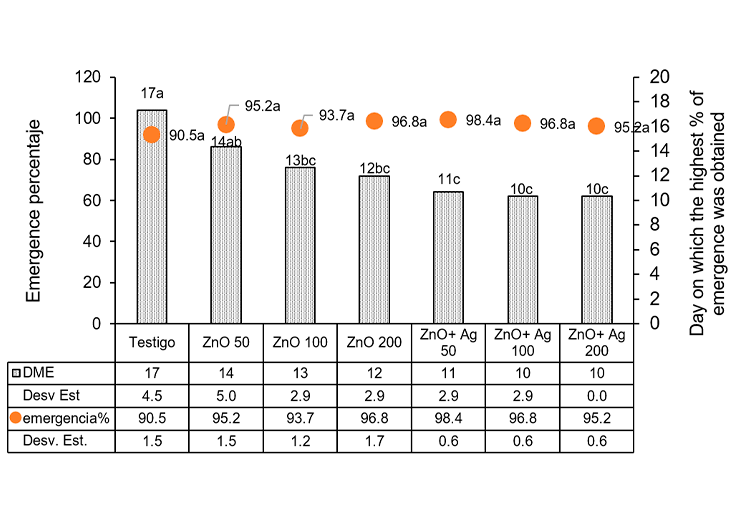
Maguey pulquero is an emblematic species of Mexico because of its productive, ecological and cultural importance; however, sexual reproduction has been underutilized, limiting plant availability and conservation. In this context, nanotechnology represents an innovative alternative to improve the initial establishment of the crop. This research aimed to evaluate the effect of imbibing seeds of Agave salmiana Cv. Xaminí in solutions of zinc oxide nanoparticles (ZnO-NPs) and their combination with silver (ZnO+Ag1%-NPs) on emergence and initial growth. The study was conducted under semi-controlled conditions at the Higher Technological Institute of Huichapan, Hidalgo, Mexico, in 2025. Concentrations of 50, 100 and 200 mg L-1, plus a control in deionized water, were evaluated under a completely randomized design with three replications. The variables evaluated were percentage of emergence, days to maximum emergence, emergence speed index and cotyledonary leaf height. The data were analyzed using Anova and Tukey’s test (p≤ 0.05). The results showed that the treatments remained statistically similar in emergence percentage, with values above 90%, promoting faster and more uniform emergence and reducing the time needed to reach the established maximum by up to nine days, mainly in ZnO+Ag 1% treatments. Intermediate concentrations promoted initial growth, increasing cotyledonary leaf height by up to 33% and improving the emergence speed index. The positive effect is attributed to zinc, a necessary element in essential physiological processes related to plant growth, as well as to the possible physiological stimulation effect of silver at low concentrations. Seed imbibition with nanoparticles improves the initial establishment of A. salmiana, representing a promising tool for propagating and conserving this high-value species in Mexico.
Downloads
References
Akbay, B. y Yalçın, F. S. 2025. Efecto del pretratamiento con nano ZnO en la germinación y la longitud de la raíz de semillas de soja (Glycine max L.). International. Journal of Secondary Metabolite. 12(1):204-215. https://doi.org/10.21448/ijsm.1527985.
Calabrese, E. J. 2008. Converging concepts: adaptive response, preconditioning, and the Yerkes-Dodson law are manifestations of hormesis. Ageing Research Reviews. 7(1):8-20. https://doi.org/10.1016/j.arr.2007.07.001.
Calabrese, E. J.; Agathokleous, E.; Kapoor, R.; Dhawan, G. and Calabrese, V. 2021. Luteolin and hormesis. Mechanisms of Ageing and Development. 19:111559. https://doi.org/10.1016/j.mad.2021.111559.
Cerroblanco-Vázquez, V.; Vasco-Leal, J. F. y Contreras-Medina, D. I. 2025. Innovación y tecnología para una agricultura mexicana sostenible: un estudio cualitativo. RAN-Revista Academia y Negocios. 11(1):1-15. https://doi.org/10.29393/RAN11-2ITVC30003.
Lira, S. R. H.; Méndez, A. B.; Santos, V. G. D. y Vera R.; I. 2018. Potencial de la nanotecnología en la agricultura. Acta Universitaria. 28(2):9-24. https://doi.org/10.15174/au.2018.1575.
Maguire, J. D. 1962. Speed of germination-aid selection and evaluation for seedling emergence and vigor. Crop Science. 2(2):176-177. https://doi.org/10.2135/cropsci1962.0011183X000200020033x.
Manh-Cuong, D.; Cong-Du, P.; Tung, H. T.; Ngan, H. T. M.; Luan, V. Q.; Phong, T. H.; Khai, H. D.; Phuong, T. T. B. and Nhut, D. T. 2021. Silver nanoparticles as an effective stimulant in micropropagation of Panax vietnamensis-a valuable medicinal plant. Plant Cell, Tissue and Organ Culture. 143(3)577-588. https://doi.org/10.1007/s11240-021-02095-2.
Mazumder, J. A.; Khan, E.; Perwez, M.; Gupta, M.; Kumar, S.; Raza, K. y Sardar, M. 2020. Exposición de ZnO a nanoescala biosintetizado a la planta de cultivo Brassica juncea: aspectos morfológicos, bioquímicos y moleculares. Scientific Reports. 10:8531. https://doi.org/10.1038/s41598-020-65271-y.
Méndez-Andrade, R.; Ruiz-Torres, N. A.; Wang, Y.; García-Cerdac, L. A. and Reyes, I. V. 2024. Enhanced Tomato seed germination and seedling growth through oxidative stress using biogenic silver nanoparticles. Revista Terra Latinoamericana. 42.
Moreno-Guerrero, D. E.; López-Collado, C. J.; Leyva-Mir, S. G.; Chávez-Franco, S. H.; Alonso-López, A. y Platas-Rosado, D. E. 2025. Nanopartículas de plata en la calidad de la fresa. Revista Mexicana de Ciencias Agrícolas. 16(6):e3808. https://doi.org/10.29312/remexca.v16i6.3808.
Mota, R. I. F.; Rodríguez-Rosales, M. D. J.; Martínez-Roldán, A.; Gómez, V. J. M.; De la Peña, A. A. y Hernández, M. G. C. 2024. El agave en México: su aplicación como adsorbente para la remoción de contaminantes en el agua. Agraria. 21(3):5-14. https://doi.org/10.59741/agraria.v21i3.623.
Nandhini, M. R.; Rajini, S. B., Udayashankar, A. C., Niranjana, S. R., Lund O. S.; Shetty, H. S. and Prakash, H. S. 2019. Biofabricated zinc oxide nanoparticles as an eco-friendly alternative for growth promotion and management of downy mildew of pearl millet. Crop Protection. 121:103-112. https://doi.org/10.1016/j.cropro.2019.03.015.
Navarrete, T. M. C. y García, M. A. C. 2021. El pulque: la bebida de los dioses con valor y tradición milenaria. Journal of Tourism and Heritage Research. 4(1):20-36. https://dialnet.unirioja.es/servlet/articulo?codigo=7907925.
Noori, A.; Donnelly, T.; Colbert, J.; Cai, W.; Newman, L. A. and White, J. C. 2020. Exposure of tomato (Lycopersicon esculentum) to silver nanoparticles and silver nitrate: physiological and molecular response. International Journal of Phytoremediation. 22(1):40-51. https://doi.org/10.1080/15226514.2019.1634000.
Pivaral, C. A. G.; Flores, H. E. A.; Moreno, R. A.; Galindo, G. M. y Galindo, G. A. P. 2026. Importancia y perspectiva futura de las nanopartículas para desencadenar metabolitos secundarios en las plantas. Agraria. 23(1): 23(1):e705. https://doi.org/10.59741/agraria.v23i1.705.
Raliya, R.; Saharan, V.; Dimkpa, C. y Biswas, P. 2017. Nanofertilizantes para la agricultura de precisión y sostenible: Estado actual y perspectivas futuras. Journal of Agricultural and Food Chemistry. 66(26):6487-6503. https://doi.org/10.1021/acs.jafc.7b02178.
Rodríguez-González, V. y Díaz-Cervantes, E. 2024. Potencial de los nanomateriales en la agricultura: retos y oportunidades. Mundo Nano. Revista Interdisciplinaria en Nanociencias y Nanotecnología. 17(32):1e-20e. https://doi.org/10.22201/ceiich.24485691e.2024.32.69802.
Roldan-Cruz, E.; Medina-Mendoza, C. y Mendoza-Tolentino, Y. 2023. Políticas públicas para el aprovechamiento sustentable del maguey pulquero (Agave salmiana) en Hidalgo, México. Investigium IRE: Ciencias Sociales y Humanas. 14(1):137-147. https://doi.org/10.15658/investigiumire.231401.13.
Sánchez, L. A.; Rivera, R. J. M. y Velázquez, C. E. 2024. Management and cultural preservation of maguey (Agave salmiana var. salmiana) in San Mateo Tlajomulco, Hidalgo. Textual. 83(1):137-171. https://doi.org/10.5154/r.textual/2023.83.06.
Shahid, M., Khalid, S.; Abbas, G.; Shahid, N.; Nadeem, M.; Sabir, M.; Aslam, M. y Dumat, C. 2015. Heavy metal stress and crop productivity. In: Hakeem, K. (Ed.). Crop production and global environmental issues. Springer. 1-25 pp. https://doi.org/10.1007/978-3-319-23162-4-1.
Shaik, A. M.; David, R. M. and Rama, S. R. D. 2020. Green synthesis of zinc oxide nanoparticles using aqueous root extract of Sphagneticola trilobata Lin and investigate its role in toxic metal removal, sowing germination and fostering of plant growth. Inorganic and Nano-Metal Chemistry. 50(7):569-579. https://doi.org/10.1080/24701556.2020.1722694.
Shaikhaldein, H. O.; Al-Qurainy, F.; Nadeem, M.; Khan, S.; Tarroum, M. and Salih, A. M. 2020. Biosynthesis and characterization of silver nanoparticles using Ochradenus arabicus and their physiological effect on Maerua oblongifolia raised in vitro. Scientific Reports. 10:17569. https://doi.org/10.1038/s41598-020-74675-9.
SIAP. 2026. Servicio de Información Agroalimentaria y Pesquera. Anuario estadístico de la producción agrícola 2024 (Maguey pulquero). Gobierno de México. http://www.gob.mx/siap.
Soto-Alarcón, J. M.; González-Gómez, D. X.; González-Olivares, L. G. y Castañeda-Ovando, A. 2022. Hacer comunes con el maguey pulquero en Hidalgo, México. Hatso Hnini. Revista de Investigación de Paisajes y Espacio Construido. 1(2):1-18. https://doi.org/10.47386/2022v1n2ijdahc.
Trejo, L.; Reyes, M.; Cortés-Toto, D.; Romano-Grande, E. y Muñoz-Camacho, L. L. 2020. Morphological diversity and genetic relationships in pulque production agaves in Tlaxcala, Mexico, by means of unsupervised learning and gene sequencing analysis. Frontiers in Plant Science. 11:524812. https://doi.org/10.3389/fpls.2020.524812.
Zulfiqar, F.; Navarro, M.; Ashraf, M.; Akram, N. A. y Munné-Bosch, S. 2019. Uso de nanofertilizantes para la agricultura sostenible: ventajas y limitaciones. Plant Science. 289:110270. https://doi.org/10.1016/j.plantsci.2019.110270.
Downloads
Published
Issue
Section
License
Copyright (c) 2026 Revista Mexicana de Ciencias Agrícolas

This work is licensed under a Creative Commons Attribution-NonCommercial 4.0 International License.
The authors who publish in Revista Mexicana de Ciencias Agrícolas accept the following conditions:
In accordance with copyright laws, Revista Mexicana de Ciencias Agrícolas recognizes and respects the authors’ moral right and ownership of property rights which will be transferred to the journal for dissemination in open access. Invariably, all the authors have to sign a letter of transfer of property rights and of originality of the article to Instituto Nacional de Investigaciones Forestales, Agrícolas y Pecuarias (INIFAP) [National Institute of Forestry, Agricultural and Livestock Research]. The author(s) must pay a fee for the reception of articles before proceeding to editorial review.
All the texts published by Revista Mexicana de Ciencias Agrícolas —with no exception— are distributed under a Creative Commons License Attribution-NonCommercial 4.0 International (CC BY-NC 4.0), which allows third parties to use the publication as long as the work’s authorship and its first publication in this journal are mentioned.
The author(s) can enter into independent and additional contractual agreements for the nonexclusive distribution of the version of the article published in Revista Mexicana de Ciencias Agrícolas (for example include it into an institutional repository or publish it in a book) as long as it is clearly and explicitly indicated that the work was published for the first time in Revista Mexicana de Ciencias Agrícolas.
For all the above, the authors shall send the Letter-transfer of Property Rights for the first publication duly filled in and signed by the author(s). This form must be sent as a PDF file to: revista_atm@yahoo.com.mx; cienciasagricola@inifap.gob.mx; remexca2017@gmail.
This work is licensed under a Creative Commons Attribution-Noncommercial 4.0 International license.