Effect of the endocarp on the emergence kinetics and uniformity of coffee trees
DOI:
https://doi.org/10.29312/remexca.v17i6.4202Keywords:
genotype, germination, parchment, seed, seedlingAbstract
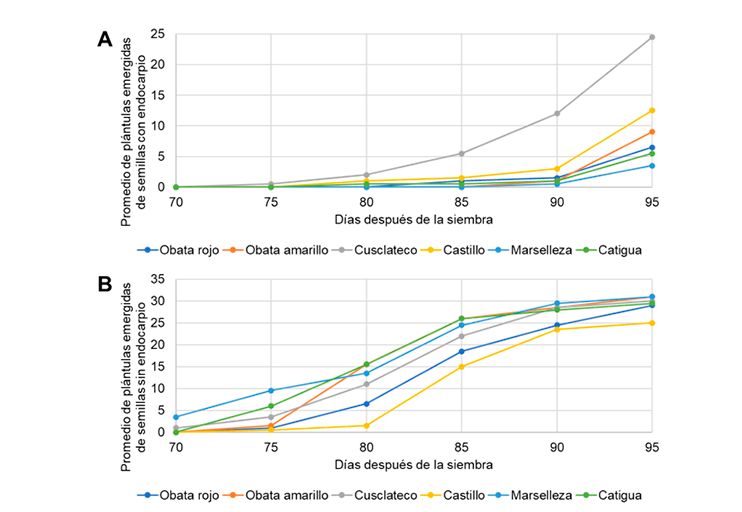
The physical quality of coffee seeds is key to producing seedlings, especially under uncontrolled edaphoclimatic conditions, where the endocarp acts as a barrier that delays emergence and makes it irregular. This study aimed to evaluate the effect of the endocarp on the emergence kinetics and uniformity of seedlings of six coffee genotypes under seedbed conditions in Oxapampa, Pasco, Peru, between May and August 2025. Six coffee genotypes and two conditions (with and without endocarp) were evaluated. The design was completely randomized with a 6 × 2 factorial arrangement and two blocks. Seedling emergence percentage, time, speed and index were evaluated. Data were analyzed with analysis of variance, simple effects and Tukey’s test (p≤ 0.05). The genotype × endocarp interaction was significant for PE, MET, MES and ESI. Endocarp removal increased the percentage and speed of emergence and reduced the mean emergence time in all genotypes. Obata Amarillo, Marsellesa, Cuscatleco and Catigua recorded the highest percentages of emergence (92.19-96.88%), while Marsellesa exhibited the fastest emergence (87.2 days) and the highest speed of emergence (1.29 seedlings day-1). ESI showed a differential response according to genotype. The research revealed that removing the endocarp improves kinetics by reducing emergence time and enhances seedling emergence uniformity.
Downloads
References
Acosta-Huamán, G. C. y Acosta-Trinidad, L. T. 2025. Desarrollo y validación de escalas diagramáticas de severidad de ojo de gallo y minador en hojas de cafeto. Revista Alfa. 9(26):532-548. https://doi.org/10.33996/revistaalfa.v9i26.364.
Acosta-Trinidad, L.; Soplin-Villacorta, H. y Chura-Chuquija, J. 2022. Remoción del endocarpio en la emergencia, vigor y fenología pre-trasplante de plántulas de semillas de nueve genotipos de cafeto, en Oxapampa. Anales Científicos. 83(1):67-77. https://doi.org/10.21704/ac.v83i1.1885.
Bewley, J. D.; Bradford, K. J.; Hilhorst, H. W. M. and Nonogaki, H. 2013. Seeds: physiology of development, germination and dormancy. 3th. Edition. Springer. https://doi.org/10.1007/978-1-4614-4693-4.
Caballero-Salas, R. G.; Caballero-Miranda, M. L. y Casimiro Soriano, E. M. 2021. Evaluación germinativa y fenología de dos variedades de Caesalpinia pulcherrima. Manglar. 18(3):295-300. https://doi.org/10.17268/manglar.2021.039.
Carrasco-Cruzado, A. Y.; Villegas-Herrera, N. A.; López-Medina, S. E.; Mostacero-León, J.; Rodríguez-Soto, J. C.; Gil-Rivero, A. E.; De La Cruz-Castillo, A. J. y Gonzales-Velasquez, C. L. Y. 2025. Influencia del ácido giberélico en la germinación de Physalis peruviana ‘aguaymanto’. Manglar. 22(1):61-66. https://doi.org/10.57188/manglar.2025.007.
Carvalho, N. M. y Nakagawa, J. 2012. Sementes: ciência, tecnologia e produção. 5ta. Edition. Fundação de Apoio a Pesquisa, Ensino e Extensão (FUNEP).
Coa-Urbaez, M.; Mendez-Natera, J. R.; Silva-Acuña, R. y Mundarain-Padilla, S. 2014. Evaluación de métodos químicos y mecánicos para promover la germinación de semillas y producción de fosforitos en café (Coffea arábica) var. Catuaí Rojo. Idesia Arica. 32(1):43-53. https://doi.org/10.4067/S0718-34292014000100006.
Coste, R. 1992. Coffee: the plant and the product. 11th. Edition. Macmillan Press Ltd.
Díaz-Medina, A.; Carrillo-González, A. y Suárez-Pérez, C. 2023. Efecto de bioproductos sobre el desarrollo de posturas de café en vivero. Revista Mexicana de Ciencias Agrícolas. 14(4):495-505. https://doi.org/10.29312/remexca.v14i4.3303.
Eira, M. T. S.; da Silva, E. A. A.; De Castro, R. D.; Dussert, S.; Walters, C.; Bewley, J. D. and Hilhorst, H. W. M. 2006. Coffee seed physiology. Brazilian Journal of Plant Physiology. 18(1):149-163. https://doi.org/10.1590/S1677-04202006000100011.
Escobedo-Baylon, J. J.; Charcape-Méndez, A. S.; López-Medina, S. E.; Mostacero-León, J.; Rodríguez-Soto, J. C.; Gil-Rivero, A. E.; De La Cruz-Castillo, A. J. y Villena-Zapata, L. I. 2025. Influencia de ácido giberélico y tiempo de remojo sobre la germinación de semillas de Coffea arabica L. var. Catimor ‘café’. Manglar. 22(3):339-346. https://doi.org/10.57188/manglar.2025.034.
Filho, J. M. 2015. Seed physiology of cultivated plants. 2nd. edition. Associação Brasileira de Tecnologia de Sementes (ABRATES).
Gebreselassie, W.; Ali-Mohammed, A. and Netsere, A. 2010. Pre-sowing treatment of coffee (Coffea arabica L.) seeds to enhance emergence and subsequent growth of seedlings. Research Journal of Seed Science. 3(4):218-226. https://scialert.net/abstract/?doi=rjss.2010.218.226.
González-Vega, M. E.; Rosales-Jenqui, P.; Castilla-Valdés, Y.; Lacerra-Espino, J. A. and Ferrer-Viva, M. 2015. Effect of bioenraiz® as stimulant of coffee plants (Coffea arabica L.) germination and the development. Cultivos Tropicales. 36(1):71-77. https://www.redalyc.org/pdf/1932/193237111009.pdf.
Julca-Otiniano, A. M.; Borjas-Ventura, R.; Bello-Amez, S.; Ladera-Manyari, Y. y Rebaza-Fernández, D. 2015. El crecimiento del café var. Caturra Roja y su relación con la aplicación de abonos orgánicos. Saber y Hacer. 2(2):75-89. https://revistas.usil.edu.pe/index.php/syh/article/view/131.
Maqueira-López, L. A.; Morejón-Rivera, R.; Roján-Herrera, O.; Blanco-Valdés, Y. y Izquierdo-Collazo, A. I. 2023. Germinación de semillas de arroz (Oryza sativa L.) a diferentes temperaturas. Cultivos Tropicales. 44(4):1-7. https://cu-id.com/2050/v44n4e01.
Martínez, F. E.; Miranda, D. y Magnitskiy, S. 2012. Temperatura de germinación de semillas de anón (Annona squamosa L.). Revista Colombiana de Ciencias Hortícolas. 6(2):129-139. https://acortar.link/ikI7PJ.
Morejón-Rivera, R. y Díaz-Solis, S. H. 2023. Ensayos de germinación en cuatro nuevas líneas de arroz obtenidas por hibridaciones en Los Palacios. Cultivos Tropicales. 44(4):1-7. https://cu-id.com/2050/v44n4e07.
Moreno-Peña, L.; Hidalgo-Escobar, K.; Cevallos-Cevallos, J. M. and Sánchez-Timm, E. 2025. An effective disinfection protocol for contamination control in vitro establishment of Mortiño (Vaccinium floribundum Kunth) and identification of endogenous microbes. Scientia Agropecuaria. 16(3):375-384. https://doi.org/10.17268/sci.agropecu.2025.028.
Nápoles-Vinent, S.; Milanés-Riquene, S.; Hernández-Forte, I.; Morales-Mena, B. y Nápoles-Garcias, M. C. 2022. Los rizobios incrementan la germinación de las semillas de Coffea arabica y Coffea canephora. Segunda evidencia en Cuba. Agronomía Mesoamericana. 33(1):1-13. https://doi.org/10.15517/am.v33i1.45719.
Narváez, I.; Torres, L.; Granados, Z. y Delgado, I. 2022. Tratamientos pregerminativos y germinación de semillas de Vochysia lehmannii en los llanos orientales de Colombia. Revista de Investigación Agraria y Ambiental. 13(2):125-136. https://doi.org/10.22490/21456453.5433.
Ranal, M. A. and Garcia-De Santana, D. 2006. How and why to measure the germination process?. Brazilian Journal of Botany. 29(1):1-11. https://doi.org/10.1590/S0100-84042006000100002.
SENAMHI. 2025. Servicio Nacional de Meteorología e Hidrología del Perú. Datos hidrometeorológicos. https://www.senamhi.gob.pe/servicios/?p=estaciones.
Valarezo-Rivera, N. Y.; Quevedo-Guerrero, J. N.; Ajila-Gia, L. G.; García-Batista, R. M. y Chabla-Carrillo, J. E. 2021. Evaluación del porcentaje de germinación de cinco cultivares de café (Coffea arabica L.) empleando cuatro tratamientos en vivero. Revista Científica Agroecosistemas. 9(1):68-75. https://aes.ucf.edu.cu/index.php/aes/article/view/446.
Vieira-Ferraz, M.; Facincani-Franco, C.; Sales-Batista, G. and Lopes-Pivetta, K. F. 2016. Salinity on the germination of seed and index of germination speed of three ornamental species. Ornamental Horticulture. 22(2):196-201. https://doi.org/10.14295/oh.v22i2.919.
Downloads
Published
Issue
Section
License
Copyright (c) 2026 Revista Mexicana de Ciencias Agrícolas

This work is licensed under a Creative Commons Attribution-NonCommercial 4.0 International License.
The authors who publish in Revista Mexicana de Ciencias Agrícolas accept the following conditions:
In accordance with copyright laws, Revista Mexicana de Ciencias Agrícolas recognizes and respects the authors’ moral right and ownership of property rights which will be transferred to the journal for dissemination in open access. Invariably, all the authors have to sign a letter of transfer of property rights and of originality of the article to Instituto Nacional de Investigaciones Forestales, Agrícolas y Pecuarias (INIFAP) [National Institute of Forestry, Agricultural and Livestock Research]. The author(s) must pay a fee for the reception of articles before proceeding to editorial review.
All the texts published by Revista Mexicana de Ciencias Agrícolas —with no exception— are distributed under a Creative Commons License Attribution-NonCommercial 4.0 International (CC BY-NC 4.0), which allows third parties to use the publication as long as the work’s authorship and its first publication in this journal are mentioned.
The author(s) can enter into independent and additional contractual agreements for the nonexclusive distribution of the version of the article published in Revista Mexicana de Ciencias Agrícolas (for example include it into an institutional repository or publish it in a book) as long as it is clearly and explicitly indicated that the work was published for the first time in Revista Mexicana de Ciencias Agrícolas.
For all the above, the authors shall send the Letter-transfer of Property Rights for the first publication duly filled in and signed by the author(s). This form must be sent as a PDF file to: revista_atm@yahoo.com.mx; cienciasagricola@inifap.gob.mx; remexca2017@gmail.
This work is licensed under a Creative Commons Attribution-Noncommercial 4.0 International license.