Efficacy of botanical and biological insecticides against Spodoptera frugiperda in corn
DOI:
https://doi.org/10.29312/remexca.v17i5.4175Keywords:
bioinsecticides, dosage, entomopathogens, mortality, substitutionAbstract
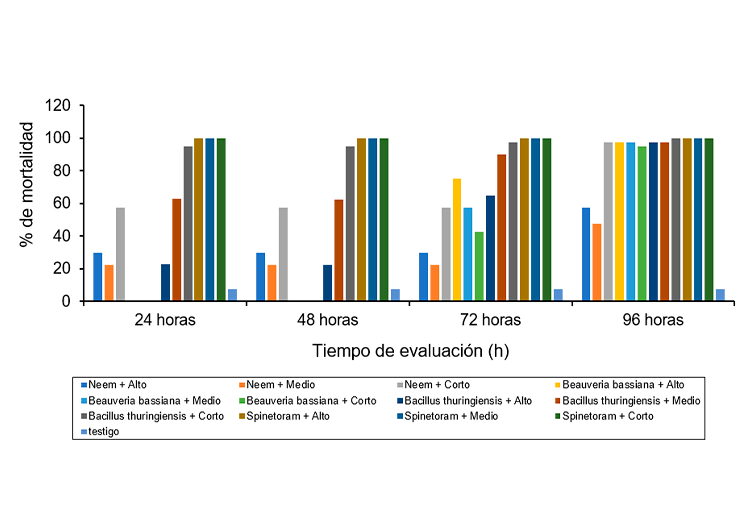
The fall armyworm, Spodoptera frugiperda, is one of the main pests of corn in Ecuador, causing significant yield losses. The intensive use of chemical insecticides for its control poses environmental and human health risks. As a sustainable alternative, this study evaluated the efficiency of biological and botanical insecticides under laboratory conditions. The research was conducted from May to July 2025 using a completely randomized design with four treatments [BotaniGard® ES (Beauveria bassiana), Dipel® WG (Bacillus thuringiensis), NeemAzal® T/S (neem oil), and Delegate® 250 WG (spinetoram, as a chemical control)], which were applied to third-instar larvae via the leaf immersion technique, with evaluations at 24, 48, 72 and 96 h. Results showed that B. thuringiensis achieved 100% mortality at 96 h, followed by neem oil and B. bassiana, both with 97.5%. Spinetoram produced immediate and sustained mortality of 100% from 24 h. In contrast, neem showed a low initial mortality rate (17.5%) that progressively increased over time. Overall, the biological and botanical insecticides evaluated are effective alternatives for managing S. frugiperda under laboratory conditions, helping reduce dependence on conventional chemical insecticides.
Downloads
References
Akeme, C.; Ngosong, C.; Sumbele, S.; Aslan, A.; Tening, A.; Krah, C.; Kamanga, B.; Denih, A. and Nambangia, O. 2021. Different controlling methods of fall armyworm (Spodoptera frugiperda) in maize farms of small- scale producers in Cameroon. IOP Conference Series: Earth and Environmental Science. 911(1):1-21. https://doi.org/10.1088/1755-1315/911/1/012053. DOI: https://doi.org/10.1088/1755-1315/911/1/012053
Amezcua, L. G.; Fuentes, L. T.; Gutiérrez, J. M.; Sánchez, J. C.; Hernández, H. A. and Castrejón, J. E. 2023. Eficacia insecticida de spinetoram, Bacillus thuringiensis Berliner y clorpirifos contra Spodoptera frugiperda (J.E. Smith, 1797) en maíz. Avances en Investigación Agropecuaria. 27(1):208-2018. https://doi.org/10.53897/RevAIA.23.27.71. DOI: https://doi.org/10.53897/RevAIA.23.27.71
Analuisa, I. A.; Jimber, J. A.; Fernández, J. A. and Vergara, A. 2023. The value chain of Ecuadorian hard yellow corn. Challenges and opportunities. Lecturas de Economía. 1(98):231-262. https://doi.org/10.17533/udea.le.n98a347315. DOI: https://doi.org/10.17533/udea.le.n98a347315
Berube, B.; Ernst, E.; Cahn, J.; Roche, B.; de Santis Alves, C.; Lynn, J.; Scheben, A.; Grimanelli, D.; Siepel, A.; Ross-Ibarra, J.; Kermicle, J. and Martienssen, R. A. 2024. Teosinte pollen drives maize diversification and domestication by RNAi. Nature. 633(1):380-388. https://doi.org/10.1038/s41586-024-07788-0. DOI: https://doi.org/10.1038/s41586-024-07788-0
Bravo, A.; Likitvivatanavong, S.; Gill, S. S. and Soberón, M. 2011. Bacillus thuringiensis: A story of a successful bioinsecticide. Insect Biochemistry and Molecular Biology. 41(7):423-431. https://doi.org/10.1016/j.ibmb.2011.02.006. DOI: https://doi.org/10.1016/j.ibmb.2011.02.006
Butt, T. M.; Coates, C. J.; Dubovskiy, I. M. and Ratcliffe, N. A. 2016. Entomopathogenic Fungi. In: Advances in Genetics. 94(1):307-364. Elsevier. https://doi.org/10.1016/bs.adgen.2016.01.006. DOI: https://doi.org/10.1016/bs.adgen.2016.01.006
González, M. B.; Gurrola, N. J. and Chaírez, I. 2015. Biological products for the control of Spodoptera frugiperda (Lepidoptera: Noctuidae). Revista Colombiana de Entomología. 41(2):200-204. http://www.scielo.org.co/scielo.php?script=sci-arttext&pid=S0120-04882015000200009. DOI: https://doi.org/10.1177/012004881504100209
Idrees, A.; Afzal, A.; Qadir, Z. A. and Li, J. 2022. Bioassays of Beauveria bassiana Isolates against the Fall Armyworm, Spodoptera frugiperda. Journal of Fungi. 8(7):1-16. https://doi.org/10.3390/jof8070717. DOI: https://doi.org/10.3390/jof8070717
Isman, M. B. 2020. Botanical insecticides in the twenty-first century-fulfilling their promise? Annual Review of Entomology. 65(1):233-249. https://doi.org/10.1146/annurev-ento-011019-025010. DOI: https://doi.org/10.1146/annurev-ento-011019-025010
Iwanicki, N. S.; Lopes, E. C.; De Lira, A. C.; Poletto, T. B.; Fonseca, L. Z. and Delalibera, J, I. 2023. Comparative analysis of Beauveria bassiana submerged conidia with blastospores: yield, growth kinetics and virulence. Biological Control. 185(1):1-16. https://doi.org/10.1016/j.biocontrol.2023.105314. DOI: https://doi.org/10.1016/j.biocontrol.2023.105314
Kinyanjui, G.; Tadesse Mawcha, K. and Ndolo, D. 2025. Advancing entomopathogenic fungi for improved management of Phthorimaea (Tuta) absoluta (Lepidoptera: Gelechiidae). Journal of Integrated Pest Management. 16(1):1-19. https://doi.org/10.1093/jipm/pmaf034. DOI: https://doi.org/10.1093/jipm/pmaf034
Kulye, M.; Mehlhorn, S.; Boaventura, D.; Godley, N.; Venkatesh, S.; Rudrappa, T., Charan, T.; Rathi, D. and Nauen, R. 2021. Baseline susceptibility of Spodoptera frugiperda populations collected in India towards different chemical classes of insecticides. Insects. 12(8):1-11. https://doi.org/10.3390/insects12080758. DOI: https://doi.org/10.3390/insects12080758
Lin, S.; Li, S.; Liu, Z.; Zhang, L.; Wu, H.; Cheng, D. and Zhang, Z. 2021. Using azadirachtin to transform Spodoptera frugiperda from pest to natural enemy. Toxins. 13(8):1-12. https://doi.org/10.3390/toxins13080541. DOI: https://doi.org/10.3390/toxins13080541
Martínez, A.; Ortega, J. S.; Hernández, S. I.; Olivas, E. H. and Alba, J. J. 2016. Applications of neem (Azadirachta indica) in agriculture: a review. Journal of Plant Growth Regulation. 13(2):191-198. https://doi.org/10.4314/ajtcam.v13i2.23. DOI: https://doi.org/10.4314/ajtcam.v13i2.23
Martinez, S. S. and Emden, H. F. 2001. Growth disruption, abnormalities and mortality of Spodoptera littoralis (Boisduval) (Lepidoptera: Noctuidae) caused by Azadirachtin. Neotropical Entomology. 30(1):113-125. https://doi.org/10.1590/S1519-566X2001000100017. DOI: https://doi.org/10.1590/S1519-566X2001000100017
Mascarin, G. M. and Jaronski, S. T. 2016. The production and uses of Beauveria bassiana as a microbial insecticide. World Journal of Microbiology and Biotechnology. 32(177):1-26. https://doi.org/10.1007/s11274-016-2131-3. DOI: https://doi.org/10.1007/s11274-016-2131-3
Mordue, A. J. and Nisbet, A. J. 2000. Azadirachtin from the neem tree Azadirachta indica: Its action against insects. Anais da Sociedade Entomológica do Brasil. 29(4):615-632. https://doi.org/10.1590/S0301-80592000000400001. DOI: https://doi.org/10.1590/S0301-80592000000400001
Palma, L.; Sauka, D. H. and Ibarra, J. E. 2024. Bacillus thuringiensis: a broader view of its biocidal activity. Toxins. 16(3):1-3. https://doi.org/10.3390/toxins16030162. DOI: https://doi.org/10.3390/toxins16030162
Real, C. I. and Paiba, K. O. 2023. Reactivation of the nuclear polyhedrosis virus strain VPNHz1991 for the management of the corn earworm (Helicoverpa zea). Revista Iberoamericana de Bioeconomia y Cambio Climático. 9(18):2193-2201. https://doi.org/10.5377/ribcc.v9i18.17547. DOI: https://doi.org/10.5377/ribcc.v9i18.17547
Rodríguez, J. C.; Salazar, M. L. and Contreras, M. 2018. Effect of different surfactants on larvae III of Spodoptera frugiperda Smith under laboratory and field conditions. Arnaldoa. 25 (3):1041-1052. http://dx.doi.org/10.22497/arnaldoa.253.25315. DOI: https://doi.org/10.22497/arnaldoa.253.25315
Sala, A.; Barrena, R.; Meyling, N. V. and Artola, A. 2023. Conidia production of the entomopathogenic fungus Beauveria bassiana using packed-bed bioreactor: Effect of substrate biodegradability on conidia virulence. Journal of Environmental Management. 341(1):1-10. https://doi.org/10.1016/j.jenvman.2023.118059. DOI: https://doi.org/10.1016/j.jenvman.2023.118059
Saleem, U.; Asrar, M.; Jabeen, F.; Makhdoom Hussain, S. and Hussain, D. 2024. Determination of insecticidal potential of selected plant extracts against fall armyworm (Spodoptera frugiperda) larvae. Heliyon. 10(20):1-13. https://doi.org/10.1016/j.heliyon.2024.e39593. DOI: https://doi.org/10.1016/j.heliyon.2024.e39593
Saquee, F. S.; Norman, P. E.; Saffa, M. D.; Kavhiza, N. J.; Pakina, E.; Zargar, M.; Diakite, S.; Stybayev, G.; Baitelenova, A. and Kipshakbayeva, G. 2023. Impact of diffent types of green manure on pest and disease incidence and severity as well as growth and yield parameters of maize. Heliyon. 9(6):1-10. https://doi.org/10.1016/j.heliyon.2023.e17294. DOI: https://doi.org/10.1016/j.heliyon.2023.e17294
Vásquez, L. H.; Alvarado, K. A.; Intriago, F. G.; Raju, N. M. and Prasad, R. 2024. Banana and apple extracts with efficient microorganisms and their effect on cadmium reduction in cocoa beans (Theobroma cacao L.). Discover Food. 4(163):1-13. https://doi.org/10.1007/s44187-024-00205-5. DOI: https://doi.org/10.1007/s44187-024-00205-5
Wan, J.; Huang, C.; Li, C.; Zhou, H.; Li, Z.; Xing, L.; Zhang, B.; Qiao, X.; Liu, B.; Liu, C.; Liu, W.; Wang, W.; Qian, W.; Makrdy, S. and Wan, F. 2021. Biology, invasion and management of the agricultural invader: Fall armyworm, Spodoptera frugiperda (Lepidoptera:Noctuidae). Journal of Integrative Agriculture. 20(3):646-663. https://doi.org/10.1016/S2095-3119(20)63367-6. DOI: https://doi.org/10.1016/S2095-3119(20)63367-6
Wen, H.; Zhang, Q.; Cheng, D.; Zhang, Z.; Xu, H. and Xiangning, C. 2013. Cassia oil as a substitute solvent for xylene for rotenone EC and its synergistic activities. Pesticide Biochemistry and Physiology. 105(3):189-196. https://doi.org/10.1016/j.pestbp.2013.02.002. DOI: https://doi.org/10.1016/j.pestbp.2013.02.002
Yang, N.; Wang, Y.; Liu, X.; Jin, M.; Vallebueno-Estrada, M.; Calfee, E.; Chen, L.; Dilkes, B. P.; Gui, S.; Fan, X.; Harper, T. K.; Kennett, D. J.; Li, W.; Lu, Y.; Ding, J.; Chen, Z.; Luo, J.; Mambakkam, S.; Menon, M. and Ross-Ibarra, J. 2023. Two teosintes made modern maize. Science. 382(6674):1-40. https://doi.org/10.1126/science.adg8940. DOI: https://doi.org/10.1126/science.adg8940
Yasin, S.; Zavala, F.; Niño, G.; Rodríguez, P.; Gutiérrez, A.; Sinagawa, S. and Lugo, E. 2024. Morphological and physiological response of maize (Zea mays L.) to drought stress during reproductive stage. Agronomy. 14(8):1-16. https://doi.org/10.3390/agronomy14081718. DOI: https://doi.org/10.3390/agronomy14081718
Zhou, W.; Li, M. and Achal, V. 2025. A comprehensive review on environmental and human health impacts of chemical pesticide usage. Emerging Contaminants; 11(1):1-13. https://doi.org/10.1016/j.emcon.2024.100410. DOI: https://doi.org/10.1016/j.emcon.2024.100410
Zimmermann, G. 2007. Review on safety of the entomopathogenic fungi Beauveria bassiana and Beauveria brongniartii. Biocontrol Science and Technology. 17(6):553-596. https://doi.org/10.1080/09583150701309006. DOI: https://doi.org/10.1080/09583150701309006
Downloads
Published
Issue
Section
License
Copyright (c) 2026 Revista Mexicana de Ciencias Agrícolas

This work is licensed under a Creative Commons Attribution-NonCommercial 4.0 International License.
The authors who publish in Revista Mexicana de Ciencias Agrícolas accept the following conditions:
In accordance with copyright laws, Revista Mexicana de Ciencias Agrícolas recognizes and respects the authors’ moral right and ownership of property rights which will be transferred to the journal for dissemination in open access. Invariably, all the authors have to sign a letter of transfer of property rights and of originality of the article to Instituto Nacional de Investigaciones Forestales, Agrícolas y Pecuarias (INIFAP) [National Institute of Forestry, Agricultural and Livestock Research]. The author(s) must pay a fee for the reception of articles before proceeding to editorial review.
All the texts published by Revista Mexicana de Ciencias Agrícolas —with no exception— are distributed under a Creative Commons License Attribution-NonCommercial 4.0 International (CC BY-NC 4.0), which allows third parties to use the publication as long as the work’s authorship and its first publication in this journal are mentioned.
The author(s) can enter into independent and additional contractual agreements for the nonexclusive distribution of the version of the article published in Revista Mexicana de Ciencias Agrícolas (for example include it into an institutional repository or publish it in a book) as long as it is clearly and explicitly indicated that the work was published for the first time in Revista Mexicana de Ciencias Agrícolas.
For all the above, the authors shall send the Letter-transfer of Property Rights for the first publication duly filled in and signed by the author(s). This form must be sent as a PDF file to: revista_atm@yahoo.com.mx; cienciasagricola@inifap.gob.mx; remexca2017@gmail.
This work is licensed under a Creative Commons Attribution-Noncommercial 4.0 International license.