Global trends and dynamics of water productivity in agriculture: a bibliometric analysis
DOI:
https://doi.org/10.29312/remexca.v17i5.4109Keywords:
agricultural efficiency, global trends, water resourcesAbstract
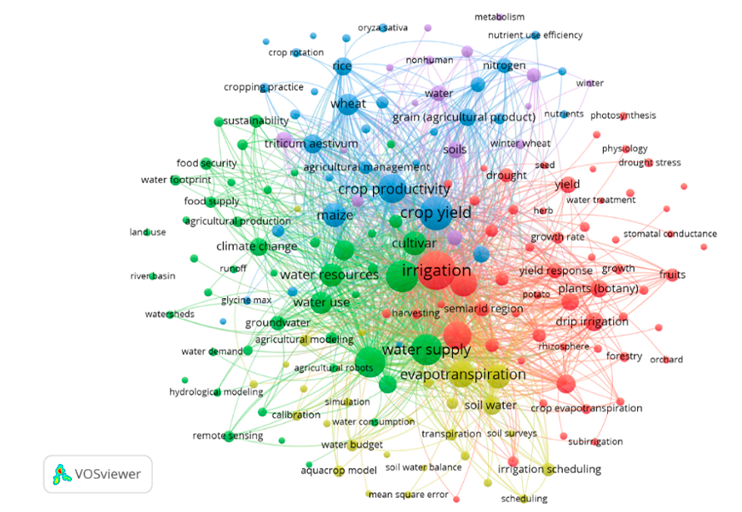
Increasing irrigation water productivity (WP) is essential to address water scarcity and ensure agrifood sustainability, especially in arid and semi-arid regions. To this end, a bibliometric analysis of the scientific literature on WP in agriculture was conducted. This research aimed to characterize global scientific output, global trends, the most influential actors, and the main lines of research in this field. A total of 3 833 documents published in Scopus between 1983 and 2024 were analyzed using bibliometric indicators. The results show exponential growth in scientific output since 2009. China, India and the United States of America account for 55% of global production. The most influential journal was Agricultural Water Management, with 776 publications, whereas China Agricultural University stood out as the institution with 181 publications and 7 058 citations. Thematic mapping identified five main clusters: agronomic strategies, sustainability and climate change, strategic crop management, agricultural modeling and ecophysiological bases. In short, water productivity has consolidated itself as a strategic axis of global agricultural research. This study offers a comprehensive view that can guide future research, drive agronomic innovation and strengthen policies for more efficient water management in agriculture.
Downloads
References
Abera, M.; Dessie, M.; Addis, H. K. and Asmamaw, D. K. 2025. Modeling maize production and water productivity under deficit irrigation and mulching as sustainable agricultural water management strategies in semiarid areas. Sustainability. 17(4): 2-26. https://doi.org/10.3390/su17041347. DOI: https://doi.org/10.3390/su17041347
Al-Qthanin, R. N.; AbdAlghafar, I. M.; Mahmoud, D. S.; Fikry, A. M.; AlEnezi, N. A.; Elesawi, I. E.; AbuQamar, S. F.; Gad, M. M. and El-Tarabily, K. A. 2024. Impact of rice straw mulching on water consumption and productivity of orange trees [Citrus sinensis (L.) Osbeck]. Agricultural Water Management. 298(1):1-15. https://doi.org/10.1016/j.agwat.2024.108862. DOI: https://doi.org/10.1016/j.agwat.2024.108862
Droogers, P. and Kite, G. 1999. Water productivity from integrated basin modeling. irrigation and drainage systems. 13(1):275-290. https://doi.org/10.1023/A:1006345724659. DOI: https://doi.org/10.1023/A:1006345724659
Estévez, E. H.; Valdés, A. A.; González, E. O.; Durand, J. P.; Lloyd, M.; Martínez, J. G. and Parra, L. G. 2021. Higher education, science, technology and academics in méxico: at a crossroads. Universities in the knowledge society: the nexus of national systems of innovation and higher education. Aarrevaara, T.; Finkelstein, M.; Jones, G. A. and Jung, J. 357-373 pp. https://doi.org/10.1007/978-3-030-76579-8-20. DOI: https://doi.org/10.1007/978-3-030-76579-8_20
Fernández, J. E.; Alcon, F.; Diaz, A.; Hernandez, V. and Cuevas, M. V. 2020. Water use indicators and economic analysis for on-farm irrigation decision: a case study of a super high density olive tree orchard. Agricultural Water Management. 237(1):1-13. https://doi.org/10.1016/j.agwat.2020.106074. DOI: https://doi.org/10.1016/j.agwat.2020.106074
Heydari, N. 2014. Water productivity in agriculture: challenges in concepts, terms and values. Irrigation and Drainage. 63(1):22-28. https://doi.org/10.1002/ird.1816. DOI: https://doi.org/10.1002/ird.1816
Hu, A.; Zhou, S. and Xie, Y. 2025. The great leap development and Outlook of China’s scientific and technological strength (2000-2035). In study on the national conditions of modernization with Chinese characteristics. Hu, A.; Zhou, S. and Xie, Y. 243-272 pp. https://doi.org/10.1007/978-981-97-7447-0-8. DOI: https://doi.org/10.1007/978-981-97-7447-0_8
Kalashnikova, I. V.; Pan, Y. and Huang, W. 2024. Innovative vector of economic development of China. Вестник ТОГУ 2(73):127-136. https://doi.org/10.38161/1996-3440-2024-2-127-136. DOI: https://doi.org/10.38161/1996-3440-2024-2-127-136
Kang, S.; Hao, X.; Du, T.; Tong, L.; Su, X.; Lu, H.; Li, X.; Huo, Z.; Li, S. and Ding, R. 2017. Improving agricultural water productivity to ensure food security in China under changing environment: from research to practice. Agricultural Water Management. 179(1):5-17. https://doi.org/10.1016/j.agwat.2016.05.007. DOI: https://doi.org/10.1016/j.agwat.2016.05.007
Lepcha, R.; Patra, S. K.; Poddar, R.; Sarkar, A.; Ray, R.; Alharbi, S. A.; Ansari, M. J. and Hossain, A. 2024. Microsprinkler irrigation in combination with nutrient management influences crop and water productivity and water-nutrient dynamics in large cardamom-growing soils in the hilly sub-Himalayan region of India. Journal of Water and Climate Change. 15(7):3074-3093. https://doi.org/10.2166/wcc.2024.683. DOI: https://doi.org/10.2166/wcc.2024.683
Li, M.; Zhou, S.; Shen, S.; Wang, J.; Yang, Y.; Wu, Y.; Chen, F. and Lei, Y. 2024. Climate-smart irrigation strategy can mitigate agricultural water consumption while ensuring food security under a changing climate. Agricultural Water Management. 292(1):1-11. https://doi.org/10.1016/j.agwat.2023.108663. DOI: https://doi.org/10.1016/j.agwat.2023.108663
Liu, J.; Williams, J. R.; Zehnder, A. J. B. and Yang, H. 2007. GEPIC-modelling wheat yield and crop water productivity with high resolution on a global scale. Agricultural Systems. 94(1):478-493. https://doi.org/10.1016/j.agsy.2006.11.019. DOI: https://doi.org/10.1016/j.agsy.2006.11.019
Ma, Y.; Xue, J.; Feng, X.; Zhao, J.; Tang, J.; Sun, H.; Chang, J. and Yan, L. 2024. Crop water productivity assessment and planting structure optimization in typical arid irrigation district using dynamic Bayesian network. Scientific Reports. 14(1):1-15. https://doi.org/10.1038/s41598-024-68523-3. DOI: https://doi.org/10.1038/s41598-024-68523-3
Martín, A.; Thelwall, M.; Orduna, E. and Delgado, E. 2021. Google Scholar, Microsoft Academic, Scopus, Dimensions, Web of Science and OpenCitations’ COCI: a multidisciplinary comparison of coverage via citations. Scientometrics. 126(1):871-906. https://doi.org/10.1007/s11192-020-03690-4. DOI: https://doi.org/10.1007/s11192-020-03690-4
Molden, D.; Oweis, T.; Steduto, P.; Bindraban, P.; Hanjra, M. A. and Kijne, J. 2010. Improving agricultural water productivity: between optimism and caution. Agricultural Water Management. 97(4):528-535. https://doi.org/10.1016/j.agwat.2009.03.023. DOI: https://doi.org/10.1016/j.agwat.2009.03.023
Narong, D. K. and Hallinger, P. 2023. A keyword co-occurrence analysis of research on service learning: conceptual foci and emerging research trends. Education Sciences. 13(4):2-24. https://doi.org/10.3390/educsci13040339. DOI: https://doi.org/10.3390/educsci13040339
Ochoa, C. A.; Aznar, J. A.; Velasco, J. F. and Álvarez, A. 2020. The use of water in agriculture in mexico and its sustainable management: a bibliometric review. Agronomy. 10(12):2-20. https://doi.org/10.3390/agronomy10121957. DOI: https://doi.org/10.3390/agronomy10121957
Ortega, A.; Murillo, B.; Troyo, E. y Valdez, R. D. 2021. El índice h: sobrevaloración de su uso en la estimación del impacto del quehacer científico en México. Revista Terra Latinoamericana. 39(1):1-8. https://doi.org/10.28940/terra.v39i0.895. DOI: https://doi.org/10.28940/terra.v39i0.895
Patanè, C.; Tringali, S. and Sortino, O. 2011. Effects of deficit irrigation on biomass, yield, water productivity and fruit quality of processing tomato under semi-arid Mediterranean climate conditions. Scientia Horticulturae. 129(4):590-596. https://doi.org/10.1016/j.scienta.2011.04.030. DOI: https://doi.org/10.1016/j.scienta.2011.04.030
Simatele, M. D.; Tantoh, H. B. and Donkor, F. K. 2023. Editorial: climate change, land, energy and food security: perspectives from Sub-Saharan Africa. Frontiers in Sustainable Food Systems. 7(1)1-12. https://doi.org/10.3389/fsufs.2023.1164917. DOI: https://doi.org/10.3389/fsufs.2023.1164917
Tolimir, M.; Gajić, B.; Kresović, B.; Životić, L.; Gajić, K.; Brankov, M. and Todorovic, M. 2024. Impact of deficit irrigation and planting density on grain yield and water productivity of maize grown under temperate continental climatic conditions. Agricultural Water Management. 302(1):1-12. https://doi.org/10.1016/j.agwat.2024.109009. DOI: https://doi.org/10.1016/j.agwat.2024.109009
Tripathi, S.; Kaur, A.; Brar, A. S.; Sekhon, K. S.; Singh, S.; Malik, A. and Kisi, O. 2024. Optimizing yield and water productivity in summer mung bean (Vigna radiata L.) through crop residue management and irrigation strategies. BMC Plant Biology. 24(1):2-17. https://doi.org/10.1186/s12870-024-05640-1. DOI: https://doi.org/10.1186/s12870-024-05640-1
Van Eck, N. J. and Waltman, L. 2010. Software survey: VOSviewer, a computer program for bibliometric mapping. Scientometrics. 84(1):523-538. https://doi.org/10.1007/s11192-009-0146-3. DOI: https://doi.org/10.1007/s11192-009-0146-3
Velázquez, M. A. y Valdez, S. I. 2022. Consumo de agua industrial en el Bajío: un análisis por Zona Metropolitana, 2008-2013. Relaciones Estudios de Historia y Sociedad. 43(171):154-191. https://doi.org/10.24901/rehs.v43i171.891. DOI: https://doi.org/10.24901/rehs.v43i171.891
Wu, L.; Quan, H.; Wu, L.; Zhang, X.; Ding, D.; Feng, H.; Siddique, K. H. M.; Liu, D. L. and Wang, B. 2024. Plastic mulching enhances maize yield and water productivity by improving root characteristics, green leaf area and photosynthesis for different cultivars in dryland regions. Agricultural Water Management. 305(1):2-11. https://doi.org/10.1016/j.agwat.2024.109105. DOI: https://doi.org/10.1016/j.agwat.2024.109105
Xie, Q. and Freeman, R. B. 2019. Bigger than you thought: China’s contribution to scientific publications and its impact on the global economy. China & World Economy. 27(1):1-27. https://doi.org/10.1111/cwe.12265. DOI: https://doi.org/10.1111/cwe.12265
Downloads
Published
Issue
Section
License
Copyright (c) 2026 Revista Mexicana de Ciencias Agrícolas

This work is licensed under a Creative Commons Attribution-NonCommercial 4.0 International License.
The authors who publish in Revista Mexicana de Ciencias Agrícolas accept the following conditions:
In accordance with copyright laws, Revista Mexicana de Ciencias Agrícolas recognizes and respects the authors’ moral right and ownership of property rights which will be transferred to the journal for dissemination in open access. Invariably, all the authors have to sign a letter of transfer of property rights and of originality of the article to Instituto Nacional de Investigaciones Forestales, Agrícolas y Pecuarias (INIFAP) [National Institute of Forestry, Agricultural and Livestock Research]. The author(s) must pay a fee for the reception of articles before proceeding to editorial review.
All the texts published by Revista Mexicana de Ciencias Agrícolas —with no exception— are distributed under a Creative Commons License Attribution-NonCommercial 4.0 International (CC BY-NC 4.0), which allows third parties to use the publication as long as the work’s authorship and its first publication in this journal are mentioned.
The author(s) can enter into independent and additional contractual agreements for the nonexclusive distribution of the version of the article published in Revista Mexicana de Ciencias Agrícolas (for example include it into an institutional repository or publish it in a book) as long as it is clearly and explicitly indicated that the work was published for the first time in Revista Mexicana de Ciencias Agrícolas.
For all the above, the authors shall send the Letter-transfer of Property Rights for the first publication duly filled in and signed by the author(s). This form must be sent as a PDF file to: revista_atm@yahoo.com.mx; cienciasagricola@inifap.gob.mx; remexca2017@gmail.
This work is licensed under a Creative Commons Attribution-Noncommercial 4.0 International license.