Associativity index in coffee-growing organizations in the Cauca Department, Colombia
DOI:
https://doi.org/10.29312/remexca.v17i3.4008Keywords:
Collective action, associativity, coffee farmingAbstract
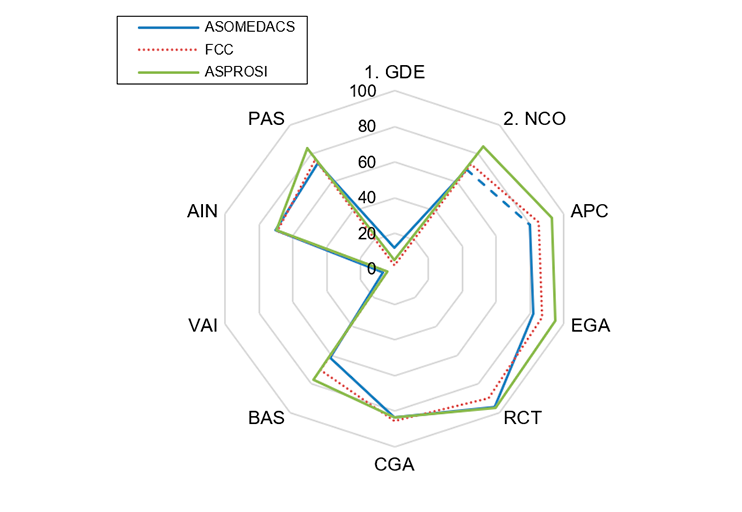
In Colombia’s rural sector, collective action presents itself as a fundamental axis for generating shared benefits and mobilizing territorial resources. In this framework, associativity represents a key strategy for strengthening it, especially in small-scale coffee-growing scenarios. In the Cauca Department, where 99% of coffee growers are small producers organized mostly in associative models, it is a priority to understand how associativity is configured and expressed in their organizational structures. This research aimed to estimate and apply the associativity index to three coffee growers’ organizations (ASOMEDACS, FCC, and ASPROSI) in order to understand the particularities of their collective dynamics. The study was conducted from 2023 to 2024, using a multiple case design with a mixed approach. A structured survey was administered to 38 coffee-grower leaders, based on ten indicators validated by institutional actors in the sector. The analysis integrated a weighted composite index and statistical tools (Anova and Tukey’s HSD test). The results revealed significant differences among the organizations, with ASPROSI standing out with the highest index (76.41), indicating greater internal cohesion, a solid organizational structure and participatory links. These findings suggest that a higher index of associativity may reflect a greater organizational capacity to generate collective action. The proposed methodology offers a replicable and relevant tool for evaluating organizational processes in rural territories and proposes a future line of research on the relationship between associativity and resource activation within the framework of localized agrifood systems.
Downloads
References
ACI. 1995. Alianza Cooperativa Internacional. Identidad cooperativa: nuestros principios y valores. In Declaración sobre identidad cooperativa. Principios cooperativos. 1-6. https://www.ica.coop/es/cooperativas/identidad-alianza-cooperativa-internacional.
Aguilar-Ávila, J.; Muñoz-Rodríguez, M.; Rendón-Medel, R.; Altamirano-Cárdenas, J. R. 2007. Capítulo 4. Técnicas de muestreo. Muestreo no estadístico. Bola de nieve. In: selección de actores a entrevistar para analizar la dinámica de innovación bajo un enfoque de redes. 14-15 pp.
Amézaga, C.; Rodríguez, D.; Núñez, M. y Herrera, D. 2013. Orientaciones estratégicas para el fortalecimiento de la gestión asociativa. IICA.
Araujo, G. I.; Mayett-Moreno, Y.; Figueroa-Rodríguez, K. A. y Arvizu-Barrón, E. 2021. Asociatividad óptima en las zonas rurales del Ecuador utilizando la teoría de juegos. Revista Mexicana de Ciencias Agrícolas. 12(7):1287-1295. https://doi.org/10.29312/remexca.v12i7.2890.
Barnes, J. A. y Harary, F. 1983. Graph theory in network analysis. Social Networks. 5(2):235-244. https://doi.org/10.1016/0378-8733(83)90026-6.
Barrera-Rodríguez, A.; Espejel-García, A.; Herrera-Cabrera, B. E. y Cuevas-Reyes, V. 2016. Asociatividad empresarial de organizaciones productoras de vainilla Vainilla planifolia Jacks. ex Andrews en el Totonacapan. Agroproductividad. 9(1):79-85.
Benavides-Santacruz, B. G.; Rodríguez-Espinosa, H. y Cerón- Muñoz, M. F. 2021. Análisis de sostenibilidad de modelos asociativos agropecuarios en Antioquia, Colombia. Acta Agronómica. 69(4):266-274. https://doi.org/10.15446/acag.v69n4.86568.
Borgatti, S. P.; Everett, M. G. and Freeman, L. C. 2002. UCINET 6 For Windows: Software for Social Network Analysis. Analytic Technologies. 5-43 pp.
Cortina, J. M. 1993. What Is coefficient alpha? an examination of theory and applications. Jornal of applied psychology. 78(1):98-104. https://publisher.uthm.edu.my/periodicals/index.php/rmtb/article/view/512.
Espinoza-Lastra, Ó. R. y Gómez- López, J. D. 2018. índice de capacidades asociativas: construcción teórica y propuesta metodológica de cálculo para organizaciones de economía solidaria. CIRIEC-España. Revista de Economía Publica, Social y Cooperativa. 94:285-316. https://doi.org/10.7203/CIRIEC-E.94.10663.
FNC. 2019. Federación Nacional de Cafeteros de Colombia. Diagnóstico de la asociatividad en el sector cafetero colombiano. In: dirección de investigaciones económicas. Ensayos Sobre Economía Cafetera. 33(1):9-36. https://federaciondecafeteros.org/app/uploads/2020/05/EconomíaCafeteraNo33Webmayo30.pdf.
FNC. 2022. Federación Nacional de Cafeteros de Colombia. Café del cauca. 1-4 pp. https://cauca.federaciondecafeteros.org/cafe-de-cauca/.
FNC. 2024. Federación Nacional de Cafeteros de Colombia. Área cultivada con café total departamental. 7-8 pp. https://federaciondecafeteros.org/wp/estadisticas-cafeteras/.
Fonseca-Carreño, N. E.; González Moreno, M. R. y Narváez Benavides, C. A. 2020. Asociatividad para la Administración de los Sistemas de Producción Campesina. Revista Estrategia Organizacional. 9(1):1-17. https://doi.org/https://doi. org/10.22490/25392786.3644.
Gerring, J. 2007. Case Study Research: Principles and Practices Ed. Cambridge University Press. 20-21 pp.
González-Vásquez, A. E. 2018. Asociatividad y desarrollo económico de los productores de cacao en la provincia de Los Ríos. Killkana Social. 2(4):49-56. https://doi.org/10.26871/killkana-social.v2i4.369.
Guntermann, K. H. 2013. El método de los estudios de caso. In: observar, escuchar y comprender. Sobre la tradición cualitativa en la investigación social. El Colegio de México, FLACSO, México. 231-261 pp.
Luna, M. y Velasco, J. L. 2005. Confianza y desempeño en las redes. Revista Mexicana de Sociología. 67(1):127-162. https://doi.org/https://doi.org/10.22201/iis.01882503p.2005.001.6014.
Mazariegos-Sánchez, A.; Águila-González, J. M.; Martínez-Chávez, J. y Milla-Sánchez, A. I. 2014. Planificación estratégica en una organización productora de café orgánico y de comercio justo. 7(6):59-65. http://search.ebscohost.com/login.aspx?direct=true&db=fap&AN=100143033&site=ehost-live.
Muñoz, R. M.; Altamirano, J. R.; Aguilar, Á. J.; Rendón, M. R. y Espejel, G. A. 2007. Innovación: motor de la competitividad agroalimentaria-políticas y estrategias para que en México ocurra. Universidad Autónoma de Chapingo-CIESTAAM/PIIA. 4(1):213-218.
Nardo, M.; Saisana, M.; Saltelli, A.; Tarantola, S.; Hoffman, A. and Giovannini, E. 2005. Handbook on constructing composite indicators. In: OECD Statistics Working Papers (03):21-23. http://www.oecd-ilibrary.org/docserver/download/5lgmz9dkcdg4.pdf?expires=1471336777&id=id&accname=guest&checksum=158391DADFA324416BB9015F3E4109AF.
Pérez, R. O.; Martínez, H.; López, B. J. y Rendón, R. 2016. Estimación de la adopción de innovaciones en la agricultura. Revista Mexicana de Ciencias Agrícolas. 15(esp):2909-2923.
Rodríguez-Herrera, D. M. 2020. Asociacionismo y cambio social en comunidades rurales andinas. Aproximación al caso de los cafeteros colombianos. Revista del CESLA: International Latin American Studies Review. 25(25):57-79. https://doi.org/10.36551/2081-1160.2020.25.57-79.
Saaty, T. L. and Vargas, L. G. 2012. Models, methods, concepts and applications of the analytic hierarchy process. International Series in Operations Research & Management Science. Springer, New York. 171-183 pp.
Santana-Ochoa, K. Y. y León-Serrano, L. A. 2021. Nivel de asociatividad del sector emprendedor de la economía popular y solidaria, cantón Machala. Cooperativismo y Desarrollo. 29(120):1-19. https://doi.org/10.16925/2382-4220.2021.02.03.
Shapiro, S. S. and Wilk, M. B. 1965. An analysis of variance test for normality complete samples. Biometrika. 52(3-4):591-611. https://doi.org/10.2307/2333709.
Yin, R. K. 2009. Estudo de caso. Planejamento e métodos. Bookman. Porto Alegre. Brasil. 87-89 pp.
Downloads
Published
Issue
Section
License
Copyright (c) 2026 Revista Mexicana de Ciencias Agrícolas

This work is licensed under a Creative Commons Attribution-NonCommercial 4.0 International License.
The authors who publish in Revista Mexicana de Ciencias Agrícolas accept the following conditions:
In accordance with copyright laws, Revista Mexicana de Ciencias Agrícolas recognizes and respects the authors’ moral right and ownership of property rights which will be transferred to the journal for dissemination in open access. Invariably, all the authors have to sign a letter of transfer of property rights and of originality of the article to Instituto Nacional de Investigaciones Forestales, Agrícolas y Pecuarias (INIFAP) [National Institute of Forestry, Agricultural and Livestock Research]. The author(s) must pay a fee for the reception of articles before proceeding to editorial review.
All the texts published by Revista Mexicana de Ciencias Agrícolas —with no exception— are distributed under a Creative Commons License Attribution-NonCommercial 4.0 International (CC BY-NC 4.0), which allows third parties to use the publication as long as the work’s authorship and its first publication in this journal are mentioned.
The author(s) can enter into independent and additional contractual agreements for the nonexclusive distribution of the version of the article published in Revista Mexicana de Ciencias Agrícolas (for example include it into an institutional repository or publish it in a book) as long as it is clearly and explicitly indicated that the work was published for the first time in Revista Mexicana de Ciencias Agrícolas.
For all the above, the authors shall send the Letter-transfer of Property Rights for the first publication duly filled in and signed by the author(s). This form must be sent as a PDF file to: revista_atm@yahoo.com.mx; cienciasagricola@inifap.gob.mx; remexca2017@gmail.
This work is licensed under a Creative Commons Attribution-Noncommercial 4.0 International license.