Land suitability for establishing espadín agave plantations in the state of Oaxaca
DOI:
https://doi.org/10.29312/remexca.v17i5.4002Keywords:
Agave angustifolia Haw., MaxEnt, potential distribution, Random ForestAbstract
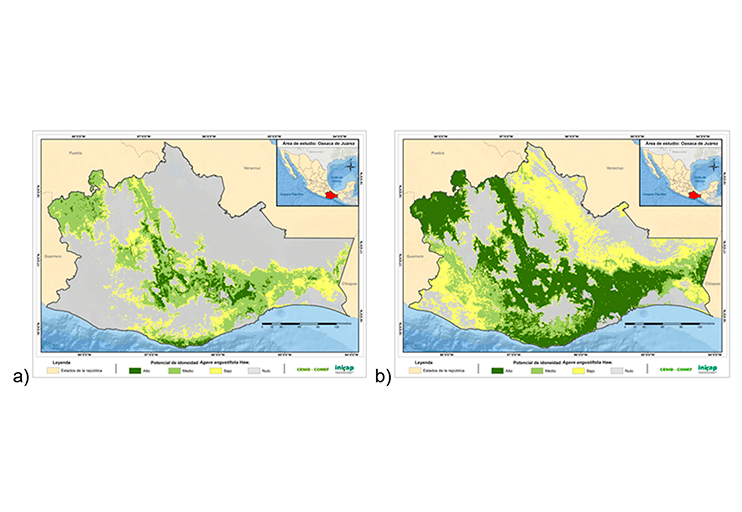
The growth in mezcal consumption has created an oversupply of agave, reducing prices for producers. This study evaluated land suitability for planting Agave angustifolia Haw. in Oaxaca using two distribution models: MaxEnt and Random Forest. Climatic, edaphological and topographic variables were used, along with records of the species’ presence. Both models showed AUC values >0.85, with 16 relevant variables. The area with high potential was 4 475.89 km² (MaxEnt) and 28 700.97 km² (Random Forest); the ideal areas for plantations were 6 671.12 km² and 9 618.67 km², respectively. Despite the differences, the models provide useful information for the sustainable planning of espadín agave.
Downloads
References
Chunrong, M.; Huettmann, F.; Guo, Y.; Han, X. and Wen, L. 2017. Why choose random forest to predict rare species distribution with few samples in large undersampled areas? Three Asian crane species models provide supporting evidence. PeerJ. 5:e2849. https://doi.org/10.7717/peerj.2849.
CONANP. 2023. Comisión Nacional de Áreas Naturales Protegidas. Información espacial de las áreas naturales protegidas. http://sig.conanp.gob.mx/website/pagsig/info-shape.htm.
Dormann, C. F.; Elith, J.; Bacher, S.; Buchmann, C.; Carl, G.; Carré, G.; García-Márquez, J. R.; Gruber, B.; Lafourcade, B.; Leitão, P. J.; Münkemüller, T.; McClean, C.; Osborne, P. E.; Reineking, B.; Schröder, B.; Skidmore, A. K.; Zurell, D. and Lautenbach, S. 2013. Collinearity: a review of methods to deal with it and a simulation study evaluating their performance. Ecography. 36(1):27-46. https://doi.org/10.1111/j.1600-0587.2012.07348.x.
Falk, H.; Yumin, G.; Xuesong, H. and Lijia, W. 2017. Why choose random forests to predict rare species distribution with few samples in large undersampled areas? Three Asian crane species models provide supporting evidence. PeerJ. 5:e2849. https://doi.org/10.7717/peerj.2849.
García-Mendoza, A. J. 2007. Los agaves de México. Revista Ciencias. Universidad Nacional Autónoma de México (UNAM). 87:14-23. https://www.revistas.unam.mx/index.php/cns/article/view/12113.
García-Mendoza, A. J. 2018. Los agaves de Oaxaca. Boletín UNAM-DGCS-045. https://www.dgcs.unam.mx/boletin/bdboletin/2018-045.html.
GBIF. 2023. Global Biodiversity Information Facility. https://www.gbif.org/.
Gutiérrez-Hernández, O.; Artigas, R. C.; González, J. M. S. y García, L. V. 2018. Modelos predictivos en biogeografía: aplicación para la modelización de nichos ecológicos en geografía física. Boletín de La Asociación de Geógrafos Españoles. 78:88-126. https://doi.org/10.21138/bage.2395.
Haile, A.; Desta, A. B. and Dejene, S. W. 2024. Modeling the distribution of Aloe ankoberensis and A. debrana under different climate change scenarios in North Shewa Zone, Amhara National Regional State, Ethiopia. Ecological Processes. 13(1):39. https://doi.org/10.1186/s13717-024-00511-x.
Hijmans, R. J. and Graham, C. H. 2006. The ability of climate envelope models to predict the effect of climate change on species distributions. Global Change Biology. 12(12):2272-2281. https://doi.org/10.1111/j.1365-2486.2006.01256.x.
INEGI. 2018. Instituto Nacional de Estadística y Geografía. Conjunto de datos vectoriales de uso del suelo y vegetación. Escala 1:250 000. Serie VII. Conjunto nacional. https://www.inegi.org.mx/app/biblioteca/ficha.html?upc=889463842781.
Romo, B. H.; Sanabria, P. and García-Barros, S. E. 2013. Predicción de los impactos del cambio climático en la distribución sobre las especies de Lepidoptera: el caso del género Boloria Moore, 1900 en la Península Ibérica (Lepidoptera: Nymphalidae). SHILAP Revista de Lepidopterología. 41(162):267-286.
Sánchez, N. S. and Garduño, R. L. 2008. Algunas consideraciones acerca de los sistemas de clasificación climática. Contactos. 68:5-10. https://www.divulgameteo.es/fotos/meteoroteca/Sistemas-clasificaci%C3%B3n-clim%C3%A1tica.pdf.
Serra, E.; Debolini, M.; Fraga, H.; Trabucco, A.; Mereu, V. and Spano, D. 2025. Machine learning and species distribution models for crops: A review. Ecological Informatics. 93:103563. https://doi.org/10.1016/j.ecoinf.2025.103563.
Torres, I.; Casas, A.; Delgado-Lemus, A. and Rangel-Landa, S. 2013. Aprovechamiento, demografía y establecimiento de Agave potatorum en el Valle de Tehuacán, México: aportes ecológicos y etnobiológicos para su manejo sustentable. Zonas Áridas. 15(1):92-109. https://doi.org/10.21704/ZA.V15I1.110.
Valavi, R.; Guillera-Arroita, G.; Lahoz-Monfort, J. J. and Elith, J. 2021. Predictive performance of presence-only species distribution models: a benchmark study with reproducible code. Ecological Modelling. 92(1):e1486. https://doi.org/10.1002/ecm.1486.
Downloads
Published
Issue
Section
License
Copyright (c) 2026 Revista Mexicana de Ciencias Agrícolas

This work is licensed under a Creative Commons Attribution-NonCommercial 4.0 International License.
The authors who publish in Revista Mexicana de Ciencias Agrícolas accept the following conditions:
In accordance with copyright laws, Revista Mexicana de Ciencias Agrícolas recognizes and respects the authors’ moral right and ownership of property rights which will be transferred to the journal for dissemination in open access. Invariably, all the authors have to sign a letter of transfer of property rights and of originality of the article to Instituto Nacional de Investigaciones Forestales, Agrícolas y Pecuarias (INIFAP) [National Institute of Forestry, Agricultural and Livestock Research]. The author(s) must pay a fee for the reception of articles before proceeding to editorial review.
All the texts published by Revista Mexicana de Ciencias Agrícolas —with no exception— are distributed under a Creative Commons License Attribution-NonCommercial 4.0 International (CC BY-NC 4.0), which allows third parties to use the publication as long as the work’s authorship and its first publication in this journal are mentioned.
The author(s) can enter into independent and additional contractual agreements for the nonexclusive distribution of the version of the article published in Revista Mexicana de Ciencias Agrícolas (for example include it into an institutional repository or publish it in a book) as long as it is clearly and explicitly indicated that the work was published for the first time in Revista Mexicana de Ciencias Agrícolas.
For all the above, the authors shall send the Letter-transfer of Property Rights for the first publication duly filled in and signed by the author(s). This form must be sent as a PDF file to: revista_atm@yahoo.com.mx; cienciasagricola@inifap.gob.mx; remexca2017@gmail.
This work is licensed under a Creative Commons Attribution-Noncommercial 4.0 International license.